

What if the greatest unexplored frontier isn't deep space, but the fragile corridors of human consciousness? If you're exhausted by cookie-cutter magic systems and predictable plot beats, you aren't alone. Readers with an appetite for true complexity crave stories that interrogate reality rather than retreating into juvenile melodrama. True speculative fiction for adults doesn't settle for simple escapism. It confronts existential consequences... the sharp, destabilizing impact of shifts in memory, identity, and time itself.
You've likely felt the frustration of digging through endless commercial backlists, only to find pulp formulas where genuine intellectual bite ought to be. That ends now. You're about to discover how adult speculative fiction challenges reality through philosophical depth, mind-bending concepts, and fearless genre experimentation. Ahead, we'll map the defining boundaries of the movement, break down subgenres built on social critique and temporal paradoxes, and assemble a curated digital reading list tailored for mature, restless minds.
Key Takeaways
- Explore how true speculative fiction for adults moves past simple escapism to interrogate psychological dilemmas, ethical quandaries, and altered realities.
- Discover the modern subgenres redefining the category, from reality-bending temporal experiments to intimate critiques of human consciousness.
- Learn the critical distinctions separating conceptual speculative storytelling from traditional hard sci-fi and epic fantasy world-building.
- Master a five-step evaluation framework designed to filter out predictable commercial tropes and identify high-concept narratives with genuine depth.
- Uncover why the most audacious, uncompromising speculative ideas are thriving in the independent digital ebook space.
What Is Speculative Fiction for Adults? Beyond the "What If"
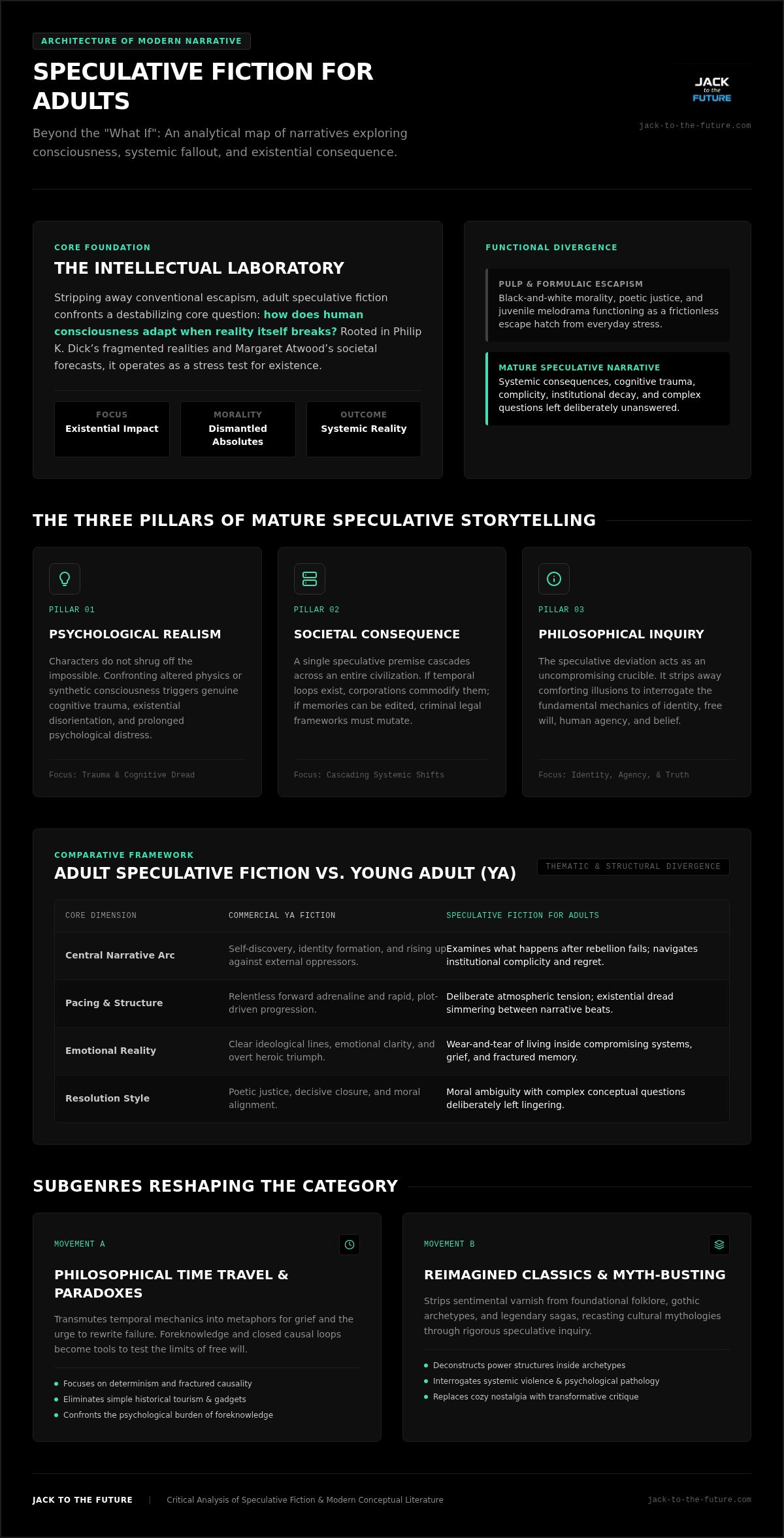
Strip away the laser pistols and dragon riders. What remains? At its core, speculative fiction functions as an intellectual laboratory. It poses a single, destabilizing question: how does human consciousness adapt when reality itself breaks? Rather than offering a frictionless escape hatch from everyday stress, speculative fiction for adults forces an encounter with systemic consequence, philosophical terror, and psychological decay.
This tradition didn't emerge in a vacuum. It traces directly from Philip K. Dick's fragmented realities and Margaret Atwood's chilling societal forecasts to today's radical innovators. Where pulp adventures lean on black-and-white morality, mature speculative narratives dismantle easy answers. Protagonists face institutional complicity, grief, and fractured memory. The universe rarely hands out poetic justice.
The Three Pillars of Mature Speculative Storytelling
To qualify as genuinely cerebral narrative, a work must ground its fantastical elements in rigorous conceptual soil. Three primary architecture points define the medium:
- Psychological Realism: Characters don't simply shrug off the impossible. Encountering altered physics or synthetic consciousness triggers genuine cognitive trauma, disorientation, and existential dread.
- Societal and Systemic Consequence: A single speculative premise cascades through an entire civilization. If time loops exist, how do corporate power structures commodify them? If memory can be altered, what happens to criminal law?
- Philosophical Inquiry: The speculative deviation acts as a crucible. It strips away comforting illusions to reveal the raw mechanics of human identity, agency, and belief.
Speculative Fiction for Adults vs. Young Adult (YA) Themes
Commercial algorithms often blur these categories together, but their thematic cores run in completely opposite directions. Young adult fiction naturally focuses on self-discovery, identity formation, and fighting back against oppressive outside forces. That works brilliantly for adolescent development. Yet adult speculative fiction explores what comes after the rebellion fails. It tackles complicity, regret, and the slow wear-and-tear of living inside compromising systems.
Pacing reflects this divide. While commercial YA relies on relentless forward adrenaline, mature speculative literature embraces deliberate atmospheric tension. It lets existential dread simmer between the lines. True maturity in speculative fiction for adults isn't measured by gratuitous violence or explicit sexuality; it's earned through conceptual ambition, moral ambiguity, and the willingness to let complex questions linger unanswered.
The Subgenres Reshaping Modern Adult Speculative Literature
Mainstream discourse often confines imaginative fiction to two extremes: escapist fantasy or bleak environmental catastrophe. Adult readers seeking intellectual friction need more. Today, boundary-pushing creators are constructing specialized subgenres that weld hard conceptual conjecture to deep metaphysical inquiry. These spaces treat complex hypotheses as magnifying glasses turned inward on human vulnerability.
When writers dismantle conventional boundaries, storytelling shifts from passive consumption to an active thought experiment. The vanguard of speculative fiction for adults thrives across three core narrative movements.
Philosophical Time Travel and Temporal Paradoxes
Forget simple gadgets and whimsical historical tourism. Modern temporal storytelling examines the crushing psychological weight of foreknowledge, determinism, and fractured causality. Closed causal loops and branching realities become visceral metaphors for grief, trauma, and the human impulse to rewrite personal failure. Readers drawn to complex physics blended with existential yearning frequently seek out sci-fi books about changing the past to witness how temporal mechanics test our illusions of free will.
Reimagined Classics and Speculative Myth-Busting
Nostalgia is comfortable; deconstruction is transformative. This movement strips sentimental varnish from foundational folklore, gothic archetypes, and legendary sagas, recasting them through sophisticated speculative lenses. Rather than offering cozy tributes, bold authors interrogate the underlying power structures, psychological pathologies, and systemic violence baked into cultural mythologies. Transporting ancient dilemmas into radical futures exposes the immutable flaws of our nature.
Dystopian Realism and Sociological Speculation
Move past Hollywood's flaming wastelands and leather-clad warlords. Contemporary sociological speculation cuts far closer to home. It examines subtle, creeping fractures:
- Algorithmic Hegemony: How predictive behavioral models erode individual agency long before physical chains appear.
- Cognitive Surveillance: The psychic exhaustion of living under relentless corporate and biometric evaluation.
- Institutional Attrition: The gradual decay of civic empathy amidst ecological and economic transition.
By mapping plausible socio-technical trajectories, these narratives construct warning systems rather than mere spectacles. For readers ready to dive into fearless temporal experiments and cerebral narrative design, exploring innovative digital catalogs like Jack to the Future reveals how modern authors turn speculative concepts into profound intellectual journeys.
Speculative Fiction vs. Sci-Fi and Fantasy: A Critical Comparison
Bookstore categorization often treats science fiction, fantasy, and speculative literature as interchangeable shelf space. That's a mistake. While commercial categories rely on familiar aesthetic props, like starships or enchanted swords, true speculative fiction for adults operates with a distinct structural logic. It functions as an umbrella architecture prioritizing conceptual experimentation over exhaustive world-building minutiae.
Every genre runs on a different engine. Hard science fiction prioritizes technical plausibility; high fantasy runs on magical metaphysics; speculative fiction is powered by existential inquiry. The following breakdown clarifies how these engines align with distinct reader desires:
- Hard Sci-Fi: Asks how the machine functions. Focuses on technological fidelity, astrophysical laws, and procedural problem-solving.
- Epic Fantasy: Asks who rules the realm. Emphasizes secondary-world mythologies, inherited power, and pre-industrial moral destinies.
- Adult Speculative Fiction: Asks why consciousness endures the rupture. Uses impossible scenarios as scalpel blades to dissect human behavior and societal constructs.
The Rulebook of World-Building: Metaphor vs. Technicality
Hard sci-fi demands rigorous schematics. If a narrative features warp drives, readers expect propulsion equations and relativistic physics. Epic fantasy constructs thousand-year genealogies and intricate linguistic systems. Speculative fiction for adults abandons those tedious infodumps. It prioritizes psychological resonance. Rather than spending fifty pages explaining the mechanics of an alternate timeline, speculative writers thrust the reader directly into the emotional turbulence of living inside it.
The Cognitive Effect: Estrangement and Intellectual Wonder
Literary scholar Darko Suvin defined the core of serious speculative thought as "cognitive estrangement." This psychological mechanism introduces an altered reality to make the familiar world feel suddenly strange, exposed, and clear. By tilting consensus reality just a few degrees off-axis, speculative authors short-circuit everyday cognitive biases. You don't just observe an alien civilization; you suddenly recognize the arbitrary cruelty of your own economic and social arrangements with complete objectivity.
How to Choose Your Next Speculative Read: An Evaluation Framework
Commercial bestseller algorithms favor mass-market comfort over conceptual daring. Chasing five-star vanity metrics often lands you right back in formulaic plot structures. To uncover boundary-pushing fiction that genuinely respects your intellect, you need a deliberate vetting strategy. Look past superficial elevator pitches. Demand philosophical weight.
Selecting authentic speculative fiction for adults requires evaluating how an author treats reality itself. Use this three-step framework to audit your next narrative investment before turning page one.
Step 1: Identify Your Preferred Intellectual Dilemma
Every cerebral narrative hinges on an underlying philosophical engine. Pinpoint what kind of friction you want your imagination to resolve:
- Temporal Causality: Do you want closed loops, paradoxes, and the psychological torment of altering the past?
- Synthetic Consciousness: Are you seeking questions of selfhood, algorithmic soul, and cognitive automation?
- Sociopolitical Critique: Do you prefer radical structural extrapolation that dissects real-world power dynamics?
Ensure the primary conflict stems from an existential crisis rather than a simple logistical hurdle. If the plot can be solved by characters finding a bigger weapon or running faster, the speculative core is purely decorative.
Step 2: Inspect Narrative Structure and Pacing Preferences
Sample the opening chapter to assess prose rhythm and structural ambition. Nonlinear time jumps and shifting perspectives signal a willingness to challenge reader cognition. Check the tonal maturity. Authentic adult speculative storytelling resists frantic adrenaline rushes, favoring slow-burn psychological dread and lingering moral tension. Most importantly, beware neat resolutions. The best works leave conceptual threads vibrating long after the final sentence.
Step 3: Look Beyond Legacy Bestseller Lists
Corporate publishing houses frequently water down radical ideas to fit focus-grouped genre templates. The most audacious speculative experiments happen at the margins. Seek out independent creators and specialized digital presses that publish directly to curious minds. Reviewing dedicated author essays and reading a high concept sci-fi ebooks buyer guide will help you spot works untamed by commercial editorial committees.
Ready to cut through the noise of cookie-cutter releases? Explore the Jack to the Future catalog and download bold, independent speculative fiction straight to your e-reader right now.
The Rise of Indie Speculative Sci-Fi Ebooks: Direct to Your Reader
Where does the true vanguard of speculative thought live? It isn't inside legacy publishing boardrooms. The most audacious conceptual experiments have migrated to independent digital releases. Unshackled from committee-driven editorial filters, indie speculative sci-fi ebooks represent an uncompromising frontier. Writers can pursue provocative questions directly to their furthest philosophical conclusions... no focus groups, no safety nets.
This digital migration puts power directly back into readers' hands. When you step away from conventional imprints, you encounter raw, inventive visions that refuse to sand down their sharpest edges.
Creative Freedom: Why Indie Authors Write Bolder Speculative Worlds
Corporate acquisitions teams lean toward predictable tropes that fit existing market boxes. That caution starves intellectual curiosity. Independent publishing completely upends that dynamic. Free from corporate oversight, indie creators boldly fuse disparate disciplines, splicing quantum mechanics, existential dread, and biting satire into singular narratives.
Consider how Charlie’s Trips by Jack Felson tackles this frontier. Rather than settling for routine time-travel tropes, Felson delivers a masterclass in temporal retelling, deconstructing a legendary journey through a sophisticated, adult lens. It's the kind of audacious, high-concept storytelling that flourishes when an author answers only to intellectual ambition.
Curating Your Digital Speculative Fiction Library
Building a personal library of cerebral literature used to require scouring obscure specialty shops. Digital delivery changed the game entirely. Instant ebook downloads eliminate distribution bottlenecks, letting you dive into sprawling timelines and reality-bending paradoxes in seconds.
Independent ecosystems give mature readers immediate access to uncompromised visions. Expanding your digital collection with visionary hubs like Jack to the Future connects you directly with high-concept sci-fi ebooks designed to push the boundaries of speculative fiction for adults. Your next mind-bending journey is just a download away.
Step Beyond the Edge of Consensus Reality
The journey into true speculative fiction for adults demands far more than predictable tropes or decorative world-building. It requires narratives that probe the fragile architecture of consciousness, confront deterministic systems, and treat altered timelines as crucibles for the human soul. Moving past commercial formulas allows you to encounter fearless literature unafraid of existential ambiguity and moral consequence.
That uncharted frontier is already waiting. Author Jack Felson crafts pioneering time-travel retellings and independent speculative narratives that deliberately shatter conventional genre boundaries... daring mature readers to interrogate memory, identity, and regret. With instant digital downloads ready for immediate reading on any device, your next intellectual adventure doesn't have to wait. Explore bold speculative sci-fi ebooks at Jack to the Future and discover how high-concept storytelling can transform your perception of reality.
Frequently Asked Questions
What makes speculative fiction specifically "for adults" rather than young adults?
Adult speculative narratives focus on existential erosion, systemic complicity, and unresolved grief rather than coming-of-age self-discovery. The distinction lies in thematic maturity and philosophical ambiguity, not merely explicit content. Characters face institutional dilemmas where perfect moral victories don't exist, forcing readers to sit with complex psychological consequences.
How does speculative fiction differ from traditional hard science fiction?
Speculative fiction prioritizes philosophical inquiry and psychological resonance over technical schematics. While hard science fiction obsesses over propulsion equations and astrophysical plausibility, speculative stories treat impossible premises as conceptual mirrors. The goal isn't detailing how a speculative technology functions, but exploring why human consciousness fractures under its influence.
Can a time travel novel be considered literary speculative fiction?
Yes, time travel novels achieve literary status when temporal displacement serves as an intellectual vehicle to explore determinism, regret, and memory. Works like Jack Felson's Charlie's Trips demonstrate this by turning temporal shifts into profound character studies. In true speculative fiction for adults, causality loops expose internal vulnerability rather than functioning as mere action mechanics.
What are the best entry-point themes for beginners to adult speculative fiction?
Begin with intimate sociological speculation or closed-loop time narratives. Stories grounded in recognizable, near-future realities allow you to grasp conceptual departures without feeling overwhelmed by secondary-world lore. Exploring premises centered on synthetic consciousness or altered personal memories provides an immediate bridge between familiar emotional truth and radical philosophical conjecture.
Why are many of the most innovative speculative fiction stories published as ebooks?
Digital publishing liberates authors from traditional corporate gatekeeping and commercial trend chasing. Independent authors can bypass mass-market editorial committees to release daring, genre-defying premises directly to readers worldwide. Downloadable speculative sci-fi ebooks provide immediate global delivery, giving intellectually adventurous audiences instant access to uncompromised storytelling on their preferred devices.
Does speculative fiction always take place in the far future or alternate realities?
No, many of the most gripping narratives unfold in an altered present day. A story needs only one speculative element, such as a localized memory anomaly or a subtle break in causality, to interrogate consensus reality. Tilting our immediate world slightly off-axis often produces sharper cognitive estrangement than setting a tale thousands of years ahead.
What role does psychological realism play in modern adult speculative novels?
Psychological realism ensures that characters react to impossible phenomena with genuine disorientation, authentic cognitive friction, and emotional trauma. Rather than treating impossible events as routine plot points, speculative fiction for adults tracks how shifts in time or identity deeply strain human mental stability, grounding high-concept premises in raw human vulnerability.
0 comments