

What if your memories aren't actually yours... but a sequence of code uploaded to bridge a gap in a dying timeline? It's a haunting thought. You've likely felt the frustration of scrolling through endless lists of generic space opera tropes while searching for thought-provoking sci-fi narratives. The same tired battles. The same predictable twists. You deserve more than a distraction. You want an evolution.
Finding stories that actually challenge your perception of reality is becoming harder in a market flooded with the familiar. We agree that the best fiction should feel like a cognitive simulation. It should prepare your mind for a future that's getting weirder by the second. Intellectual depth shouldn't be a luxury, it should be the standard.
This article promises to reconnect you with the thrill of the unknown. We'll explore how high-concept fiction serves as a vital tool for the visionary reader. You'll get a curated look at seven mind-bending works, including indie breakthroughs like Jack Felson's Charlie’s Trips. It's time to move beyond the binary and find your next obsession.
Key Takeaways
- Understand how thought-provoking sci-fi narratives use "Cognitive Estrangement" to simulate the future and challenge your sense of identity.
- Discover why temporal retellings of classic stories offer a more sophisticated intellectual anchor than standard genre tropes.
- Use our specific keyword checklist to identify high-concept indie ebooks that prioritize philosophical inquiry over mere spectacle.
- Join the digital rebellion and gain instant access to the cerebral world of Jack Felson, where memory and reality collide.
Defining the Thought-Provoking Sci-Fi Narrative
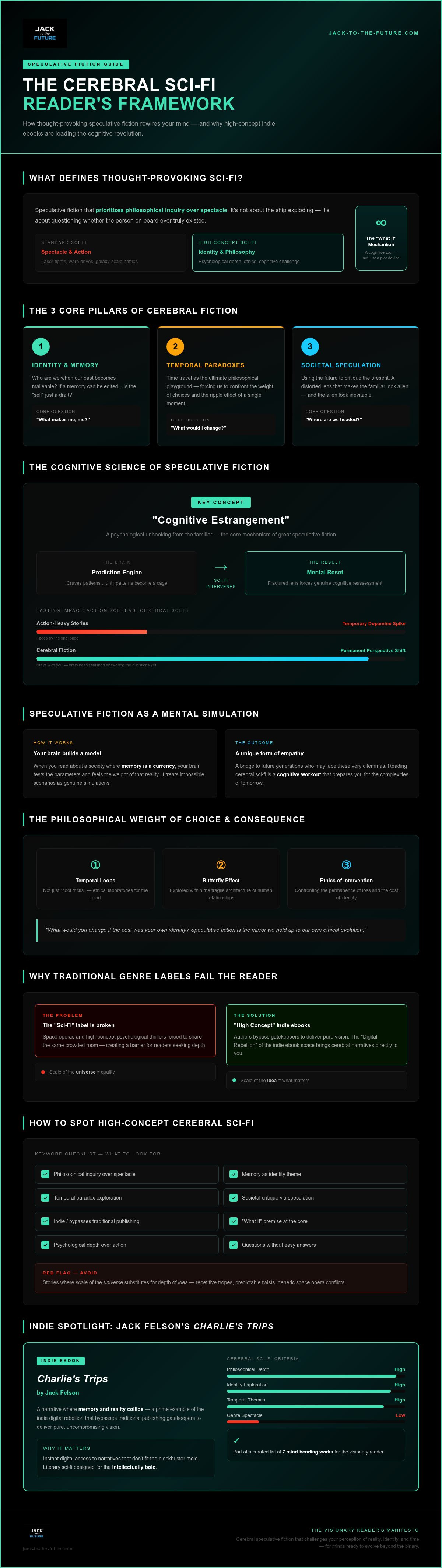
The year 2026 feels like a threshold. We've reached a point where the noise of commercial spectacle has finally exhausted the visionary reader. You're no longer looking for a laser fight in a distant galaxy; you're looking for a mirror. We define thought-provoking sci-fi narratives as speculative fiction that prioritizes philosophical inquiry over spectacle. It's the difference between watching a ship explode and wondering if the person on board ever actually existed.
At the heart of this genre lies the "What If" mechanism. It's a cognitive tool. It isn't just a plot device; it's a surgical instrument used to dissect human identity. While "Hard Sci-Fi" often traps itself in the mechanics of a warp drive, speculative fiction moves into the psychological. It asks how that drive changes the soul. It's about the feeling of the journey, not just the physics of the engine.
The Core Pillars of Cerebral Fiction
- Identity and Memory: These stories ask who we are when our past becomes malleable. If a memory can be edited... is the "self" just a draft?
- Temporal Paradoxes: Time travel isn't just a gimmick here. It's the ultimate philosophical playground. It forces us to confront the weight of our choices, and the ripple effect of a single moment.
- Societal Speculation: This is about using the future to critique the present. It's a distorted lens that makes the familiar look alien, and the alien look inevitable.
Why Traditional Genre Labels Fail the Reader
The "Sci-Fi" umbrella term is broken. In 2026, it's a crowded room where space operas and high-concept psychological thrillers are forced to share space. This creates a barrier for readers seeking depth. "High Concept" fiction isn't about the scale of the universe. It's about the scale of the idea. It's about the "Digital Rebellion" found in the indie ebook space, where authors like Jack Felson bypass the gatekeepers to deliver pure vision.
Titles like Charlie’s Trips represent this shift. They offer instant digital access to narratives that don't fit the blockbuster mold. This isn't just entertainment; it's a cognitive simulation. It's literary sci-fi designed for the intellectually bold. When you step beyond the binary of traditional publishing, you find the thought-provoking sci-fi narratives that actually change how you think.
The Cognitive Science of Speculative Fiction: Why Our Brains Crave the Unknown
The brain is a prediction engine. It craves patterns... until those patterns become a cage. This is where thought-provoking sci-fi narratives intervene. They offer "Cognitive Estrangement." It's a psychological unhooking. By stripping away the familiar, these stories force you to look at reality through a fractured lens. You aren't just consuming a plot. You're performing a mental reset. We crave the unknown because the known is a dead end. We need the shock of the new to keep our cognitive gears from grinding to a halt. It's why speculative sci-fi ebooks have become the preferred medium for the modern visionary. They provide a faster, more direct connection to concepts that challenge the status quo and offer a pure hit of thought-provoking sci-fi narratives.
Speculative Fiction as a Mental Simulation
Why do "impossible" scenarios feel so real? Because your mind treats them as simulations. When you read about a society where memory is a currency, your brain builds a model. It tests the parameters. It feels the weight of that reality. This creates a unique form of empathy. It's a bridge to future generations who might face these very dilemmas. Action-heavy stories provide a temporary spike in dopamine... a quick thrill that fades by the final page. Cerebral fiction provides a permanent shift in perspective. It stays with you because it asks questions your brain hasn't finished answering yet. It's a cognitive workout that prepares you for the complexities of tomorrow. When you dive into a narrative that defies your expectations, you're not just escaping. You're exploring. You're finding the edges of your own mind.
The Philosophical Weight of Choice and Consequence
Choice is the engine of the human experience. In speculative fiction, that engine is often pushed to the breaking point. Temporal loops and alternative timelines aren't just cool tricks. They're ethical laboratories. They allow us to explore the "Butterfly Effect" within the fragile architecture of human relationships. What would you change if the cost was your own identity? These narratives force us to confront the ethics of intervention and the permanence of loss. Speculative fiction is the mirror we hold up to our own ethical evolution as we move toward an uncertain horizon. It's a way to practice being human in a world that's becoming increasingly post-human. By exploring these "what-if" scenarios, we gain a deeper understanding of the "what-is" in our current reality.
Reimagining the Classics: How Retellings Challenge Our Perception of Time
Why do we return to the same stories? Perhaps because we need a stable foundation before we can truly appreciate the chaos of the unknown. Classic stories provide the perfect "anchor" for complex sci-fi explorations. They offer a shared vocabulary... a baseline of reality that allows an author to push the boundaries of the possible. For the visionary reader, the intellectual thrill comes from seeing a familiar world through a temporal lens. It's a "Temporal Retelling," a genre-bending masterclass that transforms nostalgia into a cognitive challenge. These thought-provoking sci-fi narratives don't just repeat the past. They reinvent it.
By leveraging a story we already know, authors can bypass the heavy lifting of world-building and dive straight into the psychological deep end. You know the characters. You know the destination. But you don't know the nature of the journey. This is where Charlie’s Trips: A Masterclass in Time Travel Retelling by Jack Felson excels. It takes the bones of a legend and gives it a new, speculative soul. It's a journey that feels both familiar and dangerously alien.
The Wizard of Oz as a Time Travel Narrative
Imagine the yellow brick road not as a path through a forest, but as a timeline through a fractured reality. In Charlie’s Trips, Jack Felson transforms a childhood journey into an adult speculative odyssey. The role of "The Man Behind the Curtain" shifts from a simple fraud to a high-concept sci-fi architect. Why does this matter? Because reimagining the past is a sophisticated way of changing the past in sci-fi books. It forces us to ask if our origins are as fixed as we believe, or if they are merely one version of a story that can be edited.
Modern Speculative Fiction Authors and the Art of the Remix
In 2026, readers are increasingly seeking "old stories with new souls." There's a specific balance required here. Too much homage, and it feels like a cover song. Too much subversion, and you lose the anchor. Visionary science fiction finds the middle ground through a few key techniques:
- Subversion of Tropes: Taking a "chosen one" and revealing them as a temporal anomaly.
- Psychological Depth: Exploring the trauma of a character who has lived their life in a loop.
- Digital Freedom: Using the ebook format to experiment with narrative structure without corporate oversight.
These thought-provoking sci-fi narratives represent a rebellion against the predictable. Indie authors are leading the charge, using digital platforms to deliver pure vision directly to your screen. It's about taking the stories that shaped us and using them to explore the concepts that will define us. You aren't just reading a book. You're participating in a literary evolution.
Building Your Digital Shelf: How to Find High-Concept Indie Ebooks
The algorithm wants to feed you the same story... over and over. But you're looking for a glitch in the system. To find truly thought-provoking sci-fi narratives, you have to look past the bestseller lists and into the digital fringes. This is where the "Instant Exploration" begins. Digital downloads aren't just convenient; they are the frontline of a literary rebellion. No waiting for physical shipping. No warehouse delays. Just a direct, high-speed connection between the author's brain and yours. By the time you finish this paragraph, you could already be three chapters into a new reality.
When scanning for your next read, look for these psychological anchors in the description:
- Identity: Does the story challenge the concept of the "self"?
- Perception: Is the reality of the characters reliable or fractured?
- Temporal: Does the narrative mess with the flow or sequence of time?
- Entropy: Is the universe, or the mind, falling apart in a meaningful way?
Buying direct from independent authors ensures you get a pure, unfiltered speculative vision. No corporate committees. No "marketability" edits to soften the blow. Just the raw, cerebral edge you crave. It's the most direct way to support the creators who are actually taking risks in 2026.
Curating Your Virtual Speculative Library
Filtering for depth requires a different set of tools. Start with the "what-if" premise. If the hook is about a laser battle, keep scrolling. If it's about the nature of consciousness in a dying sun... you've found it. Supporting independent creators is an act of intellectual preservation. Ebooks are the ideal medium for this. They allow for experimental structures and high-concept risks that traditional publishing often avoids. Your digital shelf should be a curated collection of mind-bending simulations.
Red Flags for Generic Sci-Fi Tropes
The "Chosen One" is a dead trope. It's a shortcut for lazy storytelling. Visionary science fiction doesn't need a savior; it needs a seeker. Be wary of books that spend hundreds of pages on "World-Building" but forget to give the characters a soul. If the map of the galaxy is more detailed than the character's internal conflict, the narrative is hollow. A visionary narrative is one that leaves more questions than answers. It should haunt you. It should force you to rethink your own timeline long after the screen goes dark.
Ready to start your journey? Explore the speculative sci-fi ebooks at Jack to the Future and bypass the generic noise of the mainstream.
Step Into the Future: The Speculative World of Jack Felson
Jack Felson isn't just an author. He's an architect of the impossible. In a world where mainstream publishing plays it safe, Felson leads a "Digital Rebellion." This is Jack to the Future. It's a platform built for the visionary reader... the one who demands thought-provoking sci-fi narratives that refuse to follow the rules. There's no filler here. No corporate watering down. Just pure, high-concept vision delivered directly to your device. This is about the raw connection between a creator's mind and your own curiosity.
The commitment is simple: instant exploration. Your brain shouldn't have to wait for a warehouse or a delivery truck. We offer worldwide digital delivery with zero shipping friction. You click. You download. You evolve. By cutting out the middleman, Jack to the Future ensures that the speculative vision remains "pure." It's the most direct way to access narratives that challenge the status quo of 2026.
Why Start with Charlie’s Trips?
Every journey needs a starting point. Charlie’s Trips is yours. It takes a familiar childhood odyssey and fractures it through a temporal lens. You think you know the way home... but what if home is a moving target? What if the road is a loop? This ebook is designed specifically for fans of cerebral time travel who want to see the "Man Behind the Curtain" as a master of reality itself. It challenges your perception of memory and identity in ways that traditional genre fiction wouldn't dare. You can start your journey right now with a direct ebook purchase.
The Future of Speculative Fiction at Jack to the Future
This is only the beginning of the timeline. Jack to the Future is dedicated to "Reading for the Visionary." We are constantly developing new thought-provoking sci-fi narratives that explore the fringes of human experience. From the ethics of entropy to the architecture of alternative timelines, the goal remains the same: to provide you with a cognitive simulation that matters. This isn't just about reading; it's about preparation for a complex future.
Staying connected with Jack Felson’s latest temporal explorations means staying ahead of the curve. By joining this intellectual rebellion, you're choosing depth over distraction. You're choosing the indie spirit of a creator who is always two steps ahead, inviting you to catch up. The future isn't just coming... it's already here in digital form. Step beyond the binary. Find your next obsession. The unknown is waiting for those bold enough to look.
Step Beyond the Horizon of the Known
Reality is a construct... and it's time to test its limits. We've explored how speculative fiction acts as a cognitive simulation for the future and how temporal retellings fracture our perception of the past. These aren't just stories. They are blueprints for a new way of seeing. Finding thought-provoking sci-fi narratives is the first step toward an intellectual rebellion against the generic. It's about choosing depth over distraction; vision over spectacle.
The journey doesn't have to wait for a physical package or a corporate filter. You can access unique indie perspectives right now. Every narrative in our collection is available for instant digital download. We believe in high-concept ideas without the friction. That's why we offer free worldwide digital delivery on every ebook. It's a direct link from the author's imagination to your screen.
The unknown is calling to the visionary in you. It's time to find your next obsession and rewrite your own timeline. Explore the Speculative Ebook Catalogue at Jack to the Future and start your exploration today. The future is waiting.
Frequently Asked Questions
What makes a sci-fi narrative "thought-provoking" rather than just entertaining?
A thought-provoking narrative prioritizes philosophical inquiry over simple spectacle. It isn't just about the technology; it's about how that technology changes the human soul. These stories function as cognitive simulations. They force you to question your own reality and identity. While entertainment offers a temporary escape, a cerebral narrative provides a permanent shift in perspective. It leaves you with questions that haunt your thoughts long after the final page is turned.
Is speculative fiction different from traditional science fiction?
Traditional science fiction often dwells on the mechanics of the future... the "how" of the machines. Speculative fiction is different because it explores the "why." It uses the extraordinary to critique the familiar. It focuses on societal and psychological shifts rather than just technical achievements. It's a mirror for our own ethical evolution. By stripping away the known, it allows us to see the architecture of our world with fresh, curious eyes.
Why is time travel such a common theme in cerebral sci-fi books?
Time travel is the ultimate laboratory for exploring choice and consequence. It allows authors to dissect the "Butterfly Effect" within the fragile structure of human relationships. By manipulating the timeline, these stories force us to confront the weight of our decisions. We start to wonder if identity is fixed or merely a draft. It's a sophisticated playground for testing the limits of memory and the permanence of the choices we make every day.
Can I buy Jack Felson’s books in physical paperback format?
No, we don't sell physical paperback books or audiobook versions. Jack to the Future is committed to a pure digital experience. This focus allows us to offer instant digital access and free worldwide delivery on all titles. By bypassing the traditional warehouse model, we ensure that the author's vision reaches you without corporate filters or shipping delays. Our goal is to provide a direct, high-speed connection between the creator and the visionary reader.
How do I get instant access to these speculative sci-fi ebooks?
Getting access is a seamless, high-speed process. You simply browse the catalogue, select your titles, and complete the checkout. You'll receive instant digital access to your ebooks immediately. There's no waiting for physical shipping or warehouse processing. Every purchase includes free worldwide digital delivery. This ensures you can start your journey into the unknown within seconds. It's the most efficient way to build your curated virtual speculative library today.
What are some examples of high-concept sci-fi themes for adults?
High-concept themes often center on the malleability of memory, the ethics of temporal intervention, and the nature of conscious identity. These thought-provoking sci-fi narratives might imagine a world where history can be edited like a document. They explore how societal entropy affects the human spirit. Instead of focusing on galactic wars, these stories look inward. They use the vastness of the future to investigate the smallest, most profound details of what it means to exist.
Why should I choose indie sci-fi ebooks over mainstream bestsellers?
Indie ebooks offer an unfiltered vision that mainstream bestsellers often lack. Corporate publishing usually demands "marketable" tropes and safe storytelling. Independent authors like Jack Felson have the freedom to take intellectual risks. You're supporting a rebellious spirit that isn't afraid to reimagine classic legends. This direct-from-author model ensures you're reading a pure speculative odyssey. It's about finding a distinctive, curated experience that refuses to follow the generic rules of the algorithm.
Are these stories suitable for readers who don’t usually read science fiction?
Absolutely. If you enjoy literary fiction or psychological thrillers, you'll find these thought-provoking sci-fi narratives deeply resonant. They prioritize human experience and philosophical depth over technical jargon. You don't need a background in hard science to appreciate these journeys. If you've ever wondered "what if" about the nature of your own reality, you'll find these works accessible. They are designed for anyone with a sense of intellectual curiosity and a desire to explore the unknown.
0 comments