

What if a spaceship story borrowed the logic of a haunted-house tale? A mystery plot can make an impossible invention feel like a clue; a romance can turn a time-travel paradox into a question of trust. That’s the promise of genre-bending science fiction: not simply mixing familiar ingredients, but letting each genre change what the speculative idea means.
The label can sound vague, even like a marketing tag. A story with several influences isn’t automatically a meaningful blend, either. The difference lies in purpose: does the borrowed genre reshape the conflict, deepen a character’s choices, or reveal something new about the imagined world? When it does, experimentation can make a story more absorbing without making it less satisfying.
In 2026, science-fiction ideas can be explored through literary fiction, horror, thrillers, fantasy, and other forms. This article looks at why those boundaries shift, how to recognize a deliberate blend, and what to look for when different genres work together. You’ll find practical ways to describe boundary-crossing science fiction and decide whether a hybrid premise has a story worth following.
Key Takeaways
- Recognize genre-bending science fiction by asking whether another genre’s conventions meaningfully change the speculative story.
- Notice how science-fiction ideas take on new stakes, structures, or moods when paired with genres like mystery, horror, or romance.
- Judge whether a genre blend feels purposeful by examining how the speculative premise connects to the borrowed conventions.
- Weigh the rewards of a fresh reading experience against the challenge of finding a boundary-crossing book under one familiar label.
- Consider how climate, technology, and changing ideas of identity might inspire future genre combinations without assuming where the genre must go.
What Is Genre-Bending Sci-Fi and Why Is It Popular?
What changes when a science-fiction story borrows another genre’s rules? A mystery might make a breakthrough in artificial intelligence the central puzzle. A horror story might turn that same technology into a source of dread. The science-fiction premise remains important, but the borrowed form changes how readers encounter it.
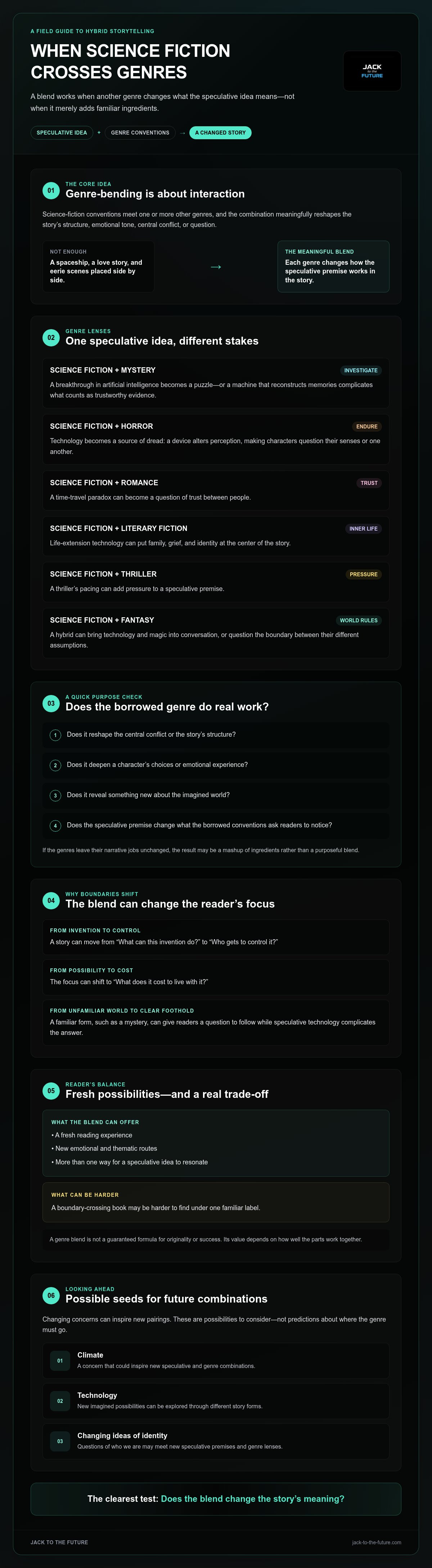
Genre-bending science fiction meaningfully combines science-fiction conventions with those of one or more other genres. It belongs to the broader idea of a hybrid genre, where distinct forms meet within one work. The key word is “meaningfully.” A story doesn’t qualify just because it contains a spaceship, a love story, and a few eerie scenes. The elements need to interact, shaping the structure, emotional tone, or central question.
This article uses 2026 as its publication context, but the date alone doesn’t establish a measured surge in hybrid stories. A more useful question is what the blend makes possible. Does a new genre lens expose another side of a speculative idea? Does it change what counts as danger, justice, intimacy, or discovery? Those effects offer a clearer way to discuss the form than a label alone.
How Is Genre-Bending Different from a Genre Mashup?
A mashup can combine recognizable ingredients while leaving each one’s narrative job unchanged. A story might feature futuristic technology and a detective, yet follow a conventional investigation with science fiction mainly as scenery. Genre-bending goes further by shifting expectations or changing the story’s engine. For example, a mystery about a machine that can reconstruct memories could ask not only “Who altered the evidence?” but also “Can a recovered memory be trusted?” The speculative premise transforms the mystery itself.
Why Do Readers and Writers Cross Genre Boundaries?
Familiar forms can give readers a foothold in unfamiliar territory. A mystery, for instance, offers a clear question to follow while imagined technology complicates what counts as evidence. For writers, combining forms can open new emotional and thematic routes: a speculative premise might gain tenderness through romance, pressure through a thriller’s pacing, or unease through horror. The appeal isn’t a guaranteed formula for originality or success. It’s the chance to make an idea resonate in more than one way.
How Science Fiction Changes When It Meets Other Genres
A genre pairing does its real work when it changes the story’s operating logic. Science fiction might supply a new technology, altered reality, or imagined future; another genre determines how characters confront it. The combination can reshape the structure, stakes, or mood, redirecting the reader’s attention from “What can this invention do?” to “Who gets to control it?” or “What does it cost to live with it?”
Genre conventions can reshape a speculative story’s central conflict, turning an imagined possibility into a different kind of human problem. A borrowed form isn’t decoration. It changes what characters pursue, what they fear, and what the reader waits to discover.
What Happens When Science Fiction Meets Mystery or Horror?
Pair science fiction with mystery, and a strange event becomes something to investigate. Perhaps a research station’s automated records contradict the memories of its crew. Clues and revelations guide the plot, while the technology complicates what counts as reliable evidence. Add horror, and attention can shift from solving the anomaly to enduring it. A device that alters perception, for example, might make characters question whether they can trust their senses or one another. These are possibilities, not claims about how often writers use either blend.
Can Science Fiction Blend with Literary Fiction or Fantasy?
Literary fiction can draw focus toward voice, inner life, and social ties. A story about people adapting to life-extension technology might be less concerned with how the technology works than with how it changes family, grief, or identity. The speculative idea still matters, becoming a pressure point in intimate relationships.
Fantasy can bring a different set of assumptions about how a world works. A science-fiction story may foreground technology or imagined explanations, while a fantasy story may make room for magic or other extraordinary forces without the same explanatory framework. These are flexible conventions, not universal rules. A hybrid story may question the distinction itself, and labels can vary between readers and booksellers.
To recognize a purposeful blend, ask what each genre contributes and whether that contribution changes the story’s questions. If you’re curious about speculative premises in ebook form, Jack Felson’s speculative science-fiction ebooks offer one place to continue exploring.
How to Tell Whether Genre-Bending Science Fiction Works
Crossing genre boundaries doesn’t automatically make a story original, coherent, or satisfying. A surprising mix can still feel like familiar parts placed side by side. To judge whether genre-bending science fiction works, look past the labels and examine how the speculative premise and the other genre’s conventions shape each other.
Try this test: name what each genre contributes to the central conflict, then ask whether the story would change if either one were removed. If the answer is yes, the blend is probably doing narrative work. If removing one element leaves the plot, character choices, and meaning largely untouched, that element may be decoration rather than a true partner.
Does Each Genre Have a Clear Storytelling Job?
Start with the science-fiction premise. What becomes possible, impossible, or uncertain because of its imagined technology or altered reality? Then consider the second genre: what does it contribute beyond atmosphere, setting, or a label? A speculative premise might create a conflict over who can access a new capability, while a political drama gives that struggle structure through competing interests and difficult compromises. This connection helps the story feel like one design, not two plots sharing a setting.
Use these questions as a quick check:
- Cause: Does the speculative idea drive events, or could it be swapped out without consequence?
- Pressure: Does the other genre shape the choices characters face and the stakes attached to them?
- Meaning: Do the conventions together raise a question neither would ask as powerfully alone?
When Can Genre-Blending Feel Confusing or Forced?
A blend can lose its footing when a story signals one kind of experience, then abruptly shifts tone without preparing the reader. It can also feel forced if it invokes a genre’s familiar promise but never follows through, or introduces a speculative premise that has no real effect on the plot. These are useful clues, not automatic flaws. A story may deliberately unsettle expectations, and ambiguity can be part of its design.
Even then, readers need meaningful signals. A shift in mood can feel purposeful when character reactions, recurring ideas, or consequences connect the different modes. Without those links, uncertainty may read less like mystery and more like a missing map. The goal isn’t to make every genre blend predictable. It’s to make its turns feel connected to the story’s deeper logic.
A successful blend doesn’t need to obey every expectation of its genres. It needs to make its choices clear enough for readers to follow the conflict, even when they can’t predict where it leads.
What Genre-Bending Science Fiction Means for Readers and Writers
A story that crosses genre lines can reward curiosity, but it may also ask readers to adjust their expectations. Its label might not tell you whether it reads like a fast-moving thriller, a reflective character study, or something less familiar. Looking at the premise, mood, and themes can give you a clearer sense of the experience ahead.
What Can Readers Gain from a Boundary-Crossing Story?
A strong blend can create surprise through contrast. A familiar mystery structure might make an imagined technology feel like evidence to examine, while a more intimate narrative could turn that same premise toward grief, identity, or connection. Readers may find new layers of meaning in how those conventions interact.
There’s a trade-off: an unusual combination can be harder to describe or discover under one familiar shelf label. Before choosing a story, consider:
- Premise: What speculative possibility draws you in?
- Mood: Are you looking for tension, wonder, intimacy, unease, or a mix?
- Themes: Do you want to explore questions of identity, technology, memory, or relationships?
- Blend: Are you in the mood for a strong genre combination or a subtler speculative element?
Readers drawn to thoughtful questions can also explore guides to sci-fi books with complex themes for adjacent reading ideas.
| Potential rewards | Possible trade-offs |
|---|---|
| Fresh surprises from contrasting conventions | A less predictable tone or structure |
| More than one lens for interpreting the story | A premise that’s harder to summarize with one label |
| New emotional or thematic possibilities | Expectations that may need to shift as the story unfolds |
How Can Writers Make Genre Experiments Read Clearly?
Writers can preserve a story’s strangeness while giving readers a few reliable bearings. Establish the speculative premise and its stakes early enough for readers to understand what could change or be lost. Then connect contrasting conventions through a consistent emotional thread, such as a character’s motive, a relationship under pressure, or a question the story keeps returning to.
Clarity doesn’t mean explaining every mystery or smoothing away every tonal shift. It means helping readers sense why the shifts matter. A writer can ask: what does each genre contribute, and how does that contribution alter the characters’ choices? For further reading context, cerebral science fiction books is a useful adjacent topic to explore.
To explore speculative storytelling in ebook form, discover Jack Felson’s speculative sci-fi ebooks.
Where Genre-Bending Science Fiction Could Go Next
What might happen when climate fiction borrows the structure of a family saga, or a story about emerging technology takes the shape of a ghost story? These are creative possibilities, not predictions or proof that any combination is already dominant. They suggest one way to think about genre-bending science fiction: changing concerns can invite writers to change not only the worlds they imagine, but also the forms they use to explore them.
Which Questions May Shape the Next Wave of Genre-Bending Stories?
Climate fiction could meet migration stories, political suspense, or intimate tales about community. How might a changing environment alter belonging, responsibility, or hope? Stories about new technologies might borrow from courtroom drama or psychological fiction to probe accountability and the boundaries of personhood. Shifting ideas of identity could also unsettle familiar assumptions about memory, bodies, or relationships. Whether writers pursue these combinations is an open question, not a settled trend.
As you read, notice how a story’s chosen form steers its underlying question. Does a thriller’s urgency make a technological threat feel immediate? Does a reflective voice turn an imagined future into a meditation on change? Genre labels may stay fluid as writers experiment and readers bring new expectations to familiar conventions. The more useful guide is often what the story asks you to feel, consider, or doubt.
Where Can Readers Explore Speculative Storytelling Further?
If you’re looking for a wider starting point, a guide to speculative fiction for adults can help you explore stories built around imagined possibilities. Then follow the premise that catches your attention, whether it turns on altered time, unfamiliar technology, or a different vision of identity. Charlie’s Trips is part of Jack Felson’s catalogue, which includes time-travel adventures inspired by classic stories.
For another path into imaginative futures, explore Jack Felson’s speculative-fiction ebooks.
Follow the Story Beyond the Label
The most useful way to approach genre-bending science fiction is to look past its category and notice how its parts work together. A borrowed genre should do more than add a familiar mood; it can change the story’s conflict, guide your expectations, or reveal a fresh angle on its speculative idea. That’s what makes crossing boundaries more than a clever label.
For readers, that shift offers a way to choose stories by the questions and feelings they’re seeking, even when a book doesn’t fit neatly on a shelf. For writers, it’s an invitation to experiment while giving readers enough character, stakes, and emotional logic to follow the journey. The boundaries may keep shifting, but curiosity can be a reliable compass.
Jack to the Future is an independent author platform featuring speculative science-fiction ebooks by Jack Felson. Its catalogue includes Charlie’s Trips and time-travel adventures inspired by classic stories. Explore Jack Felson’s ebooks at Jack to the Future and get instant access to digital books after checkout.
Frequently Asked Questions
What is genre-bending science fiction?
Genre-bending science fiction meaningfully combines science-fiction ideas with conventions from another genre, such as mystery, horror, romance, or literary fiction. The blend matters when it changes the story’s structure, stakes, mood, or central question. A futuristic setting alone doesn’t make a story genre-bending. Look for a connection between the speculative premise and the other genre’s storytelling approach that shapes what characters face and what readers wonder.
Can science fiction be combined with horror or mystery?
Yes. Mystery can turn a speculative idea into something characters investigate, with clues and revelations driving the plot. Horror can focus attention on vulnerability, dread, or the consequences of encountering the unknown. Imagine a research team finding that its records contradict its members’ memories: a mystery might ask who changed the records, while horror might ask whether anyone can trust their own perception. These are possible approaches, not rules.
Does genre-bending science fiction have to be difficult to read?
No. A story can combine genres while remaining clear and accessible. Familiar structures, such as a mystery’s central puzzle or a romance’s developing relationship, can help readers follow an unusual speculative premise. Complexity depends on the story’s language, pacing, and ideas, not simply on how many genres it blends. If you’re unsure, consider whether the premise and mood appeal to you, then see how the story handles its shifts.
Why are writers blending science fiction with other genres?
Blending genres lets writers explore speculative ideas through different emotional and narrative lenses. A thriller’s urgency could make a new technology’s risks feel immediate; a character-focused story could examine how that technology changes relationships or identity. Familiar genre expectations can also give readers an entry point into an unfamiliar world. The combination isn’t a guaranteed route to originality. Its value depends on what the genres reveal together.
How can I tell whether a genre blend works?
Ask what each genre contributes to the central conflict, then imagine removing one. Does the science-fiction premise affect what characters can do or risk? Does the second genre shape the plot beyond its atmosphere or label? A blend feels coherent when its elements influence each other and support the story’s emotional logic. Tonal surprises can be intentional, but readers still need clues that make those shifts feel connected.
What should I read after discovering genre-bending science fiction?
Choose your next story by the speculative premise, mood, and themes you want to explore. Try a mystery with imagined technology if you enjoy clues, or seek a more reflective story if questions of identity and relationships draw you in. Jack to the Future is an independent author platform featuring Jack Felson’s speculative science-fiction ebooks. Its catalogue includes Charlie’s Trips and time-travel adventures inspired by classic stories.
0 comments