

What if every version of your life existed somewhere, shaped by a different choice? That question can lead to very different reading experiences. Search results for Multiverse theory sci-fi ebooks often mix scientific explanations with fiction and broad book lists, so it can be hard to tell whether parallel worlds drive a story or simply get a passing mention.
A compelling multiverse story offers more than a clever premise. Possible worlds can sharpen questions about identity, fate, memory, and the choices that shape a life. The science may inspire the fiction, but a fictional multiverse is not proof that parallel realities exist.
This guide compares common approaches, from reality-bending thrillers to character-driven journeys, to help you choose a story that fits your preferred themes, tone, and structure. It also introduces a neighboring route into altered possibilities: Jack Felson’s downloadable time-travel adventure Charlie’s Trips, available for instant digital access after checkout.
Key Takeaways
- Use the central premise to distinguish alternate history, branching choices, parallel worlds, and stories that question reality itself.
- Compare Multiverse theory sci-fi ebooks by their reading experience and central questions, not just by whether they mention other realities.
- Choose a reading path based on what you want to explore, from how one decision changes a life to what makes identity feel stable.
- Use book descriptions and available excerpts to gauge tone, emotional focus, and how much reality-bending you want in your next read.
- Explore downloadable speculative fiction by Jack Felson, including Charlie’s Trips, a time-travel adventure for readers drawn to altered possibilities.
What Multiverse Theory Sci-Fi Ebooks Explore Beyond Parallel Worlds
A multiverse story does not need a portal, a duplicate protagonist, or an elaborate map of realities. At its core, it uses more than one reality, world, or possible history to shape the narrative. Those worlds might be reachable, separate, or imagined as alternatives. The useful question for a reader is how their existence changes the characters’ lives and what the story suggests could have happened.
A fictional multiverse is a storytelling device that imagines multiple realities; scientific interpretations are ideas explored in physics, not proof that those realities exist. The word “theory” can blur that distinction in search results. For an overview of the concept and its different meanings, see Multiverse Theory Explained. A novel can take inspiration from scientific discussions while inventing its own rules.
What does multiverse theory mean in a science-fiction story?
There is no single rulebook. One author may build a story around separate parallel worlds; another may imagine history diverging after a decision. A third may treat each choice as a doorway to a reality with different consequences. These are narrative approaches, not interchangeable descriptions of one established scientific model.
Imagine a character who takes a different train and arrives in a city shaped by a different past. That is a useful fictional premise, not a claim that such a world exists or can be visited. Keeping the distinction in mind lets you enjoy the imaginative leap without mistaking a plot mechanism for scientific evidence.
Multiverse theory sci-fi ebooks may draw on several related but distinct story approaches:
- Parallel worlds: Separate realities coexist, and the plot may follow a character moving between them or discovering their differences.
- Alternate histories: A changed event reshapes a world’s past and present.
- Choice-shaped realities: Different decisions lead to contrasting versions of a character’s life.
These categories can overlap, but each sets different expectations. A parallel-world adventure may emphasize discovery, while alternate history may trace how one changed event transforms a society. Some stories leave the mechanics mysterious and put the emotional stakes ahead of explaining exactly how each reality works.
Why do readers choose multiverse ebooks?
The appeal often comes from the uncanny familiarity: a recognizable place has changed, someone makes an unexpected choice, or the protagonist encounters a version of themselves with different memories. These shifts make relationships feel newly uncertain and turn “What if?” into a personal test of identity, loyalty, and consequence.
Readers may enjoy comparing realities as the story unfolds. Would the character still be the same after a different upbringing? Does a remembered event define a person, or do their later choices matter more? The answers vary by book. A multiverse premise can support suspense, intimate character drama, or a puzzle about what makes one life feel like your own.
How to Compare Multiverse Sci-Fi Ebooks by Story Style
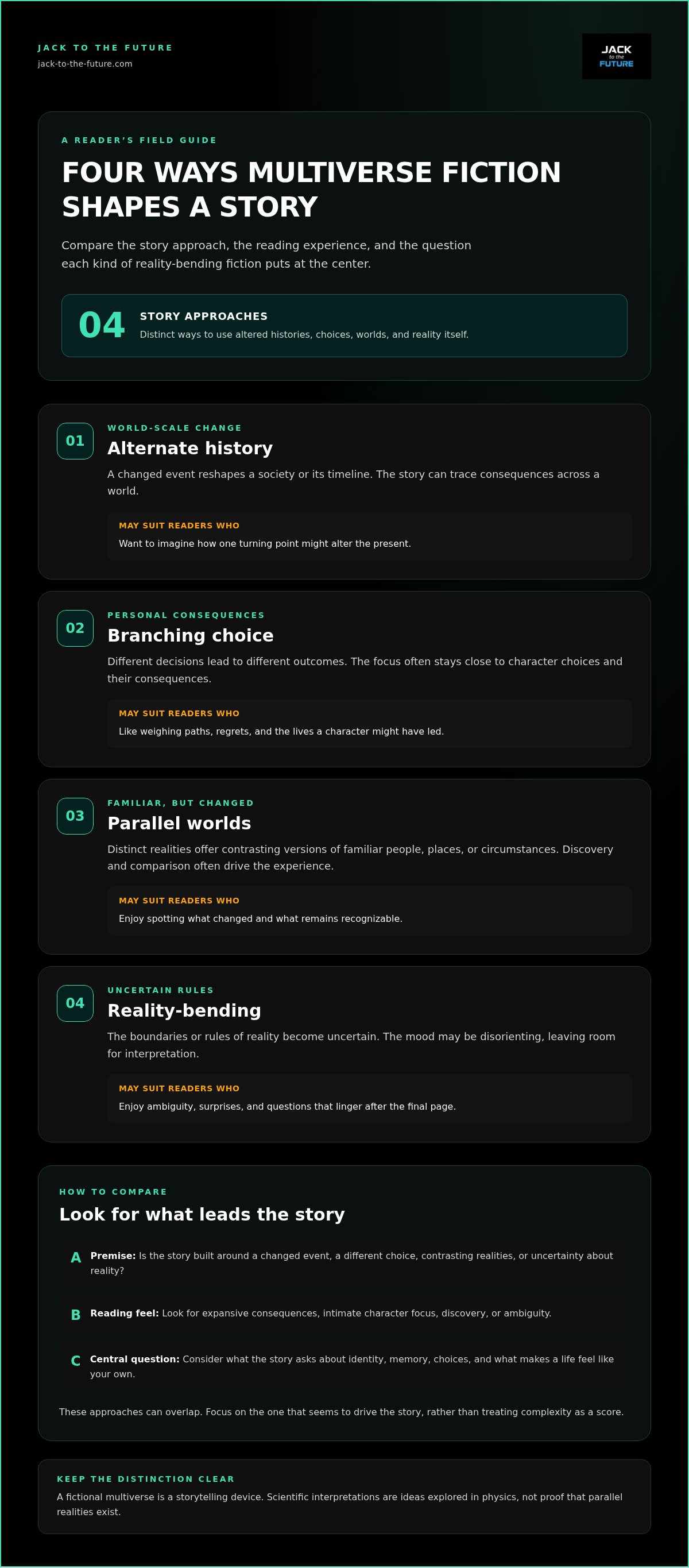
Two books can both imagine more than one reality and still feel very different. One may trace a historical change across a society; another may follow a character confronting a life that took a different turn. Compare the premise, reading experience, and central question. That is more useful than treating complexity as a score or assuming every multiverse story follows the same rules.
Story approach
Premise and reading feel
May suit readers who...
Alternate history
A changed event reshapes a society or its timeline. The experience can feel expansive, tracing consequences across a world.
Want to imagine how one turning point might alter the present.
Branching choice
Different decisions lead to different outcomes. The focus often stays close to personal consequences and character choices.
Like weighing paths, regrets, and the lives a character might have led.
Parallel worlds
Distinct realities offer contrasting versions of familiar people, places, or circumstances. Discovery and comparison often drive the reading experience.
Enjoy spotting what changed and what remains recognizable.
Reality-bending
The boundaries or rules of reality become uncertain. The mood may be disorienting, with room for interpretation.
Enjoy ambiguity, surprises, and questions that linger after the final page.
Which multiverse story approach suits your reading mood?
Start with the feeling you want from your next read. Choose alternate history for a broad “what if?” about a world’s direction, parallel worlds for the uncanny pleasure of familiar lives under unfamiliar conditions, or reality-bending fiction if uncertainty is part of the fun. Branching-choice stories turn inward, asking how a decision can reshape someone’s sense of self. Since these approaches can overlap, look for the one that seems to lead the story.
How much science and complexity should an ebook contain?
Some stories foreground explanations and systems; others use a speculative premise to illuminate character without pausing for technical detail. Neither approach is automatically more rigorous or more enjoyable. UC Davis’s discussion of quantum physics and multiverse theories offers scientific context, but a novel’s imaginative rules are not a measure of scientific accuracy. Choose based on the experience you want: accessible prose can still carry ambitious ideas.
For another way to think about premise, tone, and reader fit, explore this high-concept sci-fi ebook buyer’s guide. Then follow the question that interests you most: how might history change, who might you become, or what if reality cannot be trusted? For a separate time-travel adventure, explore Jack Felson’s speculative sci-fi ebooks.
A Multiverse Sci-Fi Ebook Roundup: Choose a Reading Path
There is no single “best” route into multiverse fiction. Start with the kind of what-if that holds your attention: a past reshaped, a choice revisited, a familiar life seen from another angle, or reality turned uncertain. These paths help you identify a reading mood; they are not a ranked list of titles. Each offers a different lens on possibility.
As you browse Multiverse theory sci-fi ebooks, look for the central premise and the human question beneath it. Does a changed event affect a whole society or mainly one person? Does the story explain its imagined rules or invite you to sit with uncertainty? Those clues can help you choose while keeping a fictional setup separate from a scientific claim.
- Follow the altered past. The premise: an event in history changes, and its consequences ripple forward. This may suit readers who like tracing cause and effect across a world. Ask: how much of the present depends on one turning point?
- Explore branching choices. The premise: a decision leads to another possible course of life. Readers drawn to intimate character dilemmas may enjoy comparing paths. Ask: would a different choice change who the protagonist becomes?
- Step into parallel worlds. The premise: distinct realities offer contrasting versions of familiar places or circumstances. This suits readers who enjoy recognition mixed with surprise. Ask: what remains the same when the world around someone changes?
- Embrace unstable reality. The premise: the boundaries or rules of reality become uncertain. Readers who enjoy ambiguity may welcome a story that leaves room for interpretation. Ask: what can the characters trust when their reality shifts?
Start with the possibility that one choice changes everything
If you are drawn to cause and consequence, look for a story where the changed event matters beyond its initial shock. Notice how the effects unfold: do they reshape relationships, daily life, or an entire society? That ripple effect can make an alternate possibility feel vivid. For a related angle on speculative stories about past events, explore sci-fi books about changing the past.
Choose time travel when the journey matters as much as the worlds
Time travel and multiverse fiction can both invite readers to imagine altered possibilities, but they are not the same premise. Jack Felson’s Charlie’s Trips is a time-travel adventure inspired by classic stories, making it an adjacent option for readers curious about that kind of journey. It is presented as a time-travel adventure, not a multiverse story. Discover more about its classic-story inspiration through this Charlie’s Trips time-travel retelling.
Ready to follow a different speculative path? Browse Jack Felson’s speculative sci-fi ebooks and choose the premise that sparks your curiosity.
How to Choose a Multiverse Ebook You Will Enjoy Reading
A striking premise can catch your eye, but the right read depends on more than how many worlds are involved. Use this checklist to find a story that fits your curiosity, attention, and preferred emotional depth. The goal is not to choose the most complicated book; it is to choose the experience you want.
- Choose the premise. Decide whether you are most curious about a changed historical event, different outcomes from a choice, contrasting parallel worlds, or reality that refuses to stay predictable. A clear preference makes blurbs easier to compare.
- Pick your preferred complexity. Do you enjoy learning the rules of an imagined reality, or would you rather follow the characters without pausing for detailed explanations? Look for clues about how much the description emphasizes world-building and speculative ideas.
- Name the emotional focus. Are you looking for suspense, a character’s difficult decision, or questions about identity and memory? A clever premise may catch your interest, but the human stakes are often what keep the pages turning.
What to look for in an ebook description or preview
Look for three signals in the description: the speculative premise, the central conflict, and the tone. A summary built around danger and pursuit suggests a different mood from one focused on philosophical questions or a character’s transformation. If an excerpt is available, sample it for voice and pacing. Notice whether the opening pulls you forward, pauses to explain the setup, or invites you to sit with uncertainty. These clues can reveal more than a genre label alone.
How to tell whether a high-concept story is right for you
Ask yourself what kind of uncertainty feels rewarding. Do unresolved questions make you want to turn the page, or do you prefer a story that steadily clarifies its rules? Then weigh the characters against the concept. If you care about what a protagonist risks, remembers, or regrets, look for descriptions that signal personal stakes alongside the reality-bending idea. For a neighboring speculative route, a time-travel books reading guide can help you explore stories built around journeys through time.
Also consider how you like to read. An ebook provides a digital reading experience that can suit readers who value flexible access and the option to pick up a story at different moments. Choose a premise that fits your mood, then use the description or an available preview to see whether the writing feels right. You do not need to solve every mystery before you begin.
Ready to put your shortlist into action? Explore Jack Felson’s speculative sci-fi ebooks and choose a digital story that matches the journey you want to take.
Begin Your Speculative Fiction Journey with Jack Felson
You have explored different kinds of multiverse stories. Now choose the question or reading mood that stays with you. Are you drawn to a world altered by one decision, a journey through time, or a reality that resists easy answers? Let that curiosity guide your next read. The best starting point is the premise that makes you want to turn the page.
Jack Felson’s catalogue brings together downloadable speculative science-fiction ebooks with a bold, cerebral outlook. If you are searching for Multiverse theory sci-fi ebooks, use the story approaches in this guide to clarify what you want, then explore a related speculative path through Felson’s work. The connection is a shared appetite for possibility, not a claim that every ebook in the catalogue explores parallel worlds.
What readers can expect from Jack Felson’s speculative fiction
The catalogue focuses on intellectually curious speculative storytelling. One title, Charlie’s Trips, is a time-travel adventure inspired by classic stories. It is an adjacent choice for readers intrigued by time and altered possibilities, while its premise remains clear: it is a time-travel adventure, not a multiverse title. Choose it for that genre connection rather than assuming it features parallel worlds.
That distinction helps set expectations. Multiverse fiction and time-travel adventure may both invite questions about what could have happened, but they are different story premises. If you are choosing a read for a specific theme, focus on what the book is described as exploring. With Charlie’s Trips, the point of entry is time travel and inspiration from classic stories.
Take the next step toward your next digital read
Jack to the Future offers downloadable ebooks, so the reading experience is digital rather than a physical book or audiobook. Digital purchases provide instant access after checkout, giving you a direct way to begin once you have chosen a title.
Before choosing, keep in mind the preference you identified: the premise you want, the storytelling that suits your mood, or the question you hope will linger after the final page. Then explore with those priorities in mind.
- Want a time-travel adventure? Consider Charlie’s Trips for its classic-story inspiration.
- Looking for speculative ideas? Explore Jack Felson’s downloadable science-fiction ebooks.
- Prefer a digital read? Digital purchases provide instant access after checkout.
Your next speculative journey can begin with one clear choice: follow the premise that sparks your curiosity. Explore Jack to the Future’s downloadable ebooks and find your next digital read.
Choose the What-If That Stays With You
The right speculative read does not have to answer every question. It can leave you turning over one possibility long after you have closed the book: What might have changed? Which choice mattered? What makes a life feel like your own? Let the question that keeps returning guide your next step.
For readers drawn to bold, cerebral storytelling, Jack Felson’s catalogue includes Charlie’s Trips, a time-travel adventure inspired by classic stories. It is a neighboring route for readers curious about time and possibility, not a claim that the book explores a multiverse. Jack to the Future offers downloadable speculative science-fiction ebooks, with instant digital access after checkout.
Use the reading mood you have discovered to choose a story that feels like your next door into the unknown. Explore Jack Felson’s speculative sci-fi ebooks and start your next imaginative journey.
Frequently Asked Questions
What are multiverse theory sci-fi ebooks?
Multiverse theory sci-fi ebooks are science-fiction stories that use multiple realities, parallel worlds, or alternative histories as part of their premise. The label can cover very different reading experiences, from action-driven journeys to quieter explorations of identity and choice. Check a book’s description to see how the idea shapes its story. A fictional multiverse is an imaginative premise, not evidence that multiple universes exist.
Is the multiverse real, or is it only science fiction?
The multiverse is discussed in some scientific theories and interpretations, but that does not establish that other universes exist. Fiction can use the idea more freely, inventing characters, events, and ways of moving between realities to serve a story. Keep the contexts separate: consult scientific sources for explanations of scientific ideas, and use a book’s description to understand its imagined premise and tone.
How do I choose a multiverse sci-fi ebook?
Choose based on the experience you want, not just a “multiverse” label. If you enjoy tracing consequences, look for a premise centered on a changed event; if character dilemmas appeal more, seek a story focused on choices and their outcomes. A blurb can help identify the central conflict, while a preview may reveal whether the prose and pacing suit you. Let genuine curiosity break a tie.
Can a time-travel ebook also explore multiverse theory?
Yes, a story can combine time travel with alternate realities, but the terms describe different premises. A journey through time does not necessarily involve parallel worlds, and a story about multiple realities does not have to include time travel. Charlie’s Trips is a time-travel adventure inspired by classic stories. Use its description as your guide rather than assuming it includes a multiverse plot.
Are multiverse sci-fi ebooks difficult to understand?
Not necessarily. A story’s difficulty depends on its writing, how it introduces its imagined rules, and how much ambiguity it leaves for readers to interpret. If you prefer clarity, look for descriptions that foreground a defined conflict or accessible adventure. If you like puzzles, uncertainty may be part of the appeal. You can sample an available preview to see whether the voice feels inviting or demanding.
What should I look for before buying a multiverse ebook?
Check that the description identifies the premise and gives you a sense of the story’s focus. Does it highlight a character’s dilemma, a speculative puzzle, or action across unfamiliar settings? Review the ebook information on the purchase page so you understand the digital product being offered. If a preview is available, use it to assess the prose before deciding. Genre labels alone do not guarantee that parallel worlds are central to the story.
Can I read Jack Felson’s ebooks immediately after purchase?
Yes. Jack to the Future sells downloadable ebooks, and digital purchases provide instant access after checkout. You can start reading the purchased ebook without waiting for a physical book to arrive. The catalogue includes Charlie’s Trips, a time-travel adventure inspired by classic stories. Read its description to decide whether that premise fits the speculative journey you want to begin.
0 comments