

What if your soul is just a glitch in the hardware? A ghost haunting a machine made of meat and memory. It's a terrifying premise... and exactly why we read. You're likely exhausted by action-heavy plots that trade philosophy for pyrotechnics. You want the deep stuff. The stories that peel back the layers of the ego until there's nothing left but the void. Finding genuine sci-fi books about consciousness shouldn't feel like a hunt for a needle in a digital haystack.
We agree that the best speculative fiction acts as a laboratory for the human spirit. You're here because you want to move beyond generic lists and discover stories that dissect the nature of self, memory, and mind. This guide promises to challenge your reality through high-concept narratives that prioritize the "inner space" of the psyche. We'll provide a framework to understand complex psychological themes and offer a curated list of visionary ebooks, including mind-bending titles like Charlie’s Trips. Let's step into the cerebral frontier. Your journey into the unknown starts now.
Key Takeaways
- Learn why speculative fiction serves as the ultimate "sandbox" for exploring the fragile intersection of memory, perception, and self-awareness.
- Discover how a curated selection of sci-fi books about consciousness tackles high-concept themes like digital afterlives and collective neural networks.
- Understand the evolution from rigid 20th-century logic puzzles to modern existential journeys that prioritize fluid psychology and subjective reality.
- Master a simple framework for identifying high-concept narratives that offer deep cerebral exploration over standard, action-heavy genre tropes.
- Explore how visionary stories like Jack Felson’s Charlie’s Trips use temporal displacement to dissect the nature of identity and fractured memory.
Ghost in the Machine: Consciousness in Speculative Fiction
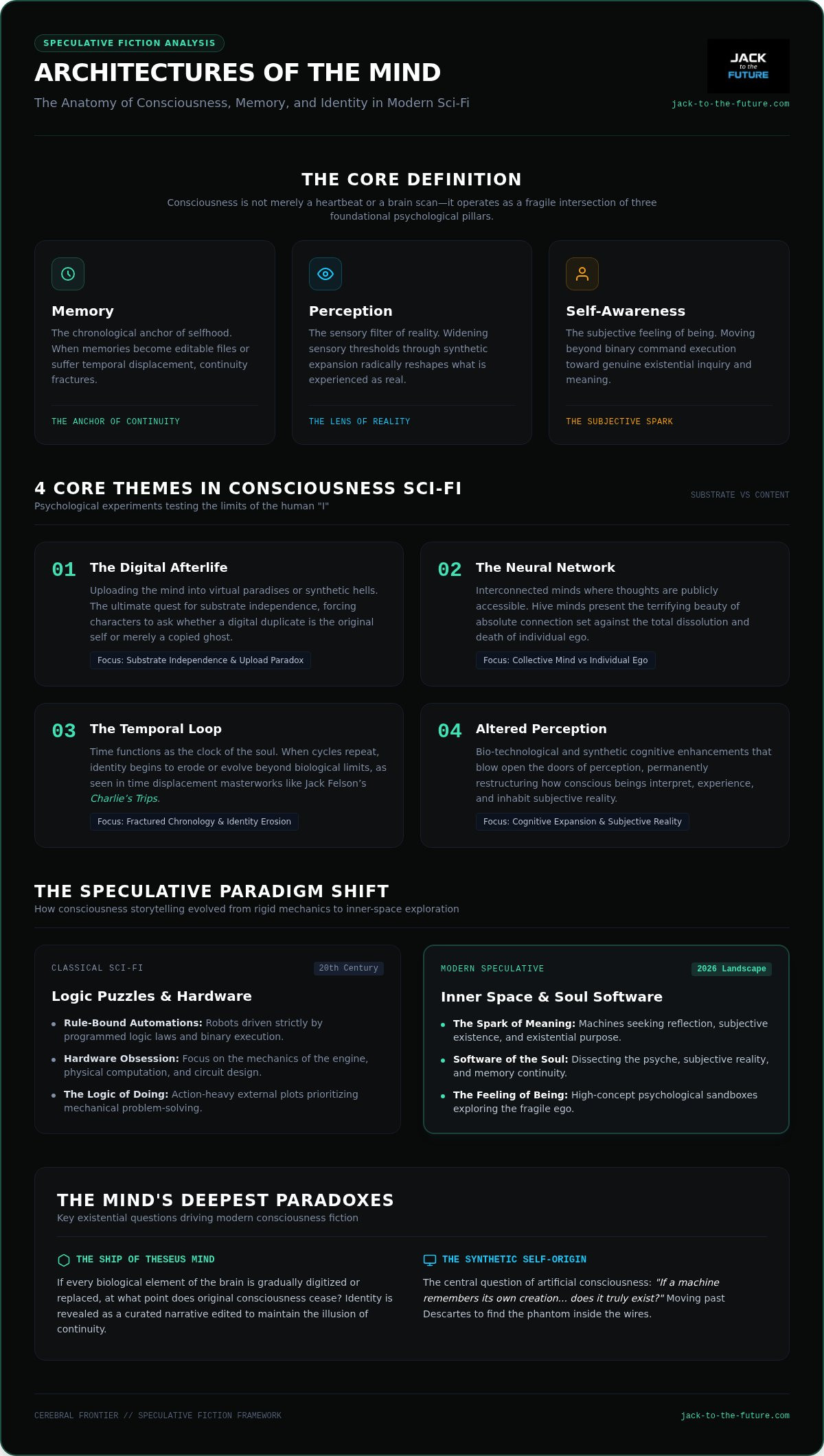
Consciousness. It isn't just a heartbeat or a brain scan. It's the jagged intersection of memory... perception... and self-awareness. For the visionary reader, the best sci-fi books about consciousness act as a high-concept sandbox. It's a space where we strip away the physical to see what's left. While "hard" sci-fi often obsesses over the mechanics of the engine, speculative fiction dives into the "mind-scape." We've moved beyond the hardware. We're now dissecting the software of the soul. In the 2026 literary landscape, this exploration is more than a trope. It's a necessity as AI begins to mirror our own complexity.
This evolution frequently revisits the concept of the ghost in the machine. Originally a critique of Cartesian dualism, the phrase has become the blueprint for how we imagine digital life. We're looking for the phantom in the wires. We're searching for the part of us that doesn't show up on a circuit board. It's about the feeling of being, rather than the logic of doing.
The Problem of the Self
Imagine the Ship of Theseus. You replace every plank of wood until nothing original remains. Is it still the same ship? Now, apply that to your mind. Digital uploading stories force us to confront this paradox head-on. If your consciousness is copied to a server, are you the ghost, or is the ghost you? Identity is terrifyingly fragile when memory becomes an editable file. In this frontier, the Self is merely a curated narrative; a story we edit to maintain the illusion of continuity.
Beyond Biology: Artificial Consciousness
We've outgrown the era where robots simply follow rules. The modern reader isn't interested in a machine that obeys commands. They want a machine that seeks meaning. In 2026, the obsession with the "spark" of digital life has reached a fever pitch. We're searching for our own reflection in the code. It leads to a haunting question that keeps us scrolling through the latest sci-fi books about consciousness and speculative ebooks. If a machine remembers its own creation... does it truly exist?
Architectures of the Mind: 4 Core Themes in Consciousness Sci-Fi
Consciousness is not a monolith. It is a structure. A blueprint. In the most compelling sci-fi books about consciousness, authors build elaborate architectures to test the limits of what we call "I." These narratives don't just tell stories; they construct psychological experiments. They ask a simple, haunting question. If you change the container, do you change the contents?
Four pillars define this cerebral frontier in 2026 fiction:
- The Digital Afterlife: Uploading the mind into virtual paradises... or digital hells. It's the ultimate quest for substrate independence.
- The Neural Network: Imagine a world where every thought is public. Hive minds represent the terrifying beauty of total connection and the absolute death of the ego.
- The Temporal Loop: Time is the clock of the soul. When cycles repeat, the self begins to erode or evolve in ways biology never intended.
- Altered Perception: Whether through bio-tech or synthetic "expansion," these stories explore how widening the doors of perception reshapes reality itself.
These themes often ground themselves in complex philosophical theories of consciousness, bridging the gap between academic debate and visceral storytelling. They challenge us to define the "hard problem" through the lens of the impossible. They force us to look at the mind from the outside in.
Memory as Identity
Who are you without your past? Amnesia is a favorite tool for authors seeking to strip a character to their core. If your memories are deleted, or worse, replaced with fabrications, does your original consciousness survive? It's a question of continuity. In Charlie’s Trips, Jack Felson explores this masterfully. By hurling a protagonist through time and fracturing his chronological memory, the story examines how temporal identity is the anchor of the self. If you're looking for a deep dive into these themes, you can explore more speculative sci-fi ebooks that challenge your sense of history.
The Collective vs. The Individual
Privacy is a relic. In the age of the "Neural Network," the individual is an outcast. Hive minds offer a terrifying unity; a shared consciousness where the "I" becomes "We." Yet, the rebellious spirit of sci-fi often champions the lone mind. The one who refuses to sync. The one who keeps their secrets. These stories highlight the tension between the comfort of belonging and the necessity of solitude. It's the "outcast" spirit that truly defines the frontier of sci-fi books about consciousness. It's the drive to remain unique in a world of copies.
From Asimov to Felson: Comparing Philosophical and Speculative Approaches
The 20th century treated the mind like a circuit board. Isaac Asimov's robots operated on rigid, logical imperatives. It was a time of puzzles... of external rules... of predictable outcomes. But the frontier has shifted. Modern sci-fi books about consciousness have moved away from "how it works" to "how it feels." We've traded the Three Laws for the "Oz Paradox." It's no longer about whether a machine can follow orders. It's about whether a person can survive the erosion of their own history. The logic of the machine has been replaced by the chaos of the soul.
This transition reflects a deeper philosophical curiosity. We aren't just looking for logic gates anymore. We're exploring the same territory as Daniel Dennett's 'Where Am I?' thought experiment. We're asking if the "I" is located in the brain, the body, or the narrative that connects them. Modern authors like Jack Felson embrace this fluid logic. They treat consciousness as a fragile, non-linear experience. They aren't afraid to let the "what if" lead them into dark, uncharted psychological waters.
The Legacy of the Mind-Benders
Philip K. Dick paved the way. He asked, "What is real?" and left us shivering in the answers. Today's psychological sci-fi takes that a step further. It asks, "Who am I?" amidst the static of false memories and temporal shifts. The register is urban. Edgy. Cerebral. It's a curated experience for the intellectually bold. We've moved from the cold vacuum of space to the crowded, messy interior of the human psyche. It's a journey from the external to the essential.
The New Wave: Speculative Fiction for Adults
Readers in 2026 are tired of generic space battles. They want weight. They want existential stakes. This is where the independent visionary thrives. Major publishers often play it safe, clinging to established tropes. But speculative fiction for adults flourishes in the indie space. Independent authors have the freedom to reimagine classic archetypes without gatekeepers. They can build worlds that prioritize atmosphere and "vibe" over exhaustive, boring detail.
Why are high concept sci-fi ebooks the perfect medium for these experiments? It's about the speed of thought. Digital downloads offer instant access to the fringes of reality. There's no waiting for distribution cycles. Just immediate immersion into the mind of a storyteller who is two steps ahead. It's the ultimate laboratory for dissecting the human soul... available with a single click.
Mapping Your Journey: How to Select High-Concept Consciousness Narratives
Choosing your next sci-fi books about consciousness shouldn't be a gamble. It is a deliberate descent into the unknown. To find a story that truly resonates, you need a map. Start by identifying your "hook." Are you drawn to the silicon sentience of artificial intelligence? The chronological trauma of time travel? Or perhaps the claustrophobic mystery of a psyche unraveling? This anchor point grounds the speculative in your specific brand of curiosity. It turns a generic search into a targeted exploration of the self.
Once you have your hook, follow these steps to ensure a high-concept experience:
- Look for weight: High-octane action often masks a thin premise. Seek narratives where the conflict is internal and the stakes are existential.
- Prioritize digital downloads: Momentum is everything. Waiting for a package to arrive kills the intellectual spark. Instant access allows for immediate immersion.
- Seek the rebels: Look for authors who reimagine familiar tropes in bold, uncomfortable ways. The best stories are often found where the mainstream fears to tread.
Evaluating the Cerebral Weight
How do you spot a visionary author from a single blurb? Look for the "what-if." A truly cerebral book sets its psychological stakes in the first chapter. It doesn't just describe a world; it challenges your place within it. If the description focuses on the internal "mind-scape" rather than the external "hardware," you're on the right track. Intellectual curiosity is your best compass. It will lead you away from the generic and toward the distinctive narratives that define the cerebral frontier.
The Digital Advantage
The rebellion of the indie ebook is real. In 2026, the most daring sci-fi books about consciousness aren't found on traditional bookstore shelves. They live in the digital space. Indie authors operate without gatekeepers, allowing them to push boundaries that major publishers won't touch. By curating a virtual shelf of unique digital downloads, you're supporting a movement of visionary storytelling. There's a thrill in discovering a "hidden gem" that hasn't been polished into mediocrity by a corporate committee. It's raw. It's edgy. It's ready for you to explore right now.
Ready to start your next psychological adventure? You can access visionary speculative sci-fi ebooks instantly and begin your journey into the mind today.
Beyond the Printed Page: Exploring Consciousness with Charlie’s Trips
We've mapped the themes and navigated the evolution of the genre. Now, we arrive at a specific lighthouse in the cerebral frontier. Jack Felson’s Charlie’s Trips isn't just another entry in the catalog. It's a cornerstone. This narrative defines the "cerebral and sophisticated" edge that modern readers crave. It’s a flagship for sci-fi books about consciousness, stripping away the noise of space battles to focus on the terrifying fragility of the human psyche. Felson doesn't just tell a story; he invites you into a psychological laboratory where identity is the primary subject of dissection.
A Retelling of the Mind
Felson utilizes a familiar framework to ground his extraordinary premise. He calls it the "Oz Paradox." Imagine a 16-year-old soldier in the American Midwest, Charlie Bradshaw, swept up by a freak tornado. It’s a classic trope, but the destination isn't a magical kingdom. It's space-time itself. Charlie wakes on a beach near San Francisco, 21 years in the future, after a three-day coma. The "trip" here is a psychological metaphor for the total severance of temporal continuity.
Charlie awakens with amnesia regarding his past, yet he's haunted by "reverse memory." He experiences precognitive visions of future disasters, including a catastrophic earthquake. This displacement explores how memory serves as the map of human identity. When that map is torn, what remains of the self? This is essential reading for the intellectually bold. It’s a journey that asks if we are defined by where we've been... or by the shadows of where we’re going.
Instant Exploration: The Jack to the Future Catalog
The visionary reader doesn't have time for traditional distribution cycles. Waiting for shipping kills the speculative momentum. Every Jack Felson ebook is designed for immediate immersion. The Jack to the Future catalog pulses with a bold, imaginative energy that prioritizes the "vibe" and atmosphere of a story over exhaustive, technical jargon. These digital downloads provide a direct line to high-concept experiences that major publishers often deem too risky or too cerebral.
By choosing digital formats, you're embracing the rebellion of the indie author. You're accessing narratives that reimagine classic tropes without the filter of corporate gatekeepers. It’s raw. It’s distinctive. It’s a curated experience for those who want their fiction to be as mentally stimulating as it is emotionally resonant. Your journey into the unknown doesn't have to wait. The frontier is open, and the next discovery is only a click away. Download your next speculative journey at Jack to the Future.
Claim Your Cerebral Frontier
The journey through the psyche is just beginning. We've explored the ghosts in our machines and the architectures that hold our sense of self. Finding the best sci-fi books about consciousness isn't about looking for answers; it's about asking the right questions. You're ready to move beyond the surface. You've seen how the evolution of speculative fiction now demands a deeper, more sophisticated exploration of identity... a journey from the external to the essential.
Don't wait for a physical package to catch up to your curiosity. You deserve instant digital access to high-concept narratives authored by visionary indie writer Jack Felson. With free shipping on all digital downloads, your next existential breakthrough is only a click away. The rebellious spirit thrives on the fringe. Join it.
Start Your Journey: Download Cerebral Sci-Fi Ebooks Now
Step into the unknown. The frontier is waiting for you to define it.
Frequently Asked Questions
What are the best sci-fi books about consciousness for beginners?
Beginners should look for stories that ground the extraordinary in the familiar. Start with narratives that use recognizable archetypes... like the classic journey found in sci-fi books about consciousness. These stories provide a psychological anchor while exploring complex themes. Jack Felson’s work is an ideal entry point because it balances literary depth with a fast-paced, cinematic rhythm. It’s about feeling the journey before you dissect the science.
Is there a difference between philosophical sci-fi and speculative fiction?
Philosophical sci-fi often functions as a rigid logic puzzle; it's a cold examination of ethics and rules. Speculative fiction is more fluid. It prioritizes the "vibe" and the emotional weight of a "what-if" scenario. Speculative stories act as a laboratory for the soul. They aren't afraid to explore the fringes of reality without getting bogged down in technical jargon. It’s the difference between studying a map and actually getting lost in the territory.
How does Charlie’s Trips explore themes of consciousness and time?
Charlie’s Trips reimagines the classic "tornado" trope to explore temporal displacement and amnesia. Charlie Bradshaw wakes up 21 years in the future, facing a fractured sense of self. The story focuses on "reverse memory"... precognitive visions that challenge his sanity and identity. It treats consciousness as a fragile anchor in a world where time is no longer linear. This is a deep dive into the psychological trauma of being out of sync with history.
Can I download these sci-fi ebooks instantly?
Yes, every title in the catalog is available for instant digital download. We believe waiting for a package to arrive kills the intellectual momentum of a great story. Upon completing the checkout process, you receive immediate access to your electronic files. This digital-first approach ensures that visionary readers can start their journey into the unknown without delay. There is no need for physical shipping; the cerebral frontier is open to you right now.
Why is consciousness such a popular theme in 2026 science fiction?
In 2026, we are witnessing a shift from "hardware" to "inner space." As AI begins to mirror our own complexity, readers are increasingly obsessed with the "spark" of digital life. We are searching for our own reflection in the code. Speculative fiction provides the perfect sandbox to explore these existential anxieties. It allows us to safely dissect the human soul in an era where the boundary between biological and synthetic is blurring.
Are there sci-fi books that explore collective consciousness?
Many sci-fi books about consciousness explore the terrifying beauty of the hive mind. These narratives investigate what happens when the "I" becomes "We" through advanced neural networks. They often depict a world where privacy of thought is a relic of the past. These stories are essential for readers who want to explore the tension between collective unity and the rebellious, individualist spirit that defines the human experience in a connected age.
What makes Jack Felson’s approach to sci-fi unique?
Jack Felson brings a rebellious, "outcast" spirit to the genre. His approach is cinematic and methodical; he prioritizes atmosphere and psychological depth over traditional sales tactics. By reimagining classic archetypes like The Wizard of Oz through a speculative lens, he creates high-concept experiences that feel both familiar and extraordinary. He acts as an authoritative guide to uncharted territories, staying two steps ahead of the audience’s expectations to keep the mystery alive.
How do I choose between hard sci-fi and cerebral speculative fiction?
Hard sci-fi obsesses over the mechanics of the engine... the nuts and bolts of the technology. Cerebral speculative fiction dives into the "mind-scape." If you want to know how a time machine is built, choose hard sci-fi. If you want to know how time travel erodes the human soul, choose speculative fiction. Look for narratives that prioritize intellectual curiosity and emotional resonance over technical blueprints and exhaustive, boring detail.
0 comments