

What makes a science-fiction ebook memorable: a complicated universe, or an idea that keeps you thinking after you finish? Sci-fi ebooks with deep meaning use questions about identity, memory, society, and time to make imagined worlds feel relevant to our own. But a list of titles alone won’t tell you which questions a book explores, or whether its depth comes from emotional insight rather than a dense premise.
If you’ve looked for a thoughtful read and found only vague labels like “mind-bending” or “philosophical,” you’re not alone. The right story should connect with ideas you care about, not just make you work to follow the plot. This guide compares meaningful science fiction by the questions it raises and the reading experience it offers, so you can find a book that fits your curiosity and appetite for complexity.
Explore stories that probe identity, reshape reality, or look at familiar ideas from a new angle. You’ll also find an independent option: Jack Felson’s Charlie’s Trips, a time-travel reimagining of The Wonderful Wizard of Oz. Start with the questions that matter to you, then look for an ebook whose premise makes you want to turn the page.
Key Takeaways
- Sci-fi ebooks with deep meaning use speculative ideas to explore human questions, not just pile on technical detail.
- Start with questions about identity, social systems, time, technology, or belonging to find the kind of story you’re in the mood for.
- Compare books by their central themes and reading experience to see which one best matches your curiosity.
- Look past labels like “profound” or “mind-bending.” Check whether a book’s premise genuinely raises questions you want to explore.
- Consider independent speculative fiction, including Jack Felson’s Charlie’s Trips, as another path to a distinctive read.
What Makes Sci-Fi Ebooks Meaningful After the Story Ends?
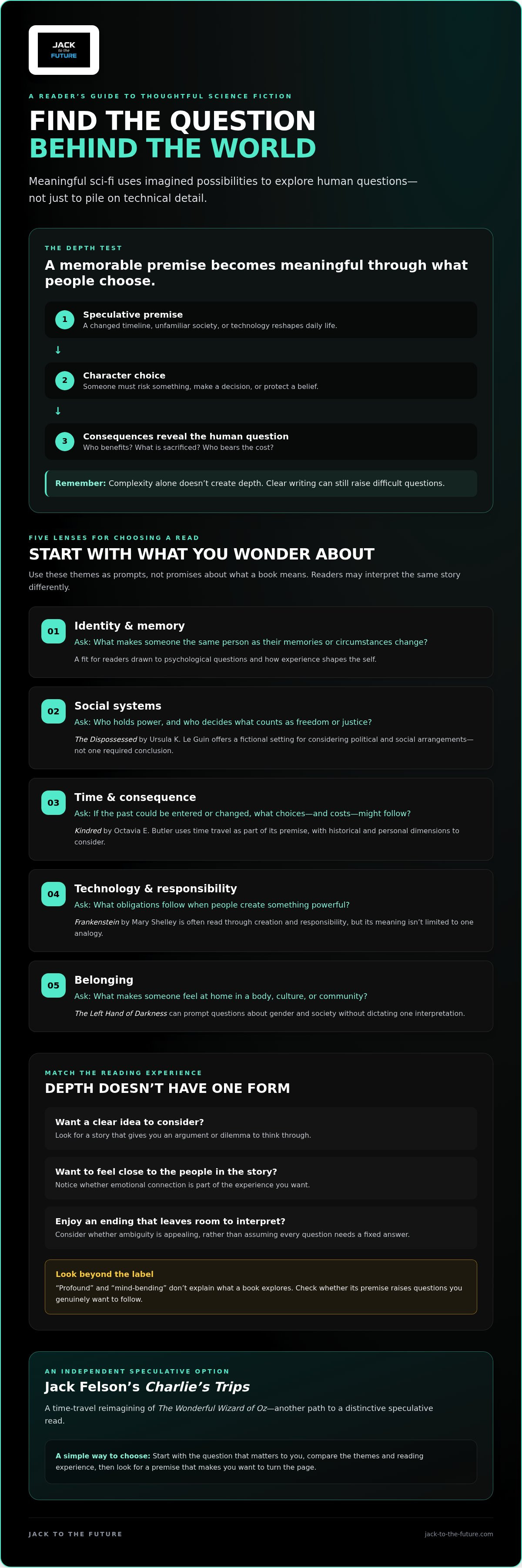
Meaningful science fiction uses imagined possibilities to examine human questions. A changed timeline, unfamiliar society, or technology that reshapes daily life becomes more than a clever premise when it reveals something about how people choose, connect, and live with consequences.
Complexity alone doesn’t create depth. A story can be packed with invented terminology, intricate world-building, and technical detail yet leave its central ideas untouched. Look instead at what the characters must risk or decide. Who benefits from a new technology? What does someone sacrifice to protect a belief? Those choices turn abstract questions into emotional stakes you can follow through the story.
A speculative premise opens the door; character choices and their consequences show which human questions are waiting inside.
Does deep meaning require difficult science or dense prose?
No. Intellectual depth and difficult writing aren’t the same thing. An accessible story can raise complex moral or personal questions through a clear dilemma, such as whether someone should alter a memory to ease pain. The idea is easy to grasp; its implications may be anything but simple.
Readers also value different kinds of experiences. Some want a clear argument to consider; others enjoy emotional connection or an ending that leaves room for interpretation. When assessing Sci-fi ebooks with deep meaning, ask whether the story gives you something to think about, not whether it makes every page hard to follow.
What questions can speculative fiction make vivid?
Use themes as starting points, not guarantees about what a book will say. Identity and memory ask how we remain ourselves as our experiences change. Freedom asks who sets the limits. Responsibility asks who bears the cost of invention or power. Social change asks what happens when a system is redesigned, and who gets to shape the new one.
Social science fiction foregrounds social and political questions, showing how imagined worlds can bring real human tensions into sharper focus. A book’s category, however, won’t tell you exactly what you’ll take from it. Notice which questions pull at you: the self, the rules of a society, or the consequences of a choice. That curiosity is a more useful guide than a broad label like “mind-bending.”
Five Meaningful Sci-Fi Lenses: Identity, Society, Time, and More
A useful way to choose your next read is to start with a question, not a label. Speculative fiction’s “what if?” can explore the human condition by shifting one familiar part of life and revealing what changes around it. The same premise can invite different readings, so treat these lenses as prompts, not promises about what every book means.
- Identity and memory: What makes someone the same person after their memories or circumstances change? Readers drawn to psychological questions may enjoy considering how selfhood is shaped. Frankenstein, for example, invites reflection on creation and responsibility, though readers may interpret its concerns in different ways.
- Social systems: Who holds power, and who gets to decide what counts as freedom or justice? This lens may appeal if you like examining how societies are built and who benefits from their rules. Ursula K. Le Guin’s The Dispossessed offers a fictional setting for thinking about political and social arrangements, not a single required conclusion.
- Time and consequence: If the past could be entered or changed, what choices would become possible, and what costs might follow? Readers who enjoy tracing cause and effect may find time-focused stories especially compelling. Octavia E. Butler’s Kindred uses time travel as part of its premise; its historical and personal dimensions invite careful interpretation.
- Technology and responsibility: When people create something powerful, what obligations follow? This question suits readers interested in moral choices and the boundary between intention and consequence. Mary Shelley’s Frankenstein is often read through this lens, but its meaning isn’t limited to one modern analogy.
- Belonging: What makes a person feel at home in a body, culture, or community? Readers interested in relationships and difference may gravitate toward stories that unsettle familiar ideas of identity. The Left Hand of Darkness can prompt questions about gender and society without dictating one interpretation.
Change one rule of the world, and the quiet tensions of ordinary life can suddenly become impossible to ignore. That’s the spark: not a guaranteed message, but a new angle on choices, relationships, and power. Before you browse, ask which question you want to carry into a story. Then look for a premise that gives it room to unfold.
If time travel is the lens that catches your attention, Jack Felson’s speculative sci-fi ebooks include Charlie’s Trips, a time-travel adventure inspired by classic stories. Explore the book’s description to decide whether its premise fits the kind of reading experience you’re looking for.
Meaningful Sci-Fi Books to Compare by Theme and Reading Experience
Meaning can come through an ethical dilemma, a shift in perspective, or a world built around unfamiliar rules. This comparison of Sci-fi ebooks with deep meaning focuses on what each premise invites you to consider and the kind of reading experience it offers. The first four titles are established works for comparison, not books sold by Jack to the Future. Ebook editions and availability can vary by retailer and region, so check current listings before choosing.
| Title | Author | Thematic lens | Reading feel | Best-fit reader |
|---|---|---|---|---|
| Frankenstein | Mary Shelley | Creation and responsibility | A gothic story shaped by a creator’s actions and their consequences. | Readers drawn to ethical questions about invention and accountability. |
| Kindred | Octavia E. Butler | Historical violence and its effects | Time travel brings a contemporary protagonist into direct contact with slavery in the American past. | Readers prepared to engage with history, power, and survival. |
| The Left Hand of Darkness | Ursula K. Le Guin | Gender, culture, and perspective | An encounter with an unfamiliar society challenges assumptions about identity and social norms. | Readers who enjoy examining how culture shapes perception. |
| The Dispossessed | Ursula K. Le Guin | Contrasting social arrangements | Two different societies create a frame for reflecting on political ideals and their trade-offs. | Readers interested in power, community, and competing visions of social life. |
| Charlie’s Trips | Jack Felson | Time travel | An independent speculative-fiction adventure inspired by classic stories. | Readers curious about a time-travel premise and an independent author’s work. |
Which classic and contemporary novels invite ethical or social reflection?
In Frankenstein, a creator’s choices make responsibility a compelling interpretive lens, though the novel supports readings beyond that one question. Kindred uses time travel to place its protagonist in the realities of slavery, making historical violence and its effects central to the reading experience. In The Dispossessed, contrasting societies invite readers to weigh different social and political arrangements rather than settle for a single prescribed message.
Which books suit readers seeking introspection or unfamiliar worlds?
The Left Hand of Darkness presents an unfamiliar culture through which readers can consider gender, social norms, and the limits of their own perspective. For a respected overview of science fiction’s ongoing questioning of the nature of our sense of selfhood, see The Encyclopedia of Science Fiction. If time and choice interest you, explore sci-fi books about changing the past for a related discussion.
How to Choose a Deep-Meaning Sci-Fi Ebook That Fits You
A book can carry a big idea and still be warm, gripping, or easy to follow. Meaningful fiction doesn’t have to feel like homework. The best match is the one whose central question catches your attention and whose characters give you a reason to care about the answer.
Use this process to narrow your options:
- 1. Choose a question. Start with something you want a story to explore, such as how memory shapes identity or who is responsible for a powerful invention.
- 2. Set your reading mood. Are you looking for emotional intensity, an unfamiliar world, a fast-moving premise, or space to reflect? Your mood can help you decide what kind of storytelling feels right now.
- 3. Compare descriptions. Look beyond words like “profound” or “mind-bending.” Does the description show what a character might risk, choose, or lose? A striking premise matters, but the human stakes help reveal how the idea takes shape.
- 4. Sample an available preview. If the seller offers one, read a passage to see whether the voice, pacing, and level of detail suit you. A preview can tell you more about the reading experience than a broad promotional label.
How can you tell whether a book’s themes match your interests?
Look for a connection between the promised theme and the story’s choices. If you’re interested in responsibility, for instance, does the description suggest someone must face consequences, or does it only advertise advanced technology? Trusted reviews can offer useful clues about tone and themes, but popularity isn’t proof that a book will feel meaningful to you. The best test is whether its questions resonate with your own curiosity.
For another way to compare books led by an intriguing premise, see this high-concept sci-fi ebooks buyer’s guide. It can help you identify the idea that draws you in, then consider whether the story offers more than a clever setup.
How do format and reading expectations affect your choice?
Before buying an ebook, check the seller’s stated file format and whether it works with your reading device. A digital edition is a convenient format, but it doesn’t guarantee a particular style, pace, or emotional effect. Those come from the book itself. Readers exploring cerebral storytelling can also consult this adult speculative fiction guide.
Ready to explore an independent author’s speculative fiction? Browse Jack Felson’s downloadable sci-fi ebooks and consider whether a time-travel adventure inspired by classic stories fits the questions you want your next read to raise.
Explore Jack Felson’s Speculative Sci-Fi Ebooks
Once you’ve identified the kind of question you want a story to raise, independent speculative fiction offers another route beyond familiar recommendations. Jack to the Future is an independent author platform selling downloadable speculative sci-fi ebooks by Jack Felson. Its catalogue includes Charlie’s Trips, a time-travel adventure inspired by classic stories.
That premise gives you a starting point, not a verdict about the book’s themes or what you’ll take away from it. If you’re comparing Sci-fi ebooks with deep meaning, apply the same reader-focused test you would use for any title: review the available description, consider whether the premise interests you, and look for details that help you decide whether the story fits your mood. A time-travel setup alone doesn’t guarantee a particular message or outcome.
What is confirmed about Charlie’s Trips?
Charlie’s Trips is by Jack Felson. It’s a time-travel adventure inspired by classic stories. Those details offer a clear premise to consider without requiring assumptions about specific characters, plot developments, or philosophical themes. For more information, read about Charlie’s Trips and time-travel retelling. Use the book’s available details to decide whether its approach to time travel appeals to you.
Think back to the question you chose earlier. Are you curious about stories that involve time and choice? Does a reimagining inspired by classic stories sound like the kind of speculative premise you want to explore? Those questions can help you assess whether the title belongs on your reading list without presuming what the book ultimately means to you.
How can readers take the next step?
Jack to the Future lets readers purchase Jack Felson’s ebooks directly as digital downloads, with instant access after checkout. Before deciding, review the available book information and check the seller’s stated file format and device compatibility. This practical step helps set expectations without assuming the digital format dictates the reading experience.
If the premise sounds like a fit, explore Jack Felson’s speculative sci-fi ebooks and choose a thought-provoking read. Take a look at Charlie’s Trips through the questions that matter to you, then decide whether this independent time-travel adventure is the next story you want to open.
Follow the Question That Stays With You
The most memorable Sci-fi ebooks with deep meaning aren’t necessarily the ones with the most complex science. Look for stories that connect an imaginative premise to choices, consequences, and questions you care about. Identity, memory, social systems, time, and responsibility each offer a different path into a thought-provoking read.
Use descriptions and available previews to judge whether a book’s themes and reading style fit your interests. Labels like “profound” can’t tell you how a story will resonate, but a compelling character dilemma might. Meaning doesn’t have to come at the cost of an engaging, accessible experience.
For an independent option, Jack to the Future sells downloadable speculative sci-fi ebooks by Jack Felson. Its catalogue includes Charlie’s Trips, a time-travel adventure inspired by classic stories. Review the available book information, then decide whether its premise fits the questions you want to explore. Direct ebook purchases include instant access after checkout.
Explore Jack Felson’s speculative sci-fi ebooks and choose a story that meets your curiosity. Your next great read may leave you with a question worth carrying into the future.
Frequently Asked Questions
What makes a sci-fi book meaningful?
A sci-fi book feels meaningful when its imagined premise helps explore human questions, not simply because its world is elaborate. Character choices and their consequences can make ideas about identity, freedom, responsibility, or society feel immediate. The story may leave you with a moral dilemma, an emotional connection, or an open question to consider. Depth comes from how the ideas shape the story, not from technical detail alone.
Which sci-fi books explore deep ideas?
Several established novels invite readers to explore big questions from different angles. Mary Shelley’s Frankenstein raises questions about creation and responsibility. Octavia E. Butler’s Kindred uses time travel to confront slavery and historical violence. Ursula K. Le Guin’s The Left Hand of Darkness explores gender and culture, while The Dispossessed considers contrasting social arrangements. These are starting points, not books with only one possible interpretation.
Can science fiction be meaningful without being difficult to read?
Yes. A clear, engaging story can raise complex questions without dense prose or complicated science. For example, a straightforward premise about changing a memory could prompt reflection on identity, grief, or personal responsibility. Readers differ in what they enjoy: some prefer direct storytelling, while others welcome ambiguity or intricate world-building. Look for a story whose ideas interest you and whose style feels inviting, rather than assuming difficulty is proof of depth.
How do I choose a sci-fi ebook with themes I care about?
Start by naming the question you want a story to explore, such as how memory shapes identity or who should be accountable for a powerful invention. Then compare descriptions for character choices and consequences, not just an unusual premise. If a preview is available, sample it to see whether the voice and pacing suit you. Trusted reviews can offer context, but popularity alone can’t tell you whether a book will resonate.
Are classic science-fiction books still relevant today?
Yes. Classic science fiction can remain relevant because questions about power, responsibility, identity, and social change continue to invite discussion. A book written in another era may also reveal how its concerns reflect the time in which it was created. Relevance doesn’t mean every idea feels current or every reader will respond the same way. Read with curiosity, and consider both what the story asks and what has changed since it was written.
Is Charlie’s Trips a sci-fi ebook about time travel?
Yes. Charlie’s Trips by Jack Felson is a time-travel adventure inspired by classic stories. Those details offer a useful starting point if you’re interested in time-travel fiction or retellings. For more about the book, review the information provided by Jack to the Future. Avoid assuming specific themes, plot developments, or outcomes without checking the book’s available description.
How do I get an ebook from Jack to the Future?
Visit Jack to the Future, review the available information about a Jack Felson ebook, and select a title if it suits your interests. You can purchase downloadable speculative sci-fi ebooks directly through the website. After checkout, customers receive instant access to the digital download. Before purchasing, check the seller’s stated file format and device compatibility so you know it works with your preferred reading setup.
0 comments