

Hard sci-fi builds the machine. Speculative fiction asks why we’re inside it... and what happens to our souls once the engine starts. You've likely felt the frustration of picking up a celebrated classic only to find yourself drowning in orbital mechanics and dry equations. It’s a common trap. You want a journey, not a physics lecture. Understanding the nuances of speculative fiction vs hard sci-fi is the key to reclaiming your reading time.
It's true that the labels often feel generic and limiting. You shouldn't have to settle for stories that feel like blueprints just to get your fix of the extraordinary. We'll break down the cerebral divide between technical rigor and visionary imagination to help you find the reality that resonates. You'll discover a clear framework for distinguishing these genres and why high-concept speculative fiction ebooks... like the mind-bending adventures in Charlie's Trips... offer a more profound exploration of identity. Let's look beyond the hardware to the heart of the story.
Key Takeaways
- Understand the fundamental rift between the "how" of engineering and the "why" of human existence... choosing between technical blueprints and visionary journeys.
- Grasp the core differences in speculative fiction vs hard sci-fi to pinpoint exactly which genre matches your current cognitive frequency.
- Debunk the myth that speculative fiction lacks intellectual weight... it simply trades technical equations for radical psychological exploration and depth.
- Identify your unique reader profile to stop settling for dry manuals and start finding high-concept speculative fiction ebooks that challenge your perspective.
- Discover how visionary narratives like Charlie’s Trips bridge the gap... blending a cinematic pulse with profound questions about memory and identity.
The Great Rift: Speculative Fiction vs Hard Sci-Fi
Imagine a line. On one side, the cold, exacting precision of a circuit board. On the other, the fluid, haunting echoes of a half-remembered dream. This is the great rift. The tension between speculative fiction vs hard sci-fi defines how we engage with the future. One calculates the trajectory of the stars; the other wonders why we’re looking at them in the first place. For the 2026 reader, choosing between these paths is the difference between studying a blueprint and stepping into a vision.
This distinction matters because your reading time is a finite resource. You've likely felt the "technical fatigue" that sets in when a story prioritizes equations over emotion. Or perhaps you've felt the hollow sting of a plot that ignores logic entirely. Understanding this divide allows you to curate a library that matches your cognitive frequency, ensuring every page turn feels like a discovery rather than a chore.
Hard Sci-Fi: The Architect’s Blueprint
Hard sci-fi is the realm of the architect. It demands a seat at the table for Newton, Einstein, and the laws of thermodynamics. Here, the "how" is everything. The narrative is grounded in known physics and engineering; if the math doesn't check out, the story collapses. The thrill comes from the possible. You aren't just reading a story... you're exploring a viable future where every ship drive and atmospheric processor is backed by logic. It's rigorous, dense, and deeply satisfying for those who crave technical detail and verifiable hardware.
Speculative Fiction: The Visionary’s Dream
Then there is the visionary’s dream. Speculative fiction moves beyond the hardware to explore the "what if" of the human condition. It treats the rules of reality as clay, bending them to reveal deeper truths about memory, identity, and social structures. This is where speculative fiction ebooks shine. They offer a cerebral journey that prioritizes the "vibe" and the psychological weight of a premise over technical manuals.
This freedom allows authors to dismantle and rebuild classic stories in ways hard sci-fi simply cannot. It’s how we get high-concept narratives like a Wizard of Oz time travel retelling. These stories don't ask how the time machine works; they ask what the journey does to the person inside. They are designed for the intellectually bold reader who wants to explore the fringes of reality without needing a PhD to navigate the prose.
Rigorous Equations or Radical Imaginations? The Key Differences
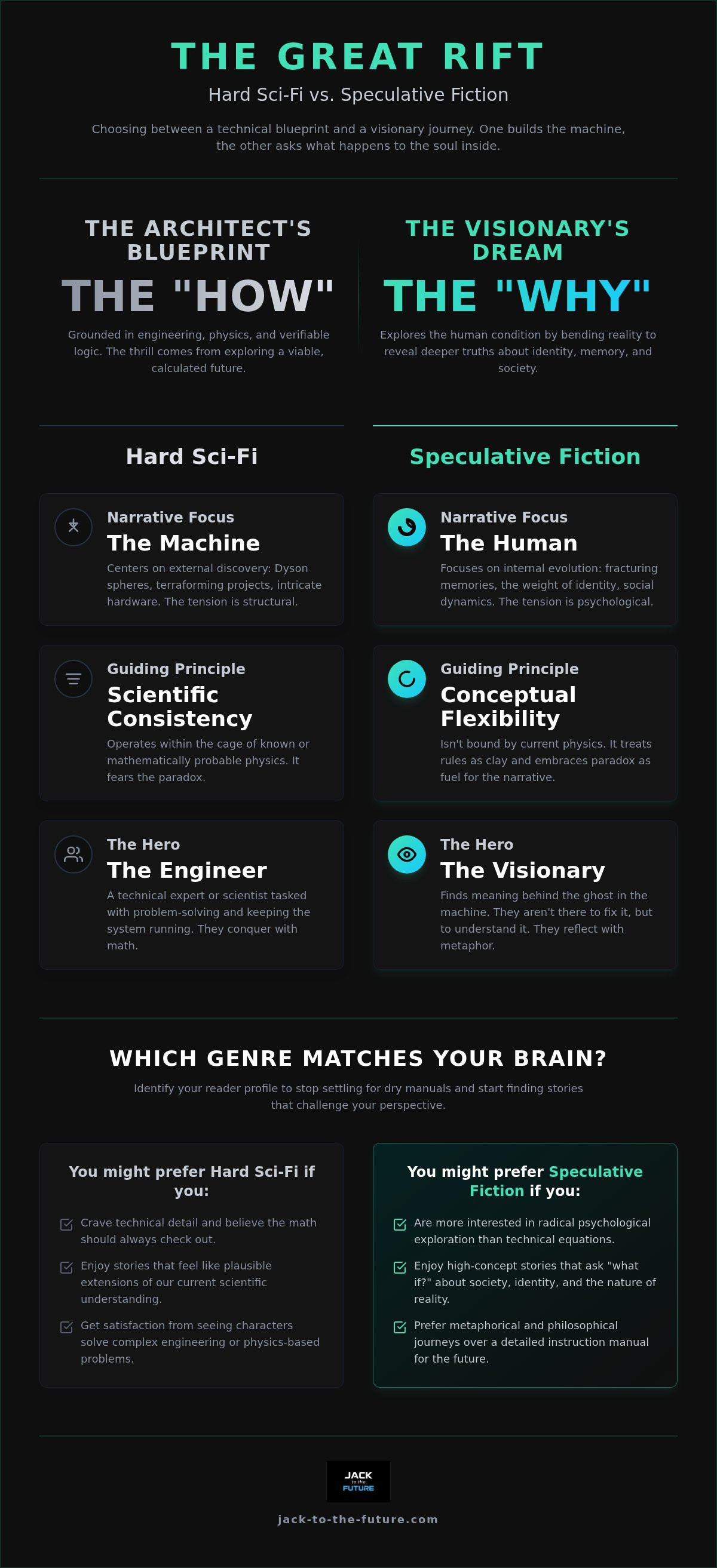
Rigorous equations or radical imaginations? It’s a choice between the map and the territory. When dissecting the DNA of speculative fiction vs hard sci-fi, you’re looking at two entirely different ways of processing reality. One is built on the cold, exacting logic of the laboratory. The other is forged in the heat of a high-concept fever dream. Both seek the unknown, but they use different tools to survive the journey.
Hard sci-fi demands scientific consistency. It lives within the cage of the known... or the mathematically probable. If a starship jumps across a galaxy, the reader expects a white paper's worth of physics to justify the leap. Speculative fiction chooses conceptual flexibility. It isn't bound by the current frontier of physics. It asks what happens when the rules simply cease to exist. Understanding the trade-offs in speculative fiction vs hard sci-fi helps you avoid the "dry" read trap and find stories that actually move the needle.
This fundamental shift changes the nature of the hero. In hard sci-fi, you follow the scientist... the engineer... the technical expert. They are the problem-solvers tasked with keeping the engine running. In speculative fiction, you walk with the visionary. They aren't there to fix the machine; they're there to find the meaning behind the ghost in it. One uses math to conquer the impossible. The other uses metaphor to reflect it back at the reader.
The Focus of the Narrative
Hard sci-fi centers on the 'machine'. It is the external discovery... the Dyson sphere... the intricate terraforming project. The tension is structural; will the hardware hold under the pressure of the void? Speculative fiction centers on the 'man'. It is the internal evolution... the fracturing of memory... the heavy weight of identity. One keeps you up at night questioning the logic of the universe. The other keeps you awake questioning the mystery of your own soul. It’s the difference between a manual and a manifesto.
Adherence to Known Laws
Hard sci-fi fears the paradox. To the technical mind, a paradox is a glitch, a failure in the system that must be resolved or avoided. Speculative fiction embraces the paradox. It uses it as fuel for the narrative fire. By moving beyond the frontier of what we currently know, authors can explore psychological territories that aren't yet mapped. This is why speculative sci-fi ebooks are the defining literary frontier of 2026. They don't just predict the future. They reimagine the nature of existence itself. If you're tired of blueprints and ready for a vision, exploring these high-concept boundaries is the next logical step in your journey.
The 'Soft' Science Myth: Why Speculative Fiction Hits Harder
The term "soft" is a dangerous misnomer. It implies a lack of rigor... a narrative foundation built on shifting sands rather than solid rock. In the debate of speculative fiction vs hard sci-fi, the assumption is often that less math equals less intellectual weight. This couldn't be further from the truth. While hard sci-fi calculates the external trajectory of a starship, speculative fiction explores the internal trajectory of the soul. It isn't a retreat from complexity; it’s an evolution into the psychological and sociological territories that equations simply cannot map.
Technical data can often feel hollow. You might understand the exact atmospheric composition of a distant moon, but without the human element, the discovery is just a spreadsheet. Speculative fiction fills this gap. It requires a specific kind of intellectual courage to look into the speculative abyss. It forces us to confront the fragility of memory and the shifting nature of identity. By prioritizing depth over data, these stories hit harder because they ground the extraordinary in our own lived experience. They don't just explain the future; they make you feel it.
Cerebral Exploration vs. Technical Data
Readers are increasingly hungry for deeper meaning. In a world saturated with information, the "how" of the future has become less interesting than the "why." Philosophical science fiction has fundamentally altered our modern perception of time. It moves beyond the hardware to examine how radical change affects our collective psyche. Speculative fiction is a psychological mirror for the 21st century, reflecting our anxieties and our potential back at us in high-definition. It’s about the weight of the journey... the cost of the discovery... and the evolution of the mind through the unknown.
The Power of the 'Retelling'
The retelling is a masterclass in speculative power. By reimagining familiar structures, authors can reveal extraordinary truths hidden in plain sight. They deconstruct classic stories to expose the visionary potential beneath the surface. Authors like Jack Felson use this technique to bridge the gap between the known and the unknown. There is a unique thrill in seeing a Wizard of Oz through a time-travel lens. It deconstructs a childhood staple to explore complex themes of causality and fate. This approach proves that speculative fiction doesn't need a blueprint to be profound; it only needs a vision that dares to reimagine the familiar.
Navigating the Multiverse: Which Genre Matches Your Brain?
Finding your frequency is an act of intellectual honesty. In the ongoing clash of speculative fiction vs hard sci-fi, your preference reveals how you process the unknown. Do you crave the solid weight of a blueprint... or the electric thrill of a paradox? This isn't just about what you read. It's about how you want to feel when the lights go out. The digital landscape has become the home of the 'speculative rebellion'. Free from the constraints of traditional publishing, high-concept narratives are flourishing in digital formats, allowing readers to bypass the gatekeepers of the "standard" genre.
The 'Technical Reader' profile is one of precision. You want to see the math. You want to know that the propulsion system follows the laws of thermodynamics. For you, the future is an engineering problem waiting to be solved. Contrast this with the 'Visionary Reader'. You aren't looking for a manual; you're looking for the best indie sci-fi ebooks that push the boundaries of human experience. You want high-concept thrills that leave the blueprints behind to explore the psychological impact of the impossible.
Signs You Crave Hard Sci-Fi
You know you’re a technical reader when the appendix is your favorite part of the book. You get frustrated by technology that "just works" without a scientific explanation. You’re here for the logic. You want a front-row seat to where NASA might be in 100 years... grounded in the possible. The machine is the star of the show. If a story breaks a law of physics without a three-page justification, you're out. You crave the thrill of the 'verifiable' future.
Signs You Are a Speculative Soul
You are a speculative soul if you prefer 'what if' to 'how to'. You don't care about the fuel cells; you care about the identity of the pilot and the memory of the world they left behind. You find beauty in non-linear time and mind-bending paradoxes. You are likely searching for books like The Time Machine that challenge your fundamental reality rather than just explaining it. If the mystery is more compelling than the mechanic, your heart belongs to the speculative.
Choosing between speculative fiction vs hard sci-fi isn't about right or wrong. It's about finding the story that speaks to your soul. If you're ready to leave the technical diagrams behind and explore the visionary edge of time travel, dive into the high-concept world of Jack to the Future and start your next journey today.
Beyond the Horizon: Jack Felson’s Visionary Narratives
Jack to the Future doesn't just observe the divide between speculative fiction vs hard sci-fi. It bridges it. By blending a speculative heart with a cinematic pulse, Jack Felson creates narratives that feel both grounded and infinite. This is where the machine meets the dream. In 2026, the demand for stories that prioritize intellectual exploration over technical manuals has never been higher. We provide a space for the bold reader who wants to explore the fringes of reality without getting bogged down in a physics lecture.
Independent speculative fiction ebooks offer a purer vision than mainstream publishing. Large houses often play it safe, sticking to established tropes or dry, technical formulas that lack a soul. The "speculative rebellion" is about reclaiming the narrative. It’s about supporting authors who aren't afraid to reimagine the familiar or explore the psychological weight of a high-concept premise. Your next cerebral journey shouldn't be buried under layers of corporate editing. It should be raw, visionary, and immediate.
The Philosophy of Charlie’s Trips
Charlie’s Trips is the flagship of this vision. It treats time travel not as a science to be solved, but as a visceral experience to be survived. This is a journey through time that defies easy categorization. By choosing to reimagine a classic adventure for a modern, adult audience, Felson deconstructs our understanding of causality and fate. It is the perfect entry point for fans of the genre who want more than just a blueprint. It’s an invitation to feel the weight of the years and the fracturing of identity that comes with every jump into the unknown.
Join the Speculative Rebellion
Supporting independent authors means choosing the extraordinary over the expected. There is a specific thrill in discovering a voice that dares to be different. The digital-only format is the perfect vehicle for this journey. It offers instant access to the unknown... no shipping delays, no physical clutter, just a direct connection to a visionary mind. For the explorer on the move, these ebooks are a curated gateway to another reality. They are designed for those who value the "vibe" and the intellectual discovery above all else.
The choice between speculative fiction vs hard sci-fi is finally yours to make. If you’re ready to move beyond the technical horizon and embrace a story that speaks to your soul, the journey starts now. Explore the speculative world of Jack Felson and download your next adventure today.
Step Into Your Next Reality
The divide between speculative fiction vs hard sci-fi is more than just a matter of technicality. It is a choice of perspective. You've discovered how hard sci-fi builds the sturdy framework of the future through rigorous logic, while speculative fiction explores the visceral impact of that future on the human spirit. Whether you crave the exacting blueprints of a Dyson sphere or the haunting echoes of a time-travel paradox, the goal remains the same. You are looking for a reality that resonates with your unique intellectual frequency.
Jack Felson’s bold indie vision offers high-concept, cerebral narratives for adults who are ready to move beyond the manual. These stories don't just predict what's coming; they reimagine what it means to be human in the face of the impossible. With an instant digital download of Charlie's Trips, your next journey through the fragments of memory and identity is only a click away. Stop settling for dry equations and start exploring the visionary edge of the unknown. Explore the speculative world of Jack Felson and download your next adventure today.
The machine is ready. The dream is waiting. It’s time to find the science fiction that speaks to your soul.
Frequently Asked Questions
What is the difference between speculative fiction and science fiction?
Speculative fiction is the broader umbrella. It encompasses everything from alternate history to dystopian futures. Science fiction is a sub-genre that specifically relies on scientific principles. While all sci-fi is speculative... not all speculative fiction is sci-fi. It’s about the "what if" versus the "how to". Speculative stories often prioritize the psychological impact of a premise over the technical mechanics of the world. It’s a journey into the unknown.
Is hard science fiction better than speculative fiction?
Neither is objectively superior; they serve different cognitive needs. Hard sci-fi satisfies the craving for technical logic and verifiable physics. Speculative fiction offers a more cerebral journey into identity and the human condition. The choice between speculative fiction vs hard sci-fi depends on whether you want a physics lecture or a visionary experience. Many readers find speculative narratives hit harder because they focus on the "why" rather than just the "how".
Can a book be both hard sci-fi and speculative fiction?
Yes, the lines often blur in high-concept literature. A story can use rigorous scientific principles to ground a radical, visionary premise. This hybrid approach provides the technical satisfaction of hard sci-fi with the emotional depth of speculative fiction. It creates a cinematic pulse where the hardware is as detailed as the psychology. These stories are rare but offer the most complete intellectual exploration for bold readers who refuse to settle for one extreme.
Why is speculative fiction so popular in 2026?
Readers in 2026 are moving beyond information toward meaning. In an age of rapid technological shifts, we no longer need books to explain how things work; we need them to explain how things feel. Speculative fiction acts as a psychological mirror. It helps us navigate modern time perception and the fracturing of identity. People are seeking speculative fiction ebooks that offer a vision of the future that is both bold and emotionally resonant.
What are some examples of speculative fiction ebooks for beginners?
Begin with stories that reimagine the familiar. High-concept time-travel retellings are a perfect entry point. Look for titles that prioritize the journey over the blueprint. Charlie’s Trips by Jack Felson is an ideal start for those seeking visionary narratives for adults. Other options include digital works that explore alternate realities or psychological shifts in the near future. These ebooks provide instant access to uncharted territories without the barrier of dense technical jargon or physical clutter.
Is time travel considered hard sci-fi or speculative fiction?
It depends on the execution of the narrative. When debating speculative fiction vs hard sci-fi, look at the focus. If the story centers on quantum mechanics, it leans toward the hard side. However, most time-travel adventures are speculative. They explore causality, fate, and memory. Speculative time travel focuses on the visceral experience of the traveler rather than the machine. It treats time as a landscape for internal evolution and personal discovery.
Why should I choose indie speculative fiction over mainstream sci-fi?
Indie publishing offers a purer, more rebellious vision. Mainstream publishers often play it safe, sticking to established tropes and dry formulas that lack a soul. Indie authors like Jack Felson have the freedom to be visionary. They can deconstruct classic stories and explore the fringes of reality without corporate gatekeepers. Choosing indie means supporting bold innovators who prioritize high-concept thrills and intellectual curiosity. It is about finding a voice that dares to be different.
What makes Jack Felson's books different from standard sci-fi?
Jack Felson bridges the gap between the known and the unknown. His work doesn't just observe the world; it reimagines it with a cinematic pulse. While standard sci-fi might get lost in the hardware, Felson focuses on the "what if" of the human soul. His books, like Charlie's Trips, are masterclasses in time-travel retelling... offering a cerebral, adult experience. They provide instant digital access to stories that are both mentally stimulating and emotionally resonant.
0 comments