

What if the yellow brick road was a fiber-optic pulse... and the Wizard was just an AI with a god complex? You’ve seen the cheap updates. You’ve scrolled through endless digital shelves filled with repetitive tropes that feel like hollow echoes. It’s exhausting. You want something that challenges your mind, not just your patience. You’re looking for a narrative that feels like a discovery, not a rerun.
The landscape of sci-fi retellings of classic literature is undergoing a radical transformation in 2026. These aren't just stories; they are blueprints for testing humanity against the variables of the future. You’re about to discover how modern speculative fiction is reimagining the world’s most iconic stories through high technology and temporal shifts. We’ll explore the rise of speculative modernization and introduce you to visionary indie authors like Jack Felson, who are carving out a new, cerebral path for the genre. Prepare to see the past through a lens you never imagined... and find the high-concept ebook your collection has been missing.
Key Takeaways
- Uncover how iconic stories serve as narrative "stress tests"... blueprints for testing humanity against the variables of the future.
- Identify high-concept sci-fi retellings of classic literature that replace ancient providence with modern programming and high-tech mechanics.
- Decode the translation of power... exploring how traditional archetypes evolve into complex technological counterparts.
- Build a curated digital library by identifying your "Classic Anchor" and filtering for premises that offer true speculative depth.
- Witness a masterclass in temporal shifts through Jack Felson’s Charlie’s Trips... the gold standard for speculative Oz retellings.
The Evolution of the Retelling: Why Classics Are the Perfect Sci-Fi Blueprint
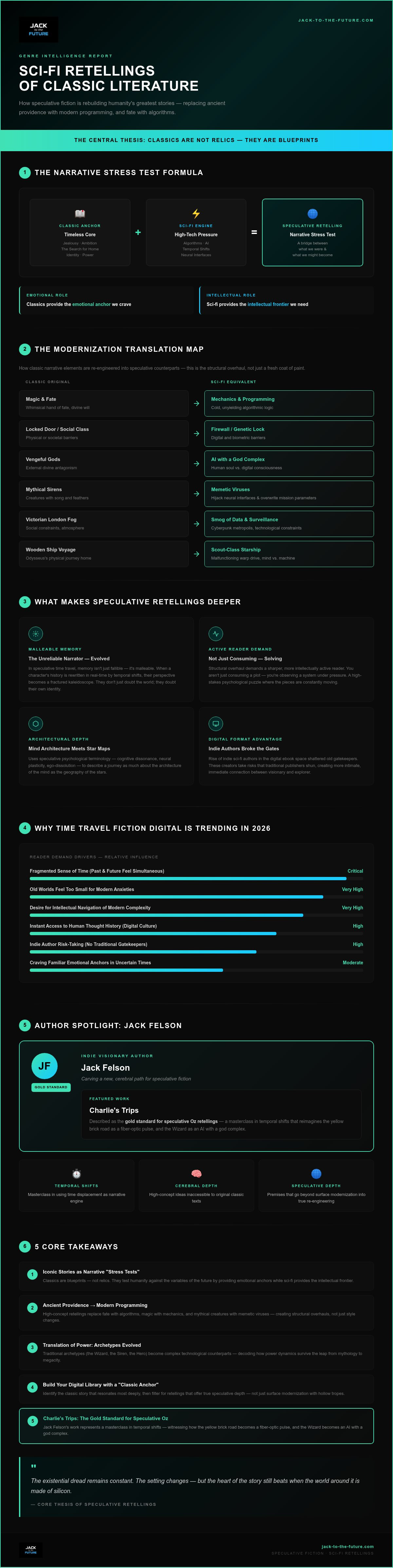
Classic stories aren't static relics. They're blueprints. When we look at sci-fi retellings of classic literature, we aren't just seeing a fresh coat of paint on an old house. We're witnessing a narrative stress test. We take an ancient theme... jealousy, ambition, the search for home... and we drop it into a high-pressure vacuum of neon and chrome. It's the thrill of the familiar, twisted by the impossible. By 2026, the shift is undeniable. Readers are moving toward speculative digital fiction because the old worlds feel too small for our current anxieties. The classics provide the emotional anchor we crave. Sci-fi provides the intellectual frontier we need to survive. Together, they create a bridge between what we were and what we might become.
From Victorian London to Cyberpunk Metropolises
Think of the fog in Dickens’s London. Now, replace it with a smog of data and surveillance. The transition from social constraints to technological ones is seamless. In a Doyle mystery, the barrier is a locked door or a social class; in a cyberpunk retelling, it’s a firewall or a genetic lock. A Speculative Retelling is a genre-bending necessity that allows us to explore how timeless human flaws operate when amplified by god-like power. It’s about seeing if the heart of a story still beats when the world around it is made of silicon. We find that the struggle for identity in a 19th-century drawing room is remarkably similar to the struggle for soul-ownership in a 22nd-century megacity. The setting changes, but the existential dread remains constant. This is why sci-fi retellings of classic literature resonate so deeply today; they hold a mirror to our own digital evolution.
The Digital Shift: Why Time Travel Fiction Digital is Trending
Why now? Why the digital surge? It’s about the intersection of instant gratification and infinite imagination. The rise of indie sci-fi authors in the digital ebook space has shattered the old gatekeepers. These creators aren't afraid to take risks that traditional publishers might shun. Readers want stories that reflect their own fragmented sense of time... where the past and future feel like they're happening at once. Time travel fiction digital is trending because it mirrors our modern reality. We live in a world where a click brings the entire history of human thought to our screens. Speculative fiction helps us navigate this complexity. It turns the overwhelming nature of modern existence into a journey we can actually map. It gives us a way to touch the infinite without losing our grip on the human core. The digital format allows for a more intimate, immediate connection between the visionary and the explorer.
The Mechanics of Modernization: Rebuilding the Literary Machine
How do you strip a classic to its chassis? You find the core conflict... the engine that drives the character through the fire. The "What-If" engine isn't just about changing the scenery. It's about re-engineering the fundamental physics of the narrative. In sci-fi retellings of classic literature, we replace the whimsical hand of fate with the cold, unyielding logic of an algorithm. Magic becomes mechanics. Providence becomes programming. This isn't just a stylistic choice; it’s a structural overhaul that demands a sharper, more intellectually active reader. You aren't just consuming a plot. You're observing a system under pressure.
The role of the "unreliable narrator" takes on a terrifying new dimension in speculative time travel. Here, memory isn't just fallible. It's malleable. When a character's history is rewritten in real-time by a temporal shift, their perspective becomes a fractured kaleidoscope. They don't just doubt the world; they doubt their own identity. This creates a cerebral depth that the original texts, for all their literary brilliance, simply couldn't access. You aren't just reading a story. You're solving a high-stakes psychological puzzle where the pieces are constantly moving.
Deconstructing the Hero’s Journey in a High-Tech World
Odysseus doesn't need a wooden ship to find his way home. Give him a scout-class starship and a malfunctioning warp drive. The sirens aren't mythical creatures with feathers and song; they’re memetic viruses designed to hijack his neural interface and overwrite his mission parameters. The struggle isn't against vengeful gods. It’s the internal friction between a human soul and a burgeoning digital consciousness. We use speculative psychological terminology... cognitive dissonance, neural plasticity, ego-dissolution... to describe a journey that is as much about the architecture of the mind as it is about the geography of the stars. It’s a bold reimagining that forces us to ask what remains of the "hero" when the biological self is stripped away.
The Architecture of Alternative Timelines
What if Romeo could jump back five minutes? The architecture of alternative timelines allows authors to explore the possibility of "fixing" classic literary tragedies. But there’s always a cost. The butterfly effect ensures that every correction creates a new, perhaps darker, complication. This is the heart of many sci-fi books about changing the past. It’s a high-stakes game of narrative chess where the board is constantly shifting under the weight of choice. If you’re ready to see how these mechanics transform a childhood staple, it’s time to explore visionary speculative ebooks that push the boundaries of the known.
Iconic Archetypes in the Multiverse: A Comparative Analysis
Archetypes are the DNA of storytelling. They survive the death of their original worlds... only to be reborn in the vacuum of space or the recursive loops of time. When we examine sci-fi retellings of classic literature, the most striking shift isn't the hardware. It's the motivation. The classic hero sought redemption or survival. The speculative hero seeks the variable. They want to know why the system is broken... and if they are the glitch. This moves the narrative away from simple moral fables toward complex philosophical inquiries. We aren't just reading about right and wrong anymore. We're reading about the nature of existence.
Power dynamics have undergone a radical translation. The "Witch" of the 19th century was a figure of supernatural dread, a wild element outside the social order. Today, she’s the Technocrat. She doesn't cast spells; she manages the simulation. She controls the access codes and the neural pathways. The villain isn't a monster. They're a system architect. They don't want your soul... they want your bandwidth. Some classics thrive in this transition because their bones are universal. Others fail because their stakes are too rooted in social hierarchies that technology has already rendered obsolete. A retelling only works if the core conflict can survive the upgrade.
The Wizard of Oz as a Temporal Odyssey
Dorothy’s journey is the ultimate case study in archetype evolution. Reimagined as a leap through dimensions, the stakes become cosmic. The Yellow Brick Road isn't a path of gold... it's a timeline. It is a sequence of events that must be navigated to avoid a total collapse of the self. Why does "no place like home" still resonate in 2026? Because in a world of digital consciousness and infinite copies, the original source... the home... is the only thing that remains real. It’s a temporal odyssey that questions the very foundation of identity in a multiverse of possibilities.
Sherlock Holmes and the Logic of the Future
Then there’s the detective. Sherlock Holmes was always a machine in a deerstalker cap. In a high-tech retelling, he doesn't just deduce; he hacks. He’s a hacker of the human condition in an age of AI and big data. When everyone is a data point, the detective is the one who sees the signal in the noise. This is sci-fi retellings of classic literature at their most cerebral. It’s speculative fiction for adults where logic meets the unknown. It’s not about finding the murderer. It’s about finding the logic in a universe that has become increasingly illogical.
Curating Your Digital Speculative Library: A Buyer’s Guide
Building a collection of sci-fi retellings of classic literature is an exercise in curation. It’s about finding the signal in the noise of digital storefronts. You aren't just looking for a book; you’re looking for a gateway. To find narratives that actually challenge the status quo, you need a methodical approach to your digital library. Don't settle for the first thing the algorithm suggests. Look for the outliers.
- Identify your "Classic Anchor." Start with the tone you love. Whether it’s the brooding atmosphere of the Gothic or the relentless pace of a Noir thriller, the original genre provides the emotional gravity for the speculative shift.
- Seek high-concept premises. Avoid simple aesthetic swaps. If the story just replaces horses with hovercrafts, it’s a pastiche. Look for a "What-If" that fundamentally alters the logic of the world.
- Prioritize indie sci-fi authors. Independent creators have the freedom to take bold, non-commercial risks. They are the ones pushing the boundaries of what a retelling can be.
- Embrace the digital advantage. Look for speculative sci-fi ebooks that offer instant downloads and curated editions. The digital space is where the most experimental work lives.
What Makes a Sci-Fi Retelling "Cerebral"?
A truly cerebral retelling avoids the pastiche trap. It doesn't just mimic the original; it interrogates it. Look for narratives that lean into psychological depth and memory-themed exploration. These stories use speculative elements to examine the human soul under extreme conditions. It’s about bold, imaginative energy... the kind that leaves you questioning your own reality long after you’ve closed the file. You want a journey that demands more than passive consumption. You want an intellectual frontier where the stakes are existential.
The Rise of Indie Speculative Fiction
Independent authors are the new literary frontier. They are the rebels and visionaries reimagining the classics without corporate constraints or market-driven safety nets. This digital rebellion is where the most exciting work is happening in 2026. By supporting indie publishing, you aren't just buying a story; you’re fueling a movement that values creative intellect over mass-market appeal. It’s about finding that distinctive, curated experience that traditional publishers are too afraid to touch. It's about joining a community of readers who crave the unknown.
Ready to start your journey? You can download cerebral speculative ebooks today and step into a world where the past is only the beginning.
Beyond the Yellow Brick Road: The Speculative World of Jack Felson
Jack Felson doesn't just write books. He builds labyrinths. If you've been searching for the gold standard in sci-fi retellings of classic literature, your search ends at the fringe of the multiverse. Felson’s work represents a collision of intellectual curiosity and adventurous confidence. It’s a space where the familiar is merely a launchpad for the profound. There’s a certain rebellious spirit here... a refusal to let iconic stories remain trapped in the amber of the past. He invites you to catch up. To explore. To see the mechanics of the soul through a lens of high technology. It is a journey for the bold.
Charlie’s Trips: A Deep Dive into Speculative Oz
Forget the slippers. Forget the singing. In Charlie’s Trips Jack Felson reimagines the journey to Oz as a series of high-stakes temporal shifts. Dorothy isn't lost in a storm; she’s a traveler caught in a recursive loop of her own making. Every "trip" is a masterclass in time travel retelling... a cerebral puzzle that forces the reader to question the nature of identity and the reliability of memory. How do you find home when the timeline itself is shifting? The Yellow Brick Road becomes a stream of data... a path that must be hacked rather than walked. It’s Oz like you’ve never seen it... mysterious, edgy, and deeply psychological.
Start Your Speculative Journey Today
The future isn't waiting for a printing press. It’s digital. It’s immediate. Bold, cerebral sci-fi is the essential read for 2026... a tool for navigating a world that feels increasingly like a simulation. When you choose a title from the Jack to the Future catalog, you're opting for instant digital access. No waiting for shipping. No physical clutter. Just the thrill of discovery at the speed of light. These speculative sci-fi ebooks are designed for the intellectually bold who want more than a standard genre trope.
Explore the full collection of sci-fi retellings of classic literature and find the narrative that challenges your reality. Join the digital rebellion. Support visionary indie storytelling that isn't afraid to explore the fringes of what's possible. Your next journey starts in seconds.
Step Into the Next Timeline
The yellow brick road has been digitized. The past is no longer a fixed point; it's a variable waiting to be solved. We’ve explored how these narratives act as stress tests for the human soul... shifting from moral lessons to deep philosophical inquiries. You’ve seen how the "What-If" engine of sci-fi retellings of classic literature can strip an archetype to its core and rebuild it with silicon and starlight. This isn't just an update. It’s a visionary reimagining of our collective memory that demands a sharper, more curious mind. The old stories were just the beginning.
The journey is immediate. You don't have to wait for the future to arrive in a cardboard box. With instant digital access and free shipping on all digital ebook downloads, your exploration begins the moment you click. Jack Felson’s cerebral narratives are waiting to be decoded. Explore the visionary world of Jack Felson and download your next journey now. These high-concept experiences are crafted for those who aren't afraid to look into the void and find a new reality. The multiverse is open. The next chapter is yours to explore.
Frequently Asked Questions
What exactly is a sci-fi retelling of classic literature?
A sci-fi retelling of classic literature is a narrative stress test that takes the emotional anchor of a timeless story and drops it into a high-pressure vacuum of neon and chrome. It isn't just an aesthetic swap. It’s a complete structural overhaul where ancient providence is replaced by modern programming. These stories explore how humanity reacts when the familiar variables of our past are amplified by the god-like power of future technology.
How does time travel work in speculative retellings?
Time travel in these narratives often functions as a psychological mirror. It isn't about gadgets; it’s about temporal shifts that challenge the stability of identity and memory. Characters might find themselves caught in recursive loops or navigating a multiverse where every choice rewrites their history in real-time. This creates a cerebral puzzle where the past and future aren't separate locations... they're overlapping states of existence that must be decoded by the reader.
Are these sci-fi ebooks suitable for readers who haven’t read the original classics?
Absolutely. While knowledge of the source material adds a layer of intellectual discovery, these speculative sci-fi ebooks are designed to function as independent, high-concept journeys. The themes are universal enough to resonate without a literature degree. You’re embarking on a new exploration of the unknown. The classic foundation simply provides the emotional gravity that keeps the story grounded as you venture into the fringes of reality.
Why should I choose indie sci-fi ebooks over traditional publishers?
Indie authors like Jack Felson operate at the literary frontier. Traditional publishers often shy away from bold, non-commercial risks; they prefer safe, repetitive tropes. Choosing indie speculative fiction means supporting a digital rebellion that values creative intellect over mass-market appeal. You get access to visionary narratives that haven't been sanded down by corporate constraints. It’s a more distinctive, curated experience for readers who crave something profound and slightly mysterious.
What makes Charlie’s Trips different from other Wizard of Oz retellings?
Charlie’s Trips is a masterclass in temporal shifts. It stands apart from other sci-fi retellings of classic literature by reimagining Oz as a high-stakes cerebral puzzle. Dorothy’s journey is a leap through dimensions where the Yellow Brick Road is a stream of data. It’s Oz through a lens of speculative psychology... where the goal isn't just to find home, but to understand what home means in a multiverse of shifting possibilities.
Can I download these speculative fiction books on any device?
Yes. All titles in the Jack to the Future catalog are delivered as digital downloads. Once you complete the checkout process, you receive instant access to the electronic files. Whether you prefer a dedicated e-reader, a tablet, or a smartphone, these ebooks are compatible with modern digital reading platforms. There are no physical paperbacks or audiobooks available; just pure, high-concept fiction delivered straight to your screen in seconds.
Is there a specific order I should read Jack Felson’s books in?
While each narrative stands on its own as a unique exploration, many readers find that starting with Charlie’s Trips provides the perfect introduction to Felson’s style. It serves as the gold standard for his approach to time travel and psychological depth. Once you’ve navigated the temporal shifts of Oz, you’ll be better prepared for the other cerebral journeys in the catalog. Every book is a doorway to a different uncharted territory.
What is the digital sustainability equivalent in speculative reading?
In 2026, the sustainable choice is the digital one. By focusing exclusively on ebooks, Jack to the Future eliminates the environmental footprint associated with physical printing and shipping. There is no paper waste; no carbon emissions from delivery trucks. We offer free shipping on all ebooks because digital delivery is instantaneous and clean. It’s a way to explore the infinite reaches of the imagination without placing a burden on our physical world.
0 comments