

What if the most interesting part of a time-travel story isn’t when it happens, but what the journey changes? Time traveler books can send you into a historical mystery, trap you in a repeating day, or make memory and identity feel as unstable as the timeline itself. With so many styles under one genre label, it can be hard to know where to begin, especially when each story sets its own rules for time.
You don’t need a specialist’s grasp of paradoxes to find your next read. Start with the questions you want a story to explore. Are you after suspense, romance, alternate history, or a more inward journey through regret and consequence? This guide explains common time-travel story structures, what each approach feels like to read, and how to choose one that fits your mood. Jack Felson’s Charlie’s Trips offers one speculative journey shaped by memory and visions of a disastrous future. The timelines may bend, but your reading preferences can be the compass.
Key Takeaways
- Time-travel fiction is shaped by how movement through time changes the story, not by a single set of genre rules.
- Follow the timeline and cause-and-effect rules each book establishes. You don’t need to solve real-world physics to enjoy the journey.
- Compare time traveler books by the experience you want, from historical atmosphere and future-facing adventure to personal reflection and conceptual puzzles.
- Choose your next read by starting with your preferred mood: fast-paced suspense, emotional stakes, or a story that challenges your ideas about time.
- Charlie’s Trips by Jack Felson offers a speculative example that connects a time-travel premise with memory and visions of the future.
What Are Time Traveler Books, and Why Do Their Journeys Stay With Us?
What if one decision could change the past, rewrite the future, or erase the life you know? That possibility gives time traveler books their charge. A character crosses a boundary in time, and suddenly an ordinary choice can carry consequences across decades, generations, or realities.
Time-travel fiction is a story in which a character, consciousness, or event crosses from one time period to another, and that crossing meaningfully shapes what happens. That’s the distinction: a novel set in another era may explore the past, but a time-travel story makes movement through time part of its engine. The journey might drive an adventure, unsettle a relationship, expose a historical turning point, or probe questions of identity and possibility. The Time travel in fiction overview traces how writers have imagined these journeys through devices such as time machines and time slips.
What counts as a time-travel story?
The crossing can happen in different ways. A person might arrive in the past, a mind might awaken in a different period, or an event might send characters into the future. Some stories move between distinct eras; others return to the same stretch of time again and again. Historical fiction generally stays within its chosen period. In time-travel fiction, a boundary between periods is crossed, and that crossing changes the story.
Why do readers return to time traveler books?
Time travel turns familiar questions into live possibilities. Could one changed choice undo a loss? Would you recognize yourself after taking a different path? These stories give regret and consequence a speculative shape, letting readers follow a character toward what might have been or what could still come.
They can also make relationships feel newly uncertain. A shared memory may belong to one person but not another; a reunion might bring a stranger where a loved one used to be. Even affection has to contend with shifting circumstances. The emotional stakes don’t depend on mastering a timeline. They come from watching people try to hold on to one another while the context around them changes.
Time travel can also make a familiar world seem strange. A known place may become a vanished landscape or an unrecognizable future. That shift creates distance, but it can also sharpen your view of the present: what lasts, what disappears, and which choices shape the world we inherit. The blend of recognition and dislocation is part of the genre’s lasting pull.
How Time-Travel Stories Build Their Rules, Timelines, and Consequences
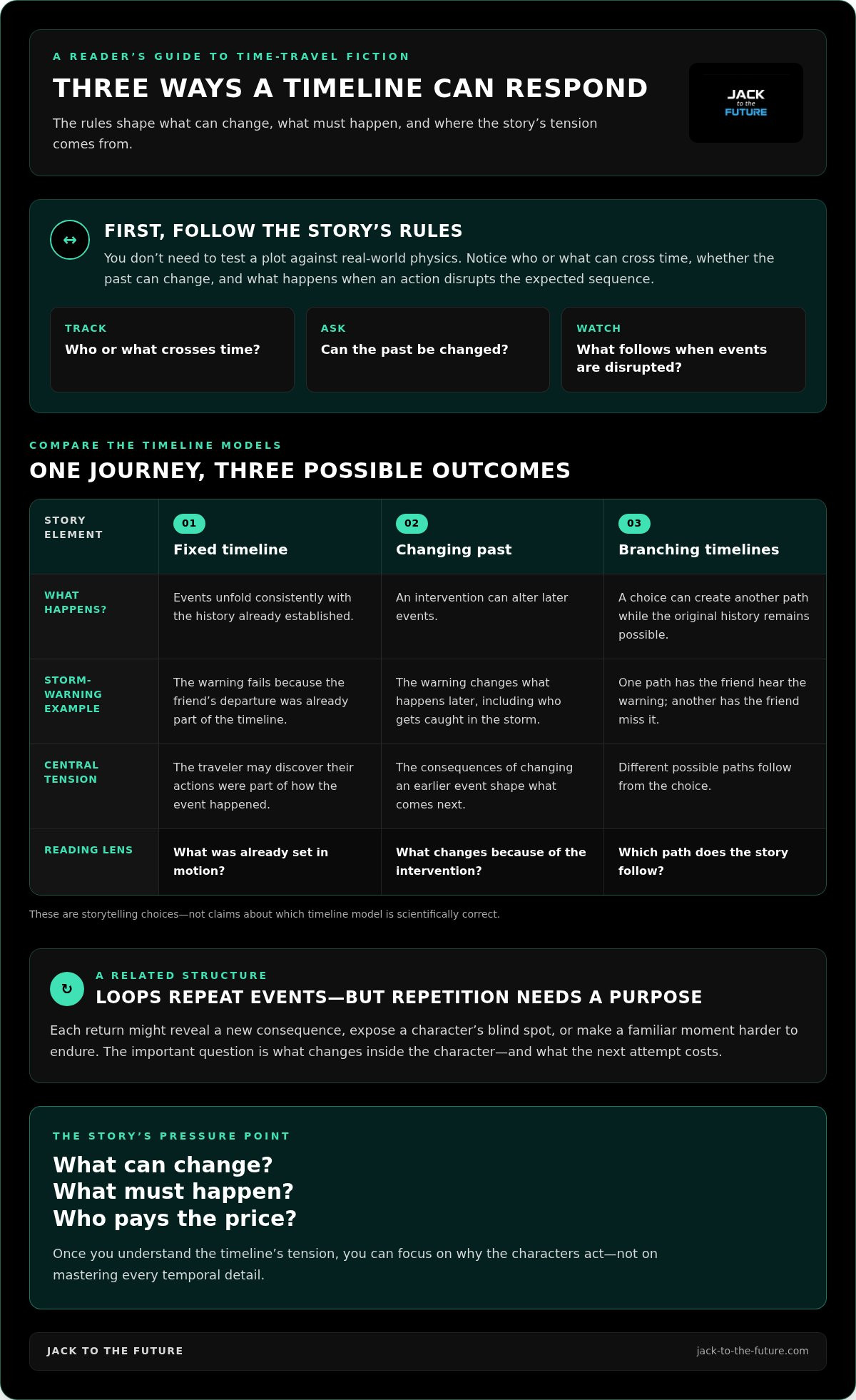
A time-travel story asks you to accept an imaginative premise, then follow what it makes possible. You don’t need to test the plot against real-world physics. Instead, notice the rules the story establishes: who or what can cross time, whether the past can change, and what happens when an action disrupts the expected sequence.
That sequence is shaped by causality, the relationship between events and their effects. In an everyday chain, a choice leads to an outcome. In a time-travel narrative, the chain can twist: an event in the future may influence an earlier decision, or a visitor’s action in the past may alter what comes later. Following those connections helps you keep track of the plot without needing a diagram.
Fixed timelines, changing pasts, and branching possibilities
Different stories set different conditions. In a fixed timeline, events unfold consistently with the history already established. A traveler might try to prevent an event, only to discover that their actions were part of how it happened. In a changing-past story, an intervention can alter later events. In a branching-timeline story, a choice may create another path while the original history remains possible.
Imagine someone traveling back to warn a friend about a storm. In one story, the warning might fail because the friend’s departure is already part of the timeline. In another, the warning might change who gets caught in the storm. A third story could split into one path where the warning is heard and another where it isn’t. These are storytelling choices, not claims about which model is scientifically correct.
A story’s timeline rules create its central tension: what can change, what must happen, and who pays the price? Once you understand that tension, you can focus on why the characters act instead of worrying about whether you’ve mastered every temporal detail.
Paradoxes, loops, and the human stakes
A paradox is a conflict in the story’s cause and effect. Suppose a traveler prevents the event that originally prompted them to travel back. If that event never happens, what sent them on the journey? The contradiction can become a puzzle, a source of danger, or a pressure point that forces a character to choose.
A loop repeats a sequence, but repetition needs a purpose. Each return might reveal a new consequence, expose a character’s blind spot, or make a familiar moment harder to endure. The mechanics can stay simple. What matters is what changes inside the character and what the next attempt costs.
That focus on choice and consequence is part of the genre’s deeper appeal. A Lindenwood University thesis discusses the time traveler as a figure in a search for redemption, a useful lens for stories where revisiting time means confronting an earlier self. For a speculative example shaped by memory and visions of the future, explore Jack Felson’s time-travel adventure ebooks, including Charlie’s Trips.
Which Time-Travel Book Style Fits Your Reading Mood?
Time travel can lead to very different reading experiences. One story races through a dangerous mission; another lingers over a character’s changing sense of self. Treat the premise as a clue to the book’s mood, not a guarantee that every story in a category will follow the same pattern.
| Narrative approach | Reader mood | Likely appeal |
|---|---|---|
| Historical encounters | You want atmosphere and a vivid sense of another era. | A character’s arrival in the past creates contrasts between their expectations and the customs, people, or events they encounter. |
| Future-facing journeys | You’re curious about what may come next. | New societies and changed landscapes let you explore how the familiar world might transform. |
| Altered pasts | You enjoy high-stakes choices and “what if?” questions. | A different decision can reshape later events, making the consequences central to the suspense. |
| Personal or philosophical journeys | You prefer character depth and ideas that linger. | Shifts in time can unsettle memory, identity, and loyalty, prompting questions that may not have easy answers. |
Adventure, history, and alternate outcomes
For momentum, look for adventure-led stories where discovery comes with a cost. A character might need to act quickly in an unfamiliar period, with each choice carrying consequences beyond the immediate danger. Historical encounters add the friction of another era: different assumptions, social expectations, and ways of seeing the world. Stories about altered pasts focus on possibility itself. If one choice had gone another way, what else might change?
These approaches often overlap. A journey into the past can become an adventure, while an attempt to change a historical event can turn into a personal reckoning. The labels are useful signals, not rigid shelves.
Character, identity, and philosophical journeys
Some time traveler books use temporal shifts to unsettle a character from within. Memories may no longer match the world around them. Old loyalties can become difficult to trust, and a person may wonder whether they’re still the same after seeing another possible life.
You don’t need technical science to enjoy this kind of story. The speculative premise gives familiar questions a new angle: how much of identity comes from memory, circumstance, or choice? If you like layered meanings and unresolved questions, seek stories that leave room to reflect after the final turn. If you’d rather feel the rush of discovery, choose a faster-moving adventure. If both appeal, look for a story that pairs an urgent journey with a personal cost.
How to Choose Your First or Next Time Traveler Book
Start with the reading experience you want, not with questions about paradoxes or timeline diagrams. Do you want a fast-moving adventure, the atmosphere of another era, an intimate character drama, or a puzzle that keeps turning over in your mind? That preference can quickly narrow a crowded shelf of time traveler books.
1. Choose the mood. For energy and discovery, look for a journey driven by urgent goals and consequential choices. For emotional closeness, seek a character-focused story about relationships, memory, or regret. If you enjoy reflective speculation, choose a premise that raises questions without promising neat answers.
2. Pick the direction. Does the past’s history and atmosphere appeal most? Are you curious about a transformed future? Or would you rather follow a story where a different decision creates another possibility? You don’t have to choose only one. A book can combine historical encounters with adventure, or pair altered outcomes with a personal drama.
3. Read the premise for its human stakes. Look for what the central character wants and why the time journey matters. Are they trying to reach someone, prevent an outcome, or make sense of an unfamiliar life? These details often reveal more about the reading experience than technical terms for the time-travel device.
4. Check the tone and focus. A description emphasizing danger, discovery, and a pressing goal may signal an action-led read. References to memory, identity, or difficult choices suggest a more reflective focus. Notice whether the premise foregrounds events and momentum or the ideas those events bring into question.
For more idea-driven premises, browse this guide to high concept sci-fi ebooks. If cerebral storytelling draws you in, explore the guide to adult speculative fiction for another way to think about what you want from a story.
The best starting point is the story question that most intrigues you. Maybe it’s “What would I do in another era?” Maybe it’s “Can one choice remake a life?” Let that question guide your next pick, and let the story’s own rules unfold as you read. If memory, identity, and visions of the future appeal to you, explore Jack Felson’s time-travel ebook, Charlie’s Trips.
Where Jack Felson’s Time-Travel Adventures Fit in the Genre
Once you’ve found the kind of journey that interests you, a specific title can make the genre’s possibilities feel more immediate. Charlie’s Trips is a time-travel adventure by Jack Felson and one point of entry among the speculative science-fiction ebooks available through his author platform. It’s a place to begin if you’re curious about a time-travel premise, without needing to decide in advance which style of story suits you best.
A time-travel adventure shaped by speculative curiosity
You don’t have to approach every time-travel book as a puzzle to solve. Start with the basic invitation: follow a story that makes time part of its journey. Charlie’s Trips fits that broad category. For more about the book, read Charlie’s Trips and its time-travel retelling.
Think of it as one option for readers exploring time traveler books, not a template for the whole subgenre. Stories under that label can take many directions, and a title’s time-travel category is simply a useful first clue. Your curiosity can do the rest: perhaps you’re drawn to a journey across time, or you want to see how speculative fiction uses that premise to explore what might be possible.
Take your next literary journey
Choose your next read by returning to the question that sparked your interest. Are you most curious about a temporal journey itself, or about the ideas a speculative premise can set in motion? Let that question guide you as you explore Jack Felson’s work. His catalogue features downloadable speculative science-fiction ebooks, with digital access available after checkout.
If you’re ready to explore, Explore Jack Felson’s time-travel ebooks and choose the journey that catches your imagination.
Choose the Time-Bending Story That Calls to You
The best time-travel read isn’t necessarily the one with the most intricate timeline. It’s the one whose central question draws you in. Decide whether you’re craving adventure, historical atmosphere, emotional stakes, or a more reflective journey, then let the premise guide you. The story’s own rules will help you follow its turns; your curiosity can lead the way.
That’s the lasting pull of time traveler books: a shift in time can make choices, memories, and familiar relationships feel newly uncertain. Jack Felson’s catalogue includes Charlie’s Trips and other time-travel adventures, offered as downloadable speculative science-fiction ebooks.
Ready to see where a new premise might take you? Explore Jack Felson’s time-travel ebooks and choose a journey that sparks your imagination. There’s always another possibility just beyond the next turn in time.
Frequently Asked Questions
What are time traveler books?
Time traveler books are fiction in which a person, consciousness, or event crosses from one time period to another and that crossing shapes the story. The journey might reach the past or future, revisit the same stretch of time, or alter what happens next. These stories can focus on adventure, relationships, history, identity, or speculative ideas. A novel set in the past isn’t necessarily time-travel fiction if its characters remain in their own era.
Are time-travel books science fiction?
Time-travel books often fall under science fiction, but the genre can overlap with other kinds of storytelling. A story might combine a temporal journey with romance, historical drama, mystery, or a character-focused literary approach. The time-travel premise is one ingredient, not a guarantee of spaceships, equations, or futuristic technology. To get a sense of a book’s style, look at whether its description emphasizes the journey’s mechanics, its characters, or the emotional and historical consequences.
What is the difference between time travel and alternate history?
Time travel describes movement across time within a story. Alternate history describes a version of history that diverged from the familiar past, often because a key event unfolded differently. The ideas can overlap: a traveler might change a past event and create an alternate outcome. But a story can explore an altered historical path without showing anyone traveling through time. Look for whether crossing time is part of the premise or whether the changed history is simply the world the characters inhabit.
Do I need to understand physics to enjoy time traveler books?
No. You only need to follow the rules the story itself establishes. Notice what the characters can do, whether past events can change, and what consequences follow their choices. Some books explore complex paradoxes, while others keep the temporal premise in the background and focus on relationships or personal change. If a timeline detail feels confusing, ask what the character knows and what their actions affect. That’s often enough to stay oriented.
What is a time loop in a book?
A time loop is a recurring sequence in which a character, event, or period of time happens again. The repetition may be identical at first, or small changes may reveal new information and consequences. The loop’s story purpose matters more than its technical explanation: it might build suspense, expose a character’s habits, or force them to reconsider a choice. As you read, track what repeats and what changes, especially in the character’s understanding or decisions.
How do I choose a time-travel book if I am new to the genre?
Start with the reading mood you want, then use the premise to narrow your choices. Pick adventure if you want momentum, historical encounters for atmosphere, or a character-led story if emotional stakes appeal most. If you enjoy thought-provoking fiction, look for descriptions that foreground choices, identity, or alternate possibilities. You don’t need to learn timeline terminology first. Ask which story question intrigues you, then see whether the book’s description matches that curiosity.
Can time-travel books focus on characters rather than paradoxes?
Yes. A time-travel story can use its premise to explore memory, identity, regret, or relationships instead of making paradoxes the main attraction. A changed timeline might test whether characters still trust each other; a journey into another period might shift someone’s sense of belonging. The time mechanics provide pressure, but the emotional stakes carry the story. If you prefer character-driven fiction, look for descriptions that highlight personal choices and relationships alongside the temporal premise.
0 comments