

What if the most volatile frontier in the universe isn't deep space, but the fragile architecture of your own mind? If you're exhausted by hollow action set pieces and superficial techno-babble masquerading as depth, you aren't alone. Mainstream algorithms keep recycling predictable tropes, leaving analytical readers starving for true conceptual weight. Finding authentic cerebral science fiction books that dismantle reality... that force you to interrogate memory, identity, and the software of human consciousness... shouldn't feel like an impossible search.
You deserve stories that treat your intellect as an accomplice, not a passive spectator. This guide breaks down the essential literary markers that separate cheap spectacle from profound conceptual storytelling, while pointing you directly toward provocative speculative ebooks engineered to challenge your perception. From cognitive paradoxes to bold, visionary indie narratives that dare to rewrite classic conventions, here is your definitive roadmap to the uncharted edges of speculative fiction.
Key Takeaways
- Identify the core literary markers of cerebral science fiction books, distinguishing idea-driven narratives from generic, spectacle-heavy space operas.
- Unpack the four pillars of high-concept storytelling... temporal mechanics, metaphysical allegory, cognitive estrangement, and moral ambiguity.
- Apply a practical comparative matrix to evaluate thematic complexity, structural ingenuity, and narrative pacing before choosing your next read.
- Master analytical reading techniques to anchor shifting timelines and deconstruct psychological defense mechanisms within unreliable narrators.
- Discover how bold indie speculative fiction like Jack Felson's Charlie’s Trips reimagines classic archetypes through high-concept, downloadable ebook narratives.
What Defines Cerebral Science Fiction Books in Modern Speculative Literature?
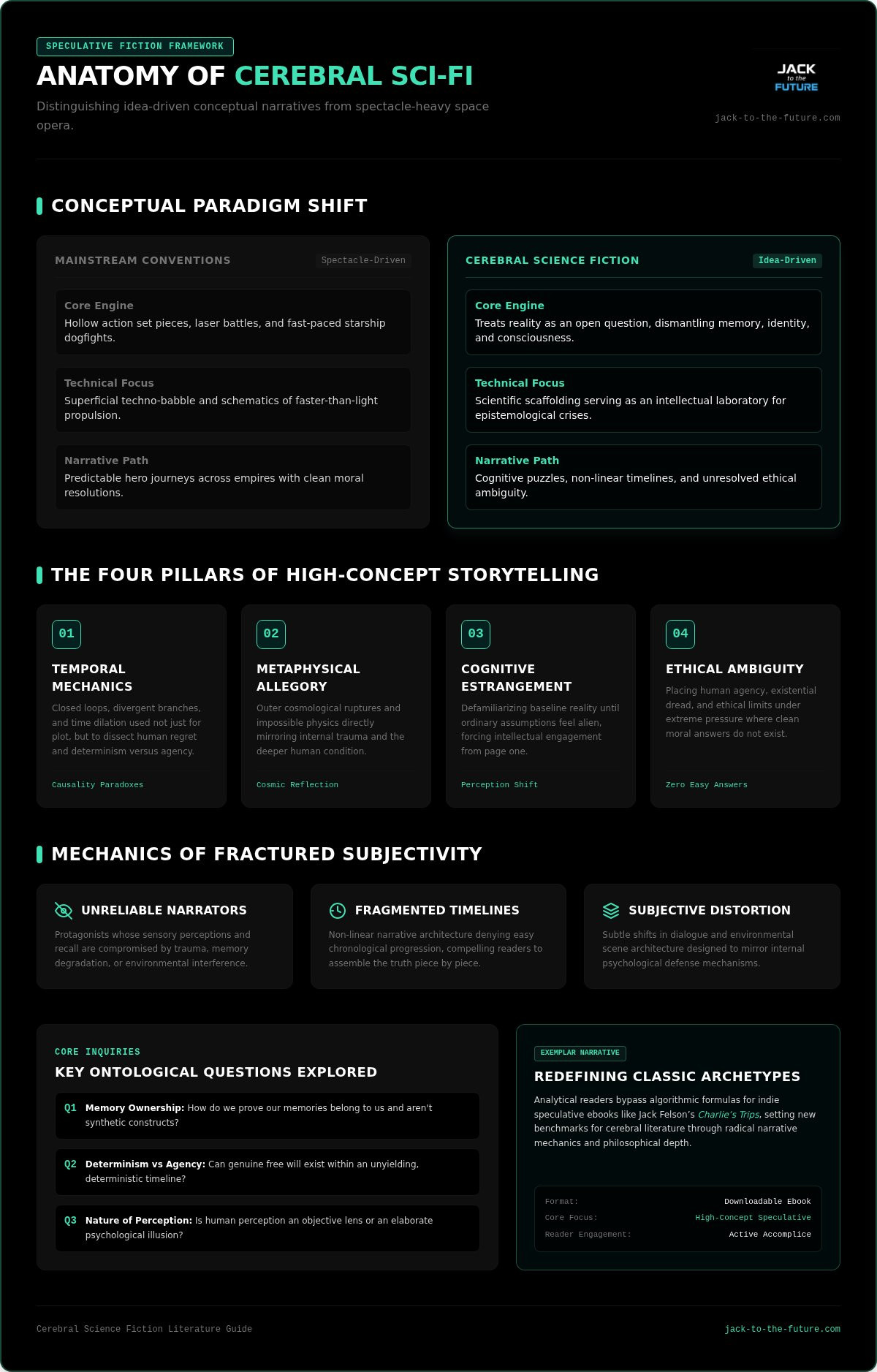
Most readers confuse technical jargon with true intellectual depth. They pick up a space opera, wade through dense schematics of faster-than-light engines, and assume they're reading something profound. It's an illusion. Authentic cerebral science fiction books don't rely on laser battles or endless hardware specs; they treat reality itself as an open question. Instead of asking how a starship fires its thrusters, these stories investigate what happens to human identity when time bends, memory fractures, and baseline truth evaporates.
The genre prioritizes cognitive puzzles over adrenaline. Rather than following predictable hero journeys through galactic empires, intellectual speculative fiction forces the reader to confront radical metaphysical ideas. It challenges ontological assumptions: How do we prove our memories belong to us? Can free will exist within a deterministic timeline? Is perception an objective lens or an elaborate psychological construct? Tired of algorithmic formulas, a growing wave of readers is bypassing mainstream publishers and turning toward independent, boundary-pushing speculative digital literature to find these provocative, rule-breaking answers.
The Philosophical Engine: Concept Over Weaponry
Mechanical tech dates quickly. Philosophical inquiry never does. While traditional hard science fiction emphasizes strict mathematical accuracy and physics, cerebral storytelling uses that scientific scaffolding to explore deeper epistemological crises. The premise serves as an intellectual laboratory... placing human agency, existential dread, and ethical limits under extreme pressure. Writers pushing the boundaries of speculative fiction for adults understand that an audience remembers the cognitive shock of a philosophical paradox long after forgettable starship dogfights fade from memory.
Psychological Realism and Fractured Subjectivity
External cosmological shifts mean nothing without internal emotional resonance. In cerebral literature, outer dimensional ruptures directly mirror internal trauma. You aren't merely observing an alien anomaly; you're trapped inside a mind struggling to synthesize contradictory realities. Writers achieve this psychological realism through distinct narrative mechanics:
- Unreliable Narrators: Protagonists whose perceptions are compromised by trauma, memory degradation, or sensory interference.
- Fragmented Timelines: Structures that deny easy linear progression, forcing the reader to assemble the chronological truth piece by piece.
- Subjective Distortion: Subtle shifts in dialogue and scene architecture that mimic psychological defense mechanisms under duress.
These perception shifts disorient by design. They pull the rug out from under you, demanding total intellectual engagement from the first sentence to the final page.
Core Hallmarks of Mind-Bending Speculative Storytelling
What separates a fleeting page-turner from a story that rewires your thinking? The distinction lies in architectural design. Truly transcendent cerebral science fiction books anchor their narratives around four foundational pillars:
- Temporal Mechanics: Causality paradoxes that turn chronological progression into an interactive logic puzzle.
- Metaphysical Allegory: Cosmological concepts operating as direct mirrors for the human condition.
- Cognitive Estrangement: Defamiliarizing the ordinary until everyday assumptions feel alien and open to debate.
- Ethical Ambiguity: High-stakes dilemmas where clean moral resolutions simply don't exist.
Temporal Mechanics and Causality Paradoxes
Closed loops. Divergent branches. Subjective time dilation. When authors warp time, they aren't just showing off clever plot mechanics; they're dissecting human regret. A character stepping into a past timeline immediately confronts determinism versus agency... can you ever truly rewrite who you were? As explored in the Philosophical Sci Fi Roundup, speculative fiction excels when it uses impossible physics to test real existential boundaries. If you're drawn to narratives that unravel cause and effect, exploring sci-fi books about changing the past reveals how temporal paradoxes force readers to become active investigators, piecing together fragile causal chains.
Mythic Retellings Through a Speculative Lens
Classic myths endure because they map the contours of our deepest anxieties. When a storyteller refracts an ancient archetype through high-concept science fiction, something electric happens. The myth provides the emotional bedrock; the speculative framework delivers the cognitive shock. It's a collision of the familiar and the radically new.
Reimagining timeless journeys through quantum uncertainty or historical crossroads gives old stories fresh, provocative urgency. For readers ready to dive into fearless digital literature that strips away genre clichés, exploring the speculative catalog at Jack to the Future offers immediate access to mind-bending ebooks engineered around these exact mythic, perception-shifting collisions.
How to Choose Your Next Intellectual Journey: A Comparative Framework
Every reader arrives at speculative fiction with a distinct mental appetite. Some want rigorous mechanical systems. Others want subjective puzzles that blur reality. Blindly trusting mass-market bestseller lists rarely satisfies that hunger. Finding the right cerebral science fiction books requires a clear diagnostic framework based on your cognitive mood, rather than commercial popularity scores.
To navigate your options, weigh three core metrics:
- Thematic Complexity: Does the plot examine existential, ethical, or epistemological paradoxes, or does it stop at technical exposition?
- Structural Ingenuity: Does the narrative architecture challenge you with non-linear timelines, fractured perspectives, or subjective distortions?
- Pacing Velocity: Does the prose unfold as an atmospheric, slow-burn psychological study or a dynamic, fast-paced high-concept ride?
Hard Science Fiction vs. Speculative Philosophy
Traditional hard science fiction builds its foundation on equations, orbital mechanics, and strict physical laws. It's an engineering puzzle. Speculative philosophy, by contrast, targets human consciousness, ethical boundaries, and the subjective nature of memory. While hard sci-fi tests mathematical plausibility, philosophical narratives challenge how you perceive reality itself. Choose technical sci-fi when you want scientific fidelity; choose speculative philosophy when you want existential vertigo.
Indie Ebooks vs. Traditional Conglomerate Publishing
Traditional corporate publishers lean heavily into proven market trends, often diluting audacious concepts to appeal to mass demographics. Independent creators operate without focus groups. They take genuine narrative risks, producing raw, intellectually adventurous ebooks that challenge mainstream conventions. In our curated breakdown of high concept sci-fi ebooks, we explore how independent storytellers bypass safe formulas to tackle uncompromising structural experiments. For analytical thinkers seeking fresh perspectives, downloadable indie ebooks deliver immediate access to daring literary experiments without the corporate filter.
Mastering Complex Narratives: How to Read and Deconstruct Intellectual Sci-Fi
Passive reading won't work here. Engaging with true cerebral science fiction books demands the focus of an investigator. When an author treats chronological time as malleable and baseline reality as subjective, you need a systematic method to deconstruct the puzzle without losing the emotional pulse of the story.
Follow this four-step diagnostic method to decode high-concept speculative architecture:
- Step 1: Map Temporal Anchors. Identify the fixed baseline reality before tracking chronological ruptures or parallel timelines.
- Step 2: Interrogate Narrator Reliability. Probe the point of view. Look for cognitive blind spots, guilt, and psychological defense mechanisms distorting the narrative.
- Step 3: Track Recurring Symbolic Motifs. Watch for repeating imagery, thematic phrases, and mythic parallels operating just below the surface plot.
- Step 4: Synthesize the Ethical Hypothesis. At the climax, strip away the speculative framework. What unresolved dilemma is the author testing about human nature?
Tracking Nonlinear Timelines and Reality Shifts
Watch the prose cadence closely. Subtle shifts in sensory descriptions, tense adjustments, or abrupt tonal breaks often signal temporal jumps before chapter markers confirm them. Map causal connections as you read... track how an altered choice in a fractured past triggers immediate psychological consequences. When narrative ambiguity leaves you disoriented, don't rush. Sit with the uncertainty. That cognitive tension is precisely where the author wants you.
Decoding Allegorical and Philosophical Subtext
Look beyond the external world-building. Is that decaying orbital habitat just a cool setting, or is it an allegory for societal decay? Writers frequently transplant classical myths into futuristic landscapes to interrogate modern human anxieties. Formulate your own independent conclusions rather than relying on algorithmic consensus. Trust your instincts.
If you're ready to put these analytical tools to work on stories that refuse to hold your hand, explore our library and download provocative speculative ebooks designed to challenge conventional perception from page one.
Redefining the Genre: Why Charlie’s Trips Sets a New Standard for Cerebral Sci-Fi
Mainstream publishing often plays it safe, recycling sanitized formulas and comfortable tropes. Jack Felson’s flagship novel, Charlie’s Trips, takes the opposite approach. Built from the ground up as a high-concept collision of classic literary archetypes and mind-bending temporal mechanics, it represents a bold leap forward in the indie space. For readers searching for authentic cerebral science fiction books, it delivers a rare convergence of breakneck pacing and relentless philosophical gravity.
A Reimagined Classic: Deconstructing Time and Perception
What happens when you tear down nostalgic iconography and rebuild it inside a fractured timeline? Charlie’s Trips strips away comfortable illusions. The narrative operates as an audacious time-travel retelling, placing its protagonist inside a disorienting labyrinth of cause, effect, and shifting realities. Felson deconstructs human agency... forcing characters to confront the psychological weight of their own choices across alternate realities. To see how classic myth and temporal mechanics collide, explore our in-depth analysis of Charlie’s Trips Jack Felson to trace the structural layers at play.
The Jack to the Future Experience: Direct Speculative Fiction
Visionary indie literature shouldn't be trapped behind distribution hurdles or corporate gatekeeping. Jack to the Future cuts out the middleman, connecting analytical readers directly to uncompromising speculative work. Through instant digital download delivery, you can dive straight into these thought-provoking worlds without waiting on physical shipments or navigating third-party retail delays.
Independent storytelling thrives on absolute creative freedom:
- Unfiltered Narrative Risks: High-concept premises that refuse to soften their philosophical dilemmas for mass-market appeal.
- Immediate Digital Access: Instant ebook downloads designed for immediate reading on your favorite digital device.
- Psychological Sophistication: Complex stories tailored specifically for voracious minds craving conceptual substance.
Leaving predictable genre formulas behind begins with choosing stories that treat your mind with respect. Step past conventional boundaries, challenge your perception of time, and experience what fearless speculative fiction is capable of delivering.
Step Beyond the Horizon of Conventional Storytelling
The greatest speculative stories don't offer tidy, spoon-fed answers. They demand your active participation, dismantling comfortable assumptions through fractured timelines, moral ambiguity, and deep psychological realism. Finding authentic cerebral science fiction books means looking past the safe formulas recycled by mass-market algorithms... seeking out bold narratives that treat human consciousness as an uncharted frontier.
That intellectual thrill is alive and thriving in the independent literary space. Visionary author Jack Felson brings this uncompromising edge to life in Charlie’s Trips, executing an audacious reimagining of classic narrative archetypes through high-concept time travel and psychological complexity. If you're ready for stories that provoke genuine introspection, explore Charlie’s Trips and download your next mind-bending speculative ebook today. Instant digital access puts transformative storytelling directly at your fingertips. Dive in... and let your mind do the traveling.
Frequently Asked Questions
What is the difference between cerebral science fiction and hard science fiction?
Hard sci-fi focuses on technical realism and physical laws, while cerebral science fiction books prioritize philosophical puzzles, memory, and existential crises. Hard science fiction obsesses over whether propulsion systems or orbital mechanics obey known physics. In contrast, authentic cerebral narratives use speculative concepts to question baseline reality, ethics, and human consciousness. One tests the math of the universe; the other dismantles how human beings perceive their place within it.
Can a science fiction book be intellectually demanding without being boring or dry?
High-concept storytelling becomes exhilarating when philosophical stakes carry immediate personal danger for the characters. Intellectual complexity doesn't require textbook exposition or tedious lectures. The sharpest speculative novels blend kinetic pacing with cognitive tension... thrusting characters into moral paradoxes, shifting timelines, and psychological labyrinths. When an author tethers profound questions about free will or identity directly to survival, the narrative moves fast while still challenging your mind.
How do time travel narratives contribute to cerebral speculative fiction?
Time travel transforms linear plots into dynamic causality puzzles that examine human regret and determinism. Manipulating timelines forces readers to track branching consequences across fractured realities. Beyond mechanics, temporal paradoxes dig into human psychology... exploring how characters wrestle with guilt and whether agency can overcome fate. It turns reading into an active investigation where you question every outcome and re-evaluate what truly defines the past.
Why are independent authors excelling in high-concept and cerebral science fiction?
Independent authors possess the creative freedom to take bold narrative risks that traditional corporate publishers avoid. Conglomerate imprints frequently sanitize stories to fit algorithmic mass-market formulas. Indie writers, however, can experiment with fragmented timelines, radical philosophical questions, and deep psychological ambiguity. This independence makes alternative digital platforms the natural home for fresh, rule-breaking cerebral science fiction books that refuse to compromise on conceptual complexity.
Is Charlie’s Trips suitable for readers who enjoy philosophical and psychological fiction?
Yes, Charlie’s Trips was written specifically for readers who crave high-concept narratives and psychological depth. Authored by Jack Felson, the novel deconstructs classic literary archetypes through an audacious, perception-shifting time-travel journey. Instead of relying on superficial tropes, it immerses you in fractured realities and complex character psychology. If you appreciate speculative stories that interrogate agency, memory, and personal consequence while keeping pacing tight, it delivers an unforgettable experience.
How do speculative fiction ebooks enhance the reading experience for analytical minds?
Downloadable speculative fiction ebooks provide immediate access to challenging narratives without the delays or distribution friction of traditional print cycles. Analytical readers often devour complex stories and want instant entry into new conceptual worlds. Direct digital downloads allow you to carry an entire library of provocative indie fiction on any reading device. You can dive into immersive rabbit holes immediately, exploring bold independent visions without waiting on shipments.
0 comments