

What if the person trying to prevent a disaster is the very reason it happens? Complex time travel plots thrive on that kind of twist, where a jump to the past reshapes the future or locks it into place. The challenge isn’t simply remembering who went where. It’s recognizing the story’s rules beneath the shifting dates, reveals, and memories.
If timeline jumps leave you unsure what happened when, or a paradox makes the logic feel shaky, you’re not alone. A deliberate loop can look like a plot hole until the story reveals how it works. Complexity is satisfying when the causal rules remain legible and the emotional stakes keep moving.
This guide explains what makes a time-travel story intricate, how to distinguish intentional paradoxes from inconsistent rules, and how to track twists without losing sight of the characters. We’ll explore how different timeline models shape cause and effect, and why character choices matter as much as the mechanics. Those questions make speculative adventures, including Jack Felson’s time-travel ebook Charlie’s Trips, worth following one revelation at a time.
Key Takeaways
- Separate when events happen from when the story reveals them to make tangled chronology easier to follow.
- Use the story’s established rules to judge whether a paradox is intentional or the timeline is behaving inconsistently.
- Complex time travel plots often follow fixed, branching, or changeable timeline models, each with different consequences.
- Track turning points, timeline shifts, and what each character knows instead of recording every scene.
- Look for complexity that sharpens character choices and consequences, not twists that erase their impact.
What makes a complex time-travel plot feel complex?
The journey happened. But when did its causes begin? A traveller might return to stop an accident, only to discover that their intervention caused it. Now the story asks you to track not just where events sit on a calendar, but how actions, memories, and consequences connect across time.
Complex time travel plots weave together shifting event order, cause and effect, character knowledge, and competing versions of reality while following the story’s own rules. That last part matters. Complexity invites you to revise your understanding as clues emerge. Incoherence leaves you unable to tell what the rules are or why events follow from one another.
Is a complicated timeline the same as a complex plot?
No. Nonlinear chronology changes the order in which readers encounter events. A story might show a character arriving in the past before revealing the future that sent them there. Complexity goes further by asking how each event causes, prevents, or reshapes another. Even a story told in straightforward chronological order can turn on a difficult paradox or a morally fraught choice.
Purposeful uncertainty gives you clues to reconsider later. Missing information, by contrast, blocks basic comprehension without offering a fair way to make sense of events. If a reveal changes how you interpret what came before, that’s a twist. If the story’s rules change without explanation, the confusion may signal a flaw.
Four sources of complexity in time-travel fiction
When a plot feels tangled, identify which threads it asks you to follow. Often, several overlap:
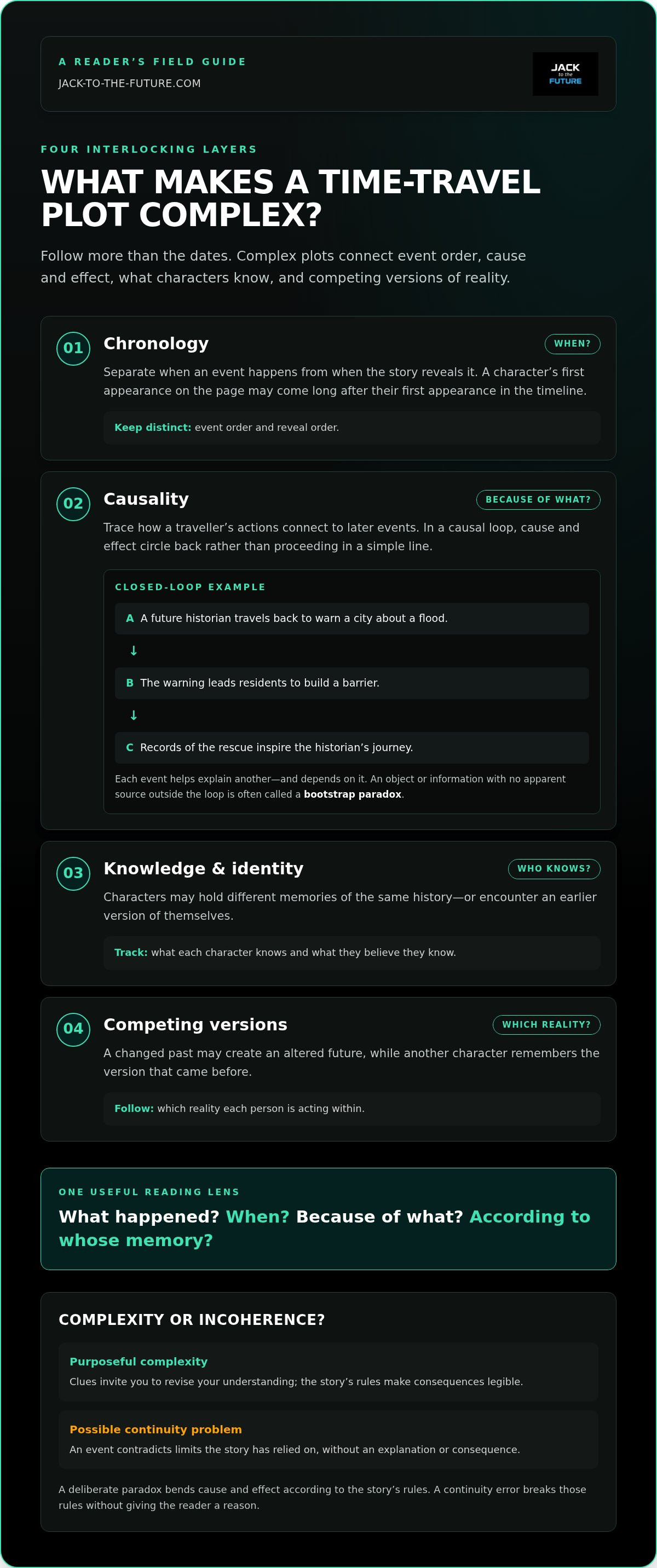
- Chronology: Separate when an event happens from when the story reveals it. A character’s first appearance on the page may come long after their first appearance in the timeline.
- Causality: Trace how a traveller’s actions connect to later events. A temporal paradox, such as a bootstrap loop, makes cause and effect circle back on themselves rather than proceed in a simple line.
- Knowledge and identity: Characters may hold different memories of the same history or encounter an earlier version of themselves. Their choices depend on what they know and what they believe they know.
- Competing versions of events: A changed past may create an altered future, while another character remembers the version that came before. The tension lies in working out which reality each person is acting within.
These layers can make a story feel like a puzzle box. Track them separately, and the design beneath the twists becomes easier to see. The key question isn’t only “What happened?” It’s “When, because of what, and according to whose memory?”
How time-travel rules create causal loops and paradoxes
Every time-travel story makes a quiet promise: actions in the past will have consequences, and those consequences will follow some kind of rule. Can a traveller change an event, or does their attempt help create it? Can two versions of the same person exist at once? The answers shape the story’s logic. Complex time travel plots become easier to follow when you treat their rules as the machinery behind each twist.
These rules belong to the fictional model, not necessarily to science. The Stanford Encyclopedia of Philosophy explores the philosophical problems of time travel, including questions about whether a traveller’s actions can contradict the past. A story can use those questions as imaginative tools without proving that time travel is physically possible.
How a closed causal loop works in a story
Imagine a future historian travels back to warn a city about a flood. The warning leads its residents to build a barrier, and records of that rescue inspire the historian to make the journey. The future event helped cause its own earlier conditions. That circular chain is a causal loop. When an object or piece of information seems to have no original source outside the loop, it’s often called a bootstrap paradox.
Readers may wonder where the loop begins. In a closed loop, there may be no first link to find: each event explains another even as it depends on it. That can be internally coherent if the story establishes the loop as part of its rules. Whether such a loop is scientifically realistic is a separate question.
When does a paradox become a plot hole?
A paradox isn’t automatically a mistake. It becomes a continuity problem when an event contradicts limits the story has already relied on, with no explanation or consequence. If characters can change the past in one scene but can’t do so in another, look for a stated difference in conditions. If none appears, the rules may have slipped.
A useful check is to ask:
- What rule has the story established? Note what travellers can change and what remains fixed.
- What consequence should follow? Trace the result the story itself leads you to expect.
- Does the apparent contradiction get addressed? A later reveal may explain it, while deliberate ambiguity may leave the answer open.
A deliberate paradox bends cause and effect according to the story’s rules; a continuity error breaks those rules without giving the reader a reason. Not every unanswered question is a plot hole. Sometimes uncertainty is the point. If you enjoy exploring time-travel storytelling through speculative fiction, discover Jack Felson’s time-travel ebooks.
Fixed, branching, or changeable timelines: how their logic differs
A traveller reaches the past with a plan. But does history resist the change, split into another reality, or rewrite the future? The answer determines what a choice can accomplish and what it might cost. These models are useful reading tools, not rigid labels: a story can combine them, so follow the rules it actually establishes.
The Encyclopedia of Science Fiction explores how time paradoxes in science fiction become narrative devices. A timeline model gives those devices their shape, from an unavoidable loop to a future that fractures into alternatives.
| Timeline model | Basic rule and consequence | Common reader confusion |
|---|---|---|
| Fixed | Events can’t be changed; attempts to interfere become part of the history that already happened. | It may seem as if characters could prevent an event, even though their actions help cause it. |
| Branching | A changed past creates a divergent reality, while the original timeline may continue to exist. | Readers may wonder whether a character has saved someone, or only created a world where that person survives. |
| Mutable | Changing the past alters the later present, replacing or reshaping events in that timeline. | The story may change memories or circumstances, leaving readers unsure what the traveller still remembers. |
What does a fixed timeline mean for the characters?
In a fixed model, a character may travel back to stop a disaster only to discover their actions were always part of its history. The past holds. This can create dramatic irony: readers recognize the approaching consequence before the character does. But fixed timelines don’t all work identically. One story may allow a traveller to influence events while preserving the outcome; another may restrict what they can do altogether.
How branching and mutable timelines change the stakes
Branching timelines turn a choice into a fork. A rescue can save someone in a new reality without erasing the loss in the original one. Responsibility stretches across worlds: the traveller may have created a better outcome, but not repaired the first timeline.
In a mutable model, the altered past changes the traveller’s present. A successful rescue might restore a relationship or prevent a tragedy, but it can also rewrite the life built around the original events. The dramatic question shifts from “Can I change history?” to “What will changing it take from me?”
Timeline rules determine whether a character’s choice preserves history, creates another reality, or transforms the world they return to. For complex time travel plots, that distinction clarifies the stakes: track not just what a character changes, but which version of the future bears the consequences.
How to follow a complex time-travel plot without losing the thread
Don’t try to map every scene. A few well-chosen notes can reveal the structure beneath the jumps and reversals. For complex time travel plots, separate what happens in the story from when you learn about it, then track the rules and knowledge that connect those moments.
A simple timeline-tracking method for readers
Keep a short list or table. Add an entry only when a major action changes the timeline, reverses an assumption, or causes a meaningful consequence. Four labels are enough to start:
- Event time: When does this happen within the story’s chronology?
- Reveal order: When does the reader discover it?
- Rule in play: What established limit or possibility shapes the event?
- Character knowledge: What does this version of the character know at this point?
That last label matters when a traveller meets an earlier self or when someone remembers a history other characters have forgotten. If a reveal makes an earlier scene look different, revisit it and ask what the character knew then. A decision that seemed irrational may make sense once you separate the character’s information from yours.
Keep the notes lean. Record the traveller’s return, a changed outcome, or a discovery that alters the meaning of earlier events. Skip routine scenes unless they establish a rule or explain a choice. For more context on stories built around time travel, read this guide to time traveler books.
How to tell a purposeful reveal from confusing exposition
A strong reveal does more than add another fact. It changes how you understand a relationship, choice, or earlier event. After a twist, ask: What does this information clarify? Which rule does it complicate? What question does it leave open?
Then distinguish an open question from a contradiction. “Why does this character remember the erased timeline?” is a useful note if the story may answer it later. It isn’t proof of a plot hole by itself. But if the narrative has clearly established that memories change with the timeline, then repeatedly preserving those memories without explanation may conflict with its own setup.
Use your notes as a compass, not a verdict. Mark what’s known, what’s newly revealed, and what remains uncertain. For another time-travel reading experience, explore Jack Felson’s speculative science-fiction ebooks.
What makes a complex time-travel plot satisfying?
A timeline can twist, split, or fold back on itself. The story still needs a human center. Complex time travel plots satisfy when readers can follow how choices lead to consequences, even if the full pattern only becomes clear later. The rules provide the puzzle; relationships, losses, and hopes make solving it matter.
Layered timelines can reward close attention with an unexpected connection or a new reading of an earlier choice. But complexity loses its force when explanations pile up without clarifying the stakes, or when a reset erases consequences so easily that choices stop mattering. A character might get another chance to act, but the emotional cost of the first attempt should still count.
The balance between intellectual puzzle and emotional stakes
Think of the plot mechanics as the map and the characters as the reason to take the journey. A clear rule can make a paradox intriguing; a meaningful relationship can make the decision to change history painful. Even if another trip through time is possible, it shouldn’t automatically undo grief, damage trust, or erase what a character learned.
This is also a useful lens for stories that revisit familiar classics. A retelling can invite fresh questions about how a story might shift across time without needing to announce a radical change or explain every mechanism upfront. Charlie’s Trips is one of Jack Felson’s time-travel adventures inspired by classic stories. Explore Jack Felson’s speculative fiction to find a time-travel story to follow.
A final checklist for evaluating a time-travel story
As the timeline settles, use these questions to test whether its complexity has earned its place:
- Can you identify the main rule? What can characters change, revisit, or preserve?
- Do the major twists connect? Can you trace them to earlier causes, character knowledge, or choices?
- Does the ending carry weight? Alongside resolving the timeline, does it deliver an emotional or thematic consequence?
You don’t need every mystery answered. You do need enough structure to understand why the choices matter. If you’re ready for another journey through time, explore Jack Felson’s speculative fiction.
Follow the twists wherever they lead
Complex time travel plots become easier to follow when you separate event order from reveal order, trace cause and effect, and keep the story’s established rules in view. Fixed, branching, and changeable timelines give characters’ choices different consequences. The most satisfying twists don’t just rearrange the past; they make those choices matter.
You don’t need to solve every mystery on the first pass. Notice what a character knows, what a new reveal changes, and which questions the story leaves open. That’s often enough to stay oriented while the timeline shifts around you.
Ready for another journey through time? Jack Felson’s catalogue includes Charlie’s Trips and other time-travel adventures, available as digital ebooks for purchase directly from the website. Explore Jack Felson’s speculative fiction and follow the next twist with curiosity.
Frequently Asked Questions
What makes a time-travel plot complex?
A time-travel plot feels complex when readers must connect more than a sequence of jumps. Chronology may shift, but so can causality, memory, character knowledge, or the versions of an event. A useful test is whether you can trace why an action matters and which rule makes its consequence possible. If so, the puzzle is intricate, not necessarily incoherent, even if the answers arrive later.
Can a time-travel story have more than one timeline?
Yes. A story may show branching realities, where a choice creates a divergent timeline, or alternate versions of events that characters remember differently. The number of timelines isn’t always the key to understanding them. Look for what happens to the original history when someone changes the past: does it persist, transform, or become one branch among several? That rule clarifies which reality each character inhabits.
What is a causal loop in time-travel fiction?
A causal loop is a chain of events in which a later event helps cause an earlier one, and the earlier event then leads to the later event. For example, a traveller receives a warning from their future self, then grows up to send that same warning back. A bootstrap paradox occurs when information or an object seems to have no origin outside the loop. It’s a fictional pattern, not proof of scientific possibility.
Is a time-travel paradox always a plot hole?
No. A paradox can be an intentional feature of the story if its timeline rules explain how the contradiction operates. It becomes a possible plot hole when events break a rule the narrative has established, without explanation or consequence. Before judging, consider whether a later reveal may resolve the apparent conflict. An unanswered question can also be deliberate ambiguity, not an error the story has forgotten to fix.
How do you keep track of timelines in a time-travel story?
Make brief notes for major turning points, not every scene. Record when an event happens, when the story reveals it, what rule shapes it, and what the relevant character knows. This helps distinguish a character’s understanding from the reader’s. When a twist changes an earlier event’s meaning, revisit your notes and check what that character knew at the time. Keep unresolved questions separate from confirmed contradictions.
What is the difference between a fixed and a branching timeline?
In a fixed timeline, attempts to change the past may become part of the history characters already know. In a branching timeline, a changed event creates a divergent reality, while the original may continue to exist. That difference shifts the stakes: a fixed timeline can make a failed intervention inevitable, while branching can raise the question of whether a rescue helped the original world or only a new one.
Why are complex time-travel plots so popular?
Complex time-travel plots let readers enjoy two journeys at once: following the characters and piecing together the timeline. A reveal can transform the meaning of an earlier choice, while a paradox invites questions about memory, identity, fate, and responsibility. The best stories balance that intellectual puzzle with emotional stakes. You don’t need every mechanism explained to stay invested, but the characters’ choices and consequences should still matter.
0 comments