

What if the most revealing journey through time isn’t about changing history, but discovering what the past has done to you? Literary time travel fiction can race across decades, yet its real engine may be memory, identity, or the cost of a choice. The genre label can feel slippery: one time-slip novel treats chronology as a puzzle to solve; another makes it a pressure point in a relationship or a life.
If you want a story with momentum, not a premise that stalls for exposition, that distinction matters. This guide explains what makes time travel fiction literary, how to compare stories by their narrative priorities, and what clues signal a satisfying balance of reflection, emotion, and adventure. You’ll see how time can reshape character and consequence, and how to identify the approach that suits your reading taste. Jack Felson’s time-travel storytelling, including Charlie’s Trips, offers a place to begin exploring. The clock may move backward or fracture altogether. The question is what changes when it does.
Key Takeaways
- See how literary time travel fiction uses disrupted chronology to explore human meaning while leaving room for adventure.
- Learn how shifts between past, present, and future can build anticipation or uncertainty, and how to tell purposeful mystery from confusing structure.
- Compare literary and plot-driven stories by their focus on character, timeline, and reader appeal, rather than treating the categories as strict opposites.
- Use your preferences for themes, pacing, timeline complexity, and ambiguity to find stories that fit your reading taste.
- Discover how Charlie’s Trips fits into Jack Felson’s speculative time-travel catalogue.
What Is Literary Time Travel Fiction, and What Makes Time Matter?
A character steps into another era. That’s the speculative event. The deeper question is why the story takes them there. Literary time travel fiction uses a journey through time to explore how memory, identity, and consequence shape a human life. The timeline isn’t just a maze of rules to solve; it can test what a character believes, regrets, or hopes to change.
That doesn’t mean literary stories leave adventure behind. Suspense, danger, and clever time-travel mechanics can keep the pages turning while the story asks what a choice means. The approaches overlap, and neither is automatically better. The difference lies in emphasis: does the time-travel premise mainly drive events, or does it also change how we understand the people caught inside them?
A few terms help readers notice that emphasis. Chronology is the order in which events happen. Point of view is whose perspective shapes what we see and know. Thematic consequence is the larger meaning of what happens, such as how a changed past alters a character’s sense of responsibility. The overview of Time travel in fiction provides genre context; close reading reveals what a particular story makes its time shifts mean.
How does literary time travel differ from a story about changing the past?
Changing an event can be the plot’s central mission. In a literary approach, that change may also expose a character’s values or unsettle a relationship. What does someone believe they’re entitled to fix? Who bears the cost of a better outcome? Familiar rules and fast-moving suspense can serve those questions, too. The key distinction isn’t whether the past changes, but what the change reveals.
Why do memory and identity matter in time travel fiction?
Memory can become an unstable map. A traveler might remember one version of an event while encountering a present shaped by another. That gap raises questions: which memories still feel true, and what happens when others remember things differently?
Identity, too, is more than a fixed label. It grows from personal history, relationships, choices, and the futures a person imagines but never reaches. Picture someone returning to a moment when they chose one path over another. The alternate life may be impossible to claim, yet imagining it could change how they understand the life they have. Time travel turns “what if?” into a pressure test for who we think we are.
How Literary Time Travel Turns a Timeline into a Storytelling Tool
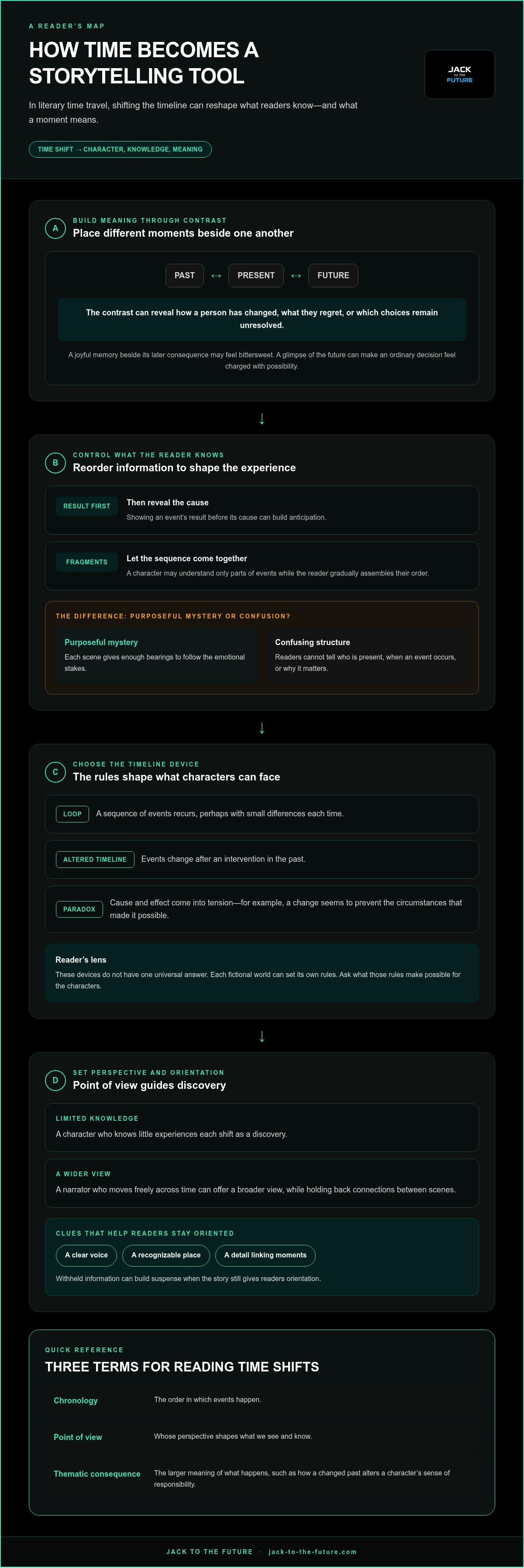
A timeline can do more than keep events in order. In literary time travel fiction, moving between past, present, and future can change what a reader knows, when they know it, and how each moment feels beside another. A joyful memory placed next to its later consequence may turn bittersweet. A glimpse of the future can make an ordinary decision feel charged with possibility.
A non-linear timeline reveals character by setting different versions of a life beside one another. The contrast may show how a person has changed, what they still regret, or which choices remain unresolved. H. G. Wells’s The Time Machine offers one example of a time-travel premise carrying ideas beyond its mechanics; a scholarly article on The Time Machine examines the novel’s literary and social themes.
Structure also controls the reader’s access to the story. A writer might show an event’s result before revealing its cause, creating anticipation. Or a character may understand only fragments while the reader slowly assembles the sequence. That uncertainty feels deliberate when each scene provides enough bearings to follow the emotional stakes. If readers can’t tell who is present, when an event occurs, or why it matters, the timeline may feel confusing rather than mysterious.
What do loops, altered timelines, and paradoxes contribute?
A loop is a sequence of events that recurs, perhaps with small differences each time. An altered timeline is a version of events changed by an intervention in the past. A paradox creates tension between cause and effect, such as a change that seems to prevent the very circumstances that made it possible. These are storytelling devices, not puzzles with one universal answer. Each fictional world can set its own rules. The useful question for a reader is what those rules make possible for the characters.
How does point of view shape a reader’s experience of time?
A character with limited knowledge experiences each shift as a discovery. A narrator who moves freely across time can offer a wider view, but may also hold back the connection between scenes. Withholding information builds suspense when the story still gives readers orientation: a clear voice, a recognizable place, or a detail that links moments together.
Point of view can make memory feel like another timeline. A character may recall a promise one way, then encounter a present that gives the memory a different weight. That gap can deepen a scene without explaining every cause. If you’re drawn to stories where time’s structure drives both momentum and reflection, explore Jack Felson’s speculative science-fiction ebooks.
Literary vs. Plot-Driven Time Travel Fiction: A Reader’s Comparison
Some time-travel stories pull you forward with a mission: reach a particular moment, solve a problem, survive the consequences. Others linger on what the journey does to a person’s inner life. These are different priorities, not opposing camps. A story can make the clock race while giving its characters room to question who they’ve become. A study of the evolution and development of time travel in Western literature offers another perspective on how the premise can carry narrative and symbolic meaning.
| Reading lens | Literary emphasis | Plot-driven emphasis |
|---|---|---|
| Dominant focus | Interiority, style, ambiguity, or thematic consequence | Pace, suspense, rules, and causal problem-solving |
| Character focus | How memory, choice, and change shape a character’s sense of self | How characters respond to urgent obstacles and goals |
| Timeline’s role | Creates contrast or uncertainty that invites interpretation | Structures the challenge and its chain of consequences |
| Reader appeal | Reflective questions and layered emotional or thematic meaning | Momentum, suspense, and the pleasure of seeing a problem unfold |
The distinction is what time travel foregrounds, not whether a story has ideas. A plot-led narrative can ask sharp questions about responsibility; a reflective one can still deliver urgency. Neither mode is automatically more sophisticated. The right fit depends on what you want the journey to make you feel and think about.
Which approach prioritizes ideas, and which prioritizes the journey?
Think of the difference as a shifting balance. In a more reflective story, a character’s identity or emotional conflict may hold the foreground while events move around it. In a more plot-forward story, the immediate objective may lead, with questions of identity emerging through decisions under pressure. A single novel can be fast-paced, emotionally rich, structurally intricate, and reflective at once. Look for emphasis, not a fixed label.
Can a time travel novel be both literary and adventurous?
Absolutely. Suspense can give philosophical questions a pulse: a character’s race to prevent an event can make the cost of intervention impossible to ignore. A clear goal also gives readers a handhold through intricate ideas. If you want momentum, look for an urgent objective. If you want reflection, notice whether descriptions or character choices invite interpretation beyond the immediate puzzle. Your preference isn’t a ranking; it’s a guide to the kind of time-bending experience you’re after.
How to Choose Literary Time Travel Fiction That Fits Your Reading Taste
A time-travel premise can promise almost anything: a personal reckoning, a historical puzzle, a high-stakes race, or a timeline that refuses to stay still. To find a story that fits, look past the label and identify what you want the journey to feel like. Use this quick method to choose literary time travel fiction without needing to decode every plot twist in advance.
- Choose the themes you want to follow. Are you curious about memory, identity, love, regret, or the consequences of changing events? A character-led description often foregrounds a relationship, a difficult choice, or what a traveler hopes to recover.
- Find your preferred pace. Words such as “race,” “escape,” or “prevent” may signal urgency and action. Language focused on reflection, loss, or transformation may suggest a more interior journey. Either kind of story can still have suspense.
- Gauge timeline complexity. A description centered on one journey or a single turning point may suggest a more direct structure. Mentions of loops, altered outcomes, or multiple periods can signal more timeline threads to follow.
- Decide how much ambiguity you enjoy. Do you want clear explanations of the time-travel rules, open questions to ponder, or a mix? Choose the level of uncertainty that feels intriguing, not frustrating.
What should a reader look for in a time travel book description?
Start with three clues: who travels, what changes, and what the character stands to lose. Then notice the description’s center of gravity. Emotional stakes and relationships suggest one kind of promise; historical settings, puzzles, and urgent missions suggest others. Promotional copy is a useful first signal, not a full map. It may spotlight the hook while leaving the story’s style or structure unstated. For wider genre possibilities, browse this time traveler books guide.
How can readers judge complexity without spoilers?
Look for non-spoiler reviews that comment on pacing, clarity, and how much timeline tracking a story asks of you. A review that says a book moves between eras can help you anticipate its structure without revealing why those shifts matter. First, check whether the premise appeals to you. You don’t need a full plot explanation to know whether you’re drawn to its central question. For adjacent reading context, explore this guide to adult speculative fiction storytelling.
Ready to follow that curiosity into a new speculative journey? Explore Jack Felson’s speculative sci-fi ebooks.
Explore Jack Felson’s Literary Time Travel Through Charlie’s Trips
Look beyond a time-travel premise by asking how chronology shapes the story, what questions it raises about identity or memory, and whether its balance of reflection and momentum suits you. Bring those same questions to Jack Felson’s speculative fiction and time-travel ebook catalogue. They’re useful ways to choose a read that fits your interests.
How can readers approach Charlie’s Trips as a time travel read?
Charlie’s Trips is a speculative fiction ebook by Jack Felson and part of his time-travel adventures. As you explore the title, consider the questions that guide any literary time travel read: How does the movement through time shape the experience? What might it suggest about identity, memory, or consequence? These are useful reading lenses to bring to the book. For a dedicated look at the title, visit Charlie’s Trips and time travel retelling.
What is the next step for readers exploring the catalogue?
Follow the question that interests you most. If you’re drawn to time’s effect on a character, start with a time-travel ebook; if you’re curious about speculative premises more broadly, explore the science-fiction catalogue. Jack Felson’s ebooks are available as digital downloads through the website, with instant access after checkout. For another angle on high-concept reading, explore this guide to high-concept science fiction ebooks.
The best next read depends on the balance you enjoy: a clear objective and fast-moving events, a reflective journey, or a story that lets both currents run together. Keep your reading preferences in view as you browse. When you’re ready to discover more, explore Jack Felson’s ebooks and choose the speculative journey that catches your imagination.
Choose Your Next Journey Through Time
The most rewarding literary time travel fiction makes chronology matter. A shifted timeline can shape what readers know, while memory, identity, and consequence give the journey its emotional gravity. Literary and plot-driven approaches can overlap, so look for the balance you enjoy: reflection and ambiguity, momentum and clear rules, or a little of each.
Use book descriptions and spoiler-free reviews as clues to a story’s themes, pace, and timeline complexity, then follow the questions that intrigue you. Jack Felson’s Charlie’s Trips is one title to explore alongside a catalogue of downloadable speculative science-fiction and time-travel adventure ebooks. The ebooks are available directly through the website, with instant access after checkout.
Ready to find a story that bends time in a way that speaks to you? Explore Jack Felson’s time-travel ebooks and let your next journey begin.
Frequently Asked Questions
What is literary time travel fiction?
Literary time travel fiction uses a disruption in chronology to explore human meaning as well as move the plot. A journey to another time might raise questions about memory, identity, relationships, or the consequences of choice. The story can still include suspense, adventure, and clear time-travel rules. What makes it literary is the attention given to what those events mean for characters and readers.
What makes a time travel novel literary?
A time travel novel often feels literary when its timeline helps develop character, style, or theme, rather than serving only as a puzzle to solve. Notice whether shifts in time reveal a character’s inner life, create meaningful contrasts, or complicate ideas about responsibility and change. This doesn’t mean the book must be slow or ambiguous. Suspense and action can carry emotional and intellectual questions, too.
Can time travel fiction be both literary and science fiction?
Yes. Time travel fiction can be science fiction because it uses a speculative premise, while also taking a literary approach to character, language, or theme. The categories aren’t opposites. A story may build its momentum around rules and consequences, then use those mechanics to explore identity or memory. Rather than relying on a label alone, consider what the time-travel premise allows the story to examine.
How do I choose a literary time travel book?
Start with the reading experience you want. Look for descriptions that emphasize themes such as memory or relationships if you’re drawn to character-led questions; clues about urgent goals, puzzles, or time-travel rules may signal a more plot-driven read. Consider your preferred pace, how many timeline shifts you enjoy tracking, and whether you like clear answers or open questions. Non-spoiler reviews can offer clues about structure and pacing.
Are time loops and alternate timelines the same thing?
No. A time loop is a sequence of events that recurs, sometimes with changes between repetitions. An alternate timeline is a different version of events, often created when an intervention changes what happens. A story may use either device or combine them, and fictional rules vary. The distinction can help you understand a premise, but you don’t need to master every mechanism to follow its character stakes.
Do I need to understand time travel theory to enjoy literary time travel fiction?
No. You can enjoy literary time travel fiction without knowing scientific theories about time. A story’s own rules and emotional stakes are usually enough to guide you. Focus on what the characters know, what changes, and why the journey matters to them. If the timeline is deliberately complex, a few details may become clearer as you read. Curiosity is useful; specialist knowledge isn’t required.
Is Charlie’s Trips a time travel ebook?
Yes. Charlie’s Trips is a time-travel adventure ebook by Jack Felson and part of Jack to the Future’s speculative science-fiction catalogue. The website offers downloadable ebooks for purchase, with instant digital access after checkout. As you consider the title, keep your reading interests in view: think about the kinds of time-bending premises, emotional stakes, and narrative momentum you enjoy.
0 comments