

What if the version of you reading this is just a ghost of a choice you didn't make? A single pivot... a different train... a world transformed. It's a haunting thought. Most readers are tired of generic "what-if" stories that lean on tired tropes or confusing time-travel logic. You're likely looking for something more visceral. You want stories that challenge your sense of identity while maintaining a rigorous, high-concept edge. Finding those bold indie voices who take real risks with alternative timeline sci-fi novels can feel like searching for a signal in the static.
It's true that the best speculative fiction acts as a psychological mirror. It reveals the fragility of our own reality through the lens of divergence. In this guide, you'll discover the intellectual depth and narrative mechanics behind the most compelling alternative timeline stories in modern fiction. We'll map the shift from "great man" history to intimate, grounded multiverses. From the 2026 Sidewise Award winners to Jack Felson's visionary ebooks like "Charlie's Trips," we're diving into the sub-genres and speculative mechanics that define this year's most distinctive digital reads. Let's step into the fracture.
Key Takeaways
- Decode the mechanics of the "Jonbar Point" to understand how a single historical fracture creates a cascade of new, haunting realities.
- Trace the evolution from "Great Man" history to grounded multiverses... find alternative timeline sci-fi novels that prioritize psychological depth over simple spectacle.
- Uncover the "uncanny valley" of speculative fiction. Discover why subtle reality shifts are often more evocative than total world transformation.
- Curate a visionary digital shelf for instant exploration. Gain access to bold indie works like Jack Felson’s "Charlie’s Trips" for a masterclass in narrative divergence.
Defining the Alternative Timeline: More Than Just a "What-If"?
The alternative timeline genre is a speculative exploration of causality and consequence. It's about the fracture. The moment history breaks. While some readers get lost in the weeds of dates and battles, alternative timeline sci-fi novels offer something deeper. They aren't just about the "what." They're about the "why." By adhering to alternate history genre conventions, authors establish a Point of Divergence (POD) that acts as a catalyst. But in sci-fi, this POD isn't just a political shift; it's a fundamental rewrite of reality. It's the "road not taken" rendered in high-definition, forcing us to look at the fragility of our own existence.
The Anatomy of a Divergence Point
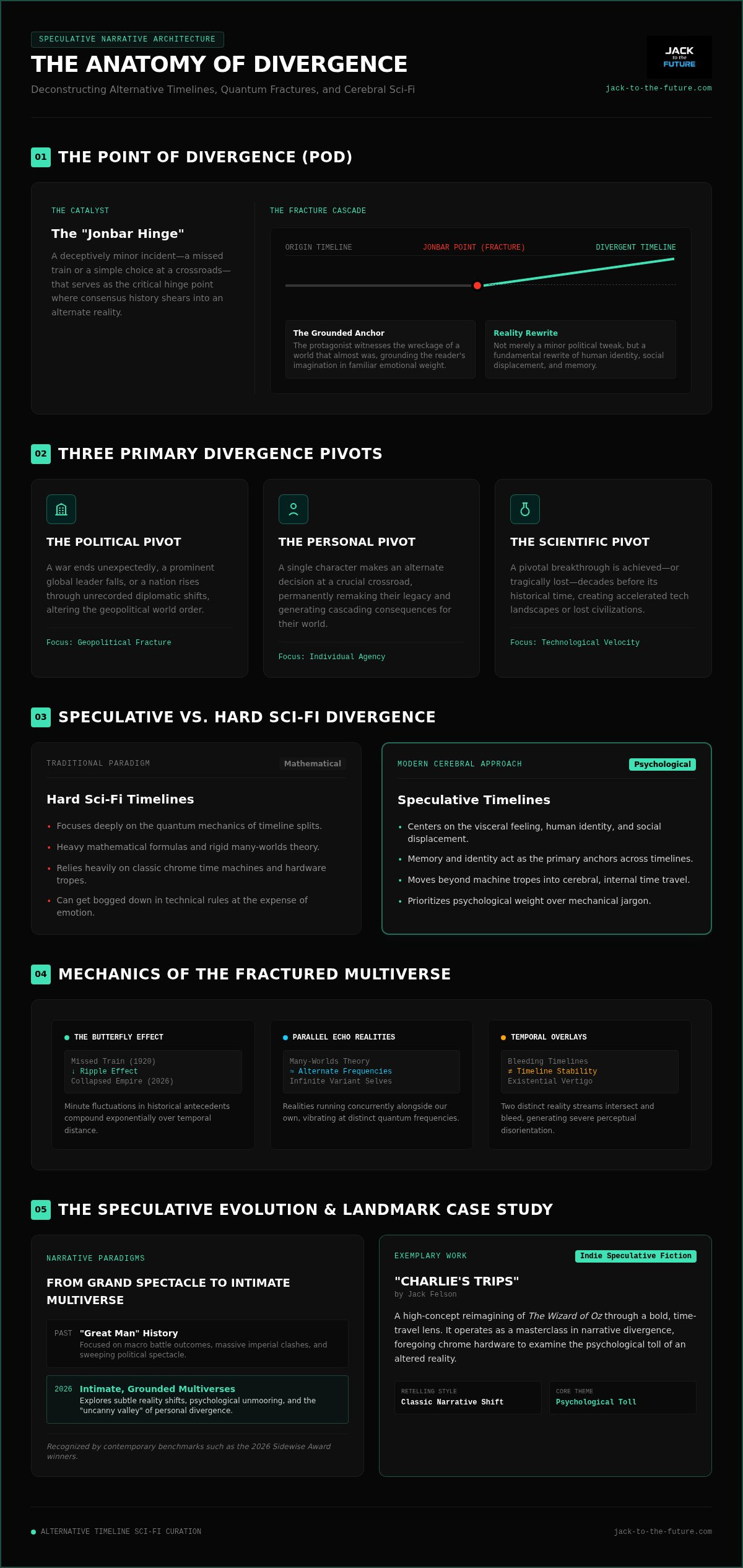
Every fracture has a hinge. In the genre, we call this the "Jonbar Hinge." It's a small event with massive ripples. A missed train. A different choice at a crossroads. The most compelling stories start with a moment that feels painfully familiar. This groundedness is what makes the subsequent divergence so jarring. The protagonist serves as our witness. They stand in the wreckage of a world that almost was, acting as an anchor for the reader's imagination. We don't just see the change; we feel the weight of it through their eyes. These pivots typically fall into three categories:
- The Political Pivot: A war ends, a leader falls, or a nation rises unexpectedly.
- The Personal Pivot: A single character makes a different choice that alters their legacy.
- The Scientific Pivot: A discovery is made, or perhaps lost, decades before its time.
Speculative vs. Hard Sci-Fi Timelines
Not all splits are created equal. Hard sci-fi often gets bogged down in the quantum mechanics of the split. It's all math and many-worlds theory. Speculative fiction takes a different path. It focuses on the "feeling" of the shift. It's about identity, memory, and social displacement. Jack Felson’s work sits firmly in this cerebral space. In his ebook "Charlie's Trips," he uses a Wizard of Oz retelling to explore these themes through a bold, time-travel lens. It's a masterclass in narrative divergence. It doesn't just explain the mechanics; it explores the psychological toll of navigating a world that has been fundamentally reimagined. This is speculative fiction at its most visionary, prioritizing the human experience over technical jargon.
The Mechanics of Divergence: How Speculative Timelines Fracture
History isn't a single, rigid line. It's a fractal. Every choice, every random collision of atoms, creates a new reality. This is the foundational logic of alternative timeline sci-fi novels. We often talk about the Butterfly Effect, the idea that small changes in the past create unrecognizable futures. A missed train in 1920 leads to a collapsed empire in 2026. But modern speculative fiction goes deeper. It explores parallel worlds, echo realities that run alongside our own, vibrating at a different frequency. In the most haunting narratives, we witness temporal overlays. This is where two distinct timelines begin to bleed into one another, creating a sense of existential vertigo for those caught in the middle.
The Multiverse Theory in Modern Fiction
Modern fiction in 2026 leans heavily into the many-worlds interpretation of quantum mechanics. This isn't just a convenient plot device; it's a structural framework for exploring human potential. Authors are increasingly obsessed with "timeline stability." They ask if a fractured world can truly survive its own internal contradictions. There's a profound, almost primal resonance in the idea of infinite versions of ourselves. It forces us to confront our identity. If there's a version of you that made every "wrong" choice, are they still you? These stories suggest that our essence might be the only thing that remains constant across the multiverse.
Cerebral Time Travel: Beyond the Machine
We're moving away from the clunky, chrome time machine tropes. The new frontier is internal. In these cerebral narratives, memory and identity act as the only true anchors between different timelines. The shift isn't physical; it's psychological. If you're drawn to sci-fi books about changing the past, you understand that the real journey is often a search for a lost version of the self. Jack Felson’s "Charlie’s Trips" exemplifies this shift. By using a Wizard of Oz retelling as its core, it reimagines a classic journey through a lens of speculative time travel. It proves that the most dangerous territory isn't a distant galaxy. It's the "what-if" lurking in your own mind. You can explore these visionary sci-fi ebooks to see how the mechanics of divergence can reshape a familiar story into something entirely new.
Classic Retellings vs. Historical Pivots: Navigating Narrative Shifts
Traditional alternate history often focuses on the "great man" theory. Battles won or lost. Empires crumbling. This is the classic pivot... the macro-view of causality. As explored in the literary traditions of alternate histories and parallel universes, these stories rely on a shared understanding of historical fact. But in 2026, the genre is evolving. We're seeing a surge in alternative timeline sci-fi novels that prioritize the subversion of narrative over the redirection of nations. It’s a shift from the political to the personal. We aren't just watching a different version of a war; we're watching a different version of our own cultural identity.
The difference lies in the stakes. A historical pivot asks us to imagine a world we never lived in. A literary retelling asks us to reimagine a story that lives inside us. It’s a psychological shift. The emotional resonance is sharper when the "road not taken" involves characters we've known since childhood. It turns a familiar comfort into a speculative interrogation.
The Power of Reimagining Classic Literature
Adults crave sophisticated versions of the stories they grew up with. We don't want the simple moral lessons anymore. We want the grit... the speculative weight of a world gone wrong. Jack Felson understands this balance. His work, specifically "Charlie’s Trips," bridges the gap between classic adventure and modern speculation. It’s a masterclass in narrative divergence. It doesn't just retell a story; it hijacks it using time-travel mechanics that feel both fresh and haunting. If you’re looking for more visionary takes on the past, explore the growing trend of sci-fi retellings of classic literature. See how the foundations of our storytelling are being rewritten in 2026.
The "What-If" of Cultural Icons
Take the Wizard of Oz. It's a cultural icon... a shared dream. This makes it the perfect temporal playground for alternative timeline sci-fi novels. When you introduce speculative mechanics into Oz, you aren't just changing a plot point; you're deconstructing a myth. The thrill is visceral. It’s the feeling of seeing a familiar room through a cracked mirror. Bold narratives require this foundation in the familiar to truly shock the reader. You don't just change the ending; you change the nature of the journey. You show the reader the cracks in the yellow brick road. This is where the real exploration begins. It’s not just an escape. It’s a journey into the unknown parts of a world you thought you knew by heart.
The Cerebral Edge: Why Modern Readers Crave Speculative Depth
Why do we return to the fracture? For many, alternative timeline sci-fi novels are more than just a diversion. They're an intellectual necessity. We aren't just hiding from our reality; we're interrogating it. Modern readers crave a depth that moves beyond simple escapism. They want to think... to feel the friction of a world that is almost, but not quite, our own. This is the "uncanny valley" of speculative fiction. It's that haunting sensation when a timeline is just slightly "off." It’s why stories like the "Wizard of Oz" serve as such an effective temporal playground. When we deconstruct a known story rather than just a known history, the stakes become personal. It forces us to confront the complexity of our own time perception in an era where reality feels increasingly fluid.
Challenging Reality Through Fiction
Alternative timelines force us to question the "inevitability" of our world. We assume things had to be this way. Speculative fiction proves they didn't. There's a heavy philosophical weight to the choices made in these narratives. Every consequence matters. This level of intellectual risk-taking is rarely found in mainstream publishing. The most visionary books are often born in the indie digital space. Independent authors aren't bound by market trends or safe tropes. They’re free to explore the fringes... to push the boundaries of what a story can be. Digital ebooks provide the perfect medium for this "instant exploration," offering a direct line from the creator's mind to the reader's device.
The Rise of the Visionary Narrative
We’ve moved past the "pulp" era of sci-fi. The cinematic rhythm of modern alternative timeline sci-fi novels demands engagement. Today’s audience wants a pace that mimics a suspenseful montage. It’s about the "vibe" as much as the plot. Jack Felson captures this perfectly. His prose doesn't just describe a journey; it makes you feel the nature of the journey itself. It’s cerebral. Sophisticated. A bit rebellious. It’s the sound of a creator who is two steps ahead, inviting you to catch up. If you're ready to leave the familiar behind, you can explore visionary sci-fi ebooks that challenge the very fabric of your reality. This isn't just reading. It's a journey into the unknown.
Beyond the Horizon: Selecting Your Next Digital Speculative Adventure
The horizon is shifting. It isn't a fixed point anymore. It's a choice... a doorway. For those seeking the most immersive alternative timeline sci-fi novels, the hunt for the next great read has moved beyond the dusty shelves of the past. We live in an era of instant exploration. You shouldn't have to wait for a courier to deliver a physical package to start your journey into a fractured reality. The digital landscape offers something more immediate. More visceral. It provides a direct connection to visionary voices who aren't afraid to break the mold of traditional storytelling. Curating a virtual shelf of speculative gems is about more than just collecting files. It’s about building a personal library of "what-ifs" that you can carry into any reality.
Instant Exploration: The Ebook Advantage
No shipping. No waiting. Just immediate immersion. This is the true edge of the digital format for speculative fans. While traditional retailers focus on the logistics of physical media, the modern reader values the speed of thought. You can discover a concept at midnight and be deep inside its mechanics by 12:01. It’s about portability. An entire multiverse fits on a single device. You can cross temporal borders while sitting in a cafe or commuting through an urban sprawl. Digital-first authors like Jack Felson are the architects of this new frontier. They understand that the "feeling" of a story is amplified by the ease of access. The transition from our world to theirs should be seamless. Instant. Uninterrupted.
Starting Your Journey with Jack Felson
If you're ready to challenge your perception of causality, "Charlie’s Trips" is the essential starting point. This isn't just another time-travel story. It’s a masterclass in narrative divergence. Jack Felson takes the familiar bones of a Wizard of Oz retelling and infuses them with bold, speculative mechanics. It’s a journey that feels both hauntingly nostalgic and dangerously new. The process is direct. You don't need a clunky machine to cross timelines; you just need the courage to click. By downloading directly, you bypass the gatekeepers of mainstream publishing and step straight into a curated, high-concept experience. The road is open. The fracture is waiting. You can download Charlie’s Trips and explore the multiverse now to see how deep the rabbit hole... or the cyclone... really goes. Your journey into the unknown starts the moment you decide to look beyond the horizon.
Step Into the Fracture
Reality is more fragile than we care to admit. A single choice... a missed connection... a world transformed. We've explored how alternative timeline sci-fi novels have evolved from simple historical pivots into deep, psychological mirrors that challenge our very identity. From the mechanics of quantum branching to the visceral thrill of reimagining cultural icons, the genre in 2026 demands more than just passive reading. It demands intellectual engagement. It's about the thrill of discovery and the courage to question the "inevitability" of our own world.
You don't have to wait for the future to arrive. It's already here, waiting in the digital space. Independent author Jack Felson offers a masterclass in this visionary style through cerebral, high-concept narratives. With instant digital delivery and free shipping on all e-books, your exploration begins the second you decide to look beyond the horizon. The road is open. The multiverse is waiting. Step through.
Start your journey into the unknown with Charlie’s Trips—Download Now
Frequently Asked Questions
What is the difference between an alternative timeline and a parallel universe?
An alternative timeline usually stems from a specific historical fracture... a point of divergence where one reality splits from our own. Parallel universes often exist as separate, simultaneous realities that may have never shared a common history. Both are staples of alternative timeline sci-fi novels, but the timeline focus is on causality. It’s about the weight of a single choice that ripples through time, creating a world that is hauntingly similar yet fundamentally different.
Are there any alternative timeline sci-fi novels that don’t involve time travel?
Absolutely. Many stories exist in a world where the divergence happened centuries ago... no time machine required. These novels explore the "aftermath" of a changed history, focusing on the social and political landscape of a reality that is fundamentally different from ours. They rely on the "Jonbar Hinge" to ground the reader in a world that feels both familiar and alien... a mirror of what could have been. It’s about the world, not the travel.
How do I start writing my own alternative timeline story?
Start with the fracture. Identify a single, familiar moment in history or literature and ask, "What if this went differently?" This is your Point of Divergence. Focus on the ripples... how one small change creates a cascade of consequences. Don't get lost in the tech. Focus on the human element... the psychological toll of living in a world that shouldn't exist. Let the "vibe" guide the world-building. It’s about the feeling of the split.
What are the best alternative timeline books for beginners?
Begin with stories that ground the extraordinary in the familiar. "Charlie’s Trips" by Jack Felson is a perfect entry point... it uses the recognizable framework of the Wizard of Oz to explore complex temporal shifts. Other notable 2026 reads include Vaishnavi Patel’s Ten Incarnations of Rebellion for historical depth, or Kaliane Bradley’s The Ministry of Time for a blend of bureaucracy and speculative romance. These titles bridge the gap between classic tropes and modern depth.
Is "Charlie’s Trips" a standalone novel or part of a series?
"Charlie’s Trips" is a complete, visionary narrative designed for immediate immersion. While it sits within Jack Felson’s broader collection of speculative sci-fi ebooks, it functions as a masterclass in the standalone time-travel retelling. It offers a definitive journey through a fractured Oz, providing a cerebral experience that doesn't require prior knowledge of a series to appreciate its intellectual depth or narrative mechanics. It’s a curated experience... a single, impactful journey into a reimagined classic.
Why are digital ebooks better for reading speculative fiction?
Digital ebooks offer instant exploration... a direct line to the unknown. There’s no waiting for shipping and no physical clutter. Speculative fiction is about the "now"... the immediate spark of a high-concept idea. Carrying a whole multiverse on a single device allows you to step into a new timeline whenever the mood strikes. For fans of alternative timeline sci-fi novels, the digital format mirrors the fluid, fast-paced nature of the genre itself. It’s about immediate immersion.
Can I read alternative timeline books if I don’t like hard science?
Yes. Many of the most compelling stories prioritize the "speculative" over the "hard" science. They focus on the feeling of the shift... the psychological impact on the characters and the social displacement of a changed world. You don't need a degree in quantum mechanics to feel the weight of a lost identity. These stories are about the human heart... the choices we make and the ghosts of the lives we didn't lead. It’s about identity.
What makes Jack Felson’s approach to time travel unique?
Jack Felson strips away the clunky tropes of traditional time travel. He leans into the cerebral and the speculative... focusing on the "uncanny valley" of reality. By reimagining classic literature like the Wizard of Oz, he creates a masterclass in narrative divergence. It’s a rebellious, "outcast" approach that isn't afraid to break the rules of the genre. His work feels like a cinematic montage... fast-paced, impactful, and always two steps ahead of the audience.
0 comments