

True narrative vertigo isn't born from cheap plot twists. It stems from the relentless, elegant precision of speculative logic. If you've spent hours hunting for a story that genuinely makes you question your reality, mainstream formulas probably leave you cold. You're tired of predictable genre tropes disguised as intellectual depth... and you want fiction that actually tests your cognitive boundaries. Finding authentic mind-bending sci-fi novels requires looking past recycled galactic sagas toward stories that dare to warp the architecture of human thought.
We know that frustration. You don't just want escapism; you want the exhilarating friction of ideas that challenge how you perceive time, memory, and identity. In this guide, you'll discover how visionary speculative fiction dismantles our daily assumptions about reality, why structural complexity creates lasting psychological resonance, and where to find bold narratives ready for instant digital exploration. From the theoretical mechanics of cognitive estrangement to independent hidden gems, your next mind-altering journey begins here.
Key Takeaways
- Explore how the modern landscape of mind-bending sci-fi novels prioritizes speculative cerebral depth, memory manipulation, and cognitive estrangement over tired mechanical tropes.
- Unpack the psychological mechanics of why intellectual discomfort and defamiliarization make complex narratives so addictive.
- Decode foundational tropes... from bootstrap time paradoxes to fractured multiverse realities and allegorical subversions.
- Learn a clear three-step framework to pinpoint your ideal narrative bend across temporal, psychological, or sociological dimensions.
- Discover bold independent storytellers pushing the boundaries of speculative fiction through instant digital author-direct releases.
What Defines a Mind-Bending Sci-Fi Novel in 2026?
Most readers know the sensation. You turn the final page, stare at the ceiling, and try to reassemble your basic assumptions about reality. Mainstream book lists often slap the "mind-bending" label onto any story with a standard third-act plot twist. That misses the entire point. True mind-bending sci-fi novels don't rely on cheap sleight of hand at the finish line; their structural architecture challenges cognitive comfort through rigorous speculative logic from the opening sentence.
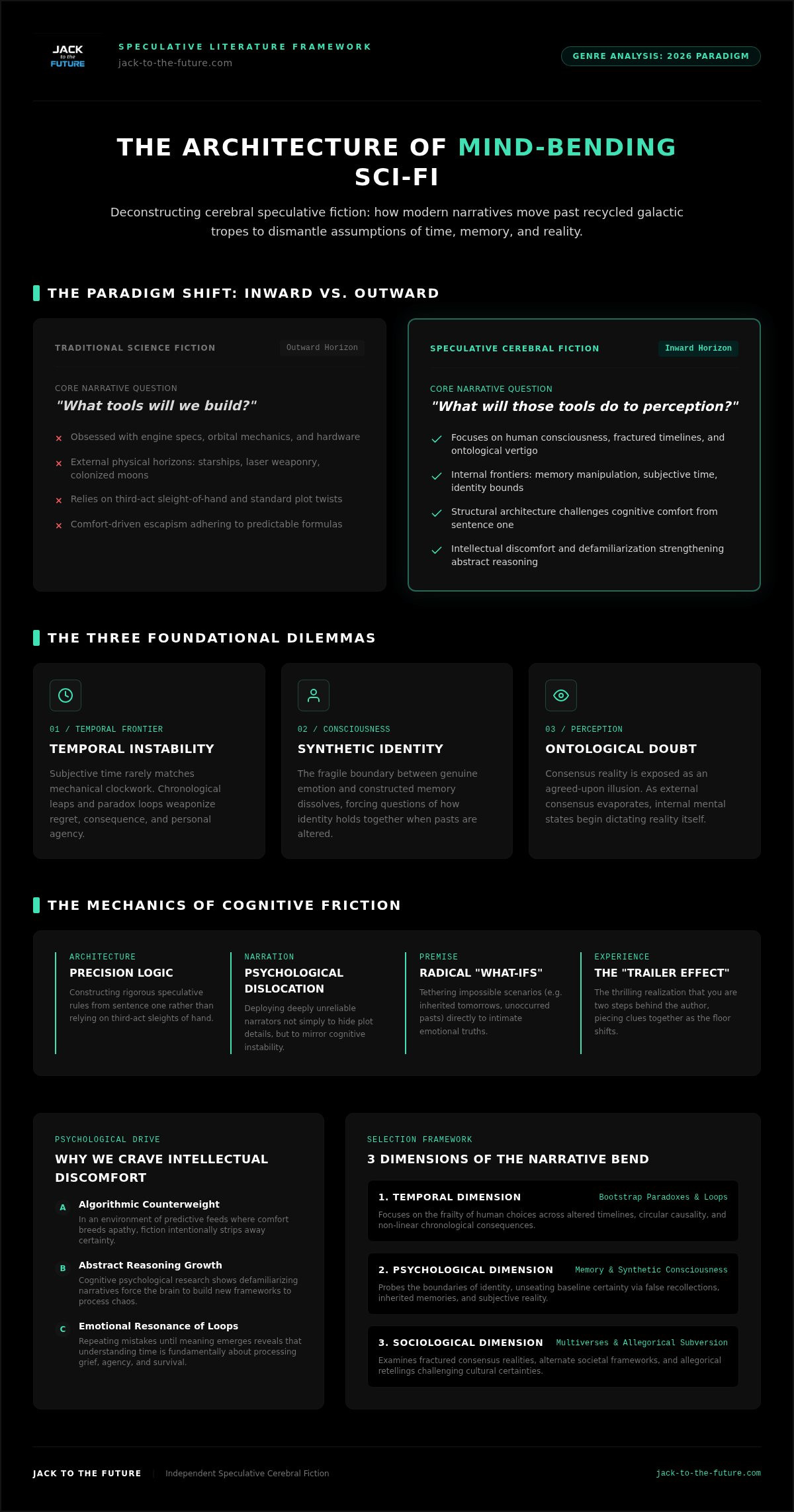
We are witnessing a decisive shift across the genre. Readers have grown exhausted by standard space operas obsessed with engine specs and orbital mechanics. Instead, the focus has pivoted toward "speculative cerebral fiction." This movement treats human consciousness, fractured timelines, and ontological vertigo as the primary narrative engine. The journey itself warps your perception, forcing you to question how memory and personal identity hold together when external consensus evaporates.
The Mechanics of Cognitive Dissonance
How does a narrative systematically unseat your grip on reality? It starts by engineering cognitive friction. Authors deploy deeply unreliable narrators not just to conceal plot facts, but to mirror psychological dislocation. The core hook always hinges on a radical "what-if" grounded in an emotional truth you recognize: What if your tomorrow is an inherited memory? What if your past never occurred? By tethering the impossible to something intensely intimate, the story pulls you into uncharted intellectual territory.
Speculative readers aren't chasing simple escapism. Intellectual curiosity drives this audience. The thrill comes from deciphering a narrative puzzle that refuses to offer easy, comforting resolutions.
Speculative vs. Traditional Science Fiction
Traditional science fiction looks outward toward starships, laser weaponry, and colonized moons. Cerebral speculative writing turns inward to explore the psychological frontier. Within the broader speculative fiction genre, the central question shifts from "What tools will we build?" to "What will those tools do to our perception of existence?"
Speculative fiction serves as an indispensable cognitive framework for processing the disorienting complexities of modern reality. It dismantles artificial certainty. When you strip away technological window dressing, the best mind-bending sci-fi novels leave you grappling with essential, haunting dilemmas:
- Temporal instability: Subjective time rarely matches mechanical clockwork.
- Synthetic identity: The boundary between genuine emotion and constructed memory dissolves.
- Ontological doubt: The realization that consensus reality might merely be an agreed-upon illusion.
The Psychology of the Unknown: Why We Crave Intellectual Discomfort
Why voluntarily subject yourself to cognitive vertigo? Simple. True adventure is a cerebral act... moving through conceptual minefields rather than physical geography. In a world saturated with algorithmic feeds predicting your next move, comfort breeds apathy. Mind-bending sci-fi novels act as cognitive counterweights. They intentionally yank away certainty, pushing you into narratives where baseline rules shatter. We crave the "trailer effect," that electrifying realization that you are two steps behind the author, desperately piecing clues together as the floor shifts beneath your feet.
Research into the cognitive psychological benefits of fiction confirms that navigating complex, defamiliarizing stories strengthens our capacity for abstract reasoning. When fiction deprives you of predictable resolutions, it forces your brain to build new frameworks for understanding chaos.
The Architecture of Time Perception
Time travel fiction rarely succeeds because of complex flux capacitors. It resonates because it weaponizes regret, consequence, and hope. A chronological leap lays bare the frailty of our choices. Temporal loops amplify this dynamic; trapped characters must repeat mistakes until meaning emerges from the cycle. These high-concept journeys into human awareness echo the core themes explored in our survey of sci-fi books about consciousness, where internal mental states dictate reality itself.
Looping narratives show us that understanding time is fundamentally about understanding grief, agency, and survival.
Memory and Identity as Narrative Playgrounds
Who remains when your past is rewritten? Modern readers gravitate toward stories that dissect the architecture of the self. What if the formative trauma defining your adulthood never happened to you, but to a divergent version of yourself across another branch? Speculative authors use alternative timelines not just as scientific playgrounds, but as emotional mirrors reflecting our fragmented digital lives.
This focus on cognitive identity explains why speculative narratives resonate so deeply right now:
- Erosion of objective truth: When external data can be modified, personal conviction becomes your only anchor.
- The weight of potential selves: Fractured timelines visualize the haunting reality of paths not taken.
- Radical defamiliarization: Forcing a protagonist to unlearn their own name strips away social conditioning down to raw survival instincts.
If you're ready to step beyond mainstream conventions, exploring an independent digital author platform like Jack to the Future offers direct entry into bold, boundary-pushing fiction designed to challenge your cognitive boundaries.
Core Tropes of Mind-Bending Sci-Fi: From Paradoxes to Retellings
Every reality-distorting narrative relies on a deliberate framework. Without precise rules, narrative complexity collapses into arbitrary chaos. The finest mind-bending sci-fi novels deploy recognizable temporal and philosophical puzzles, using them as launchpads to destabilize our everyday assumptions. When an author constructs an impossible premise with surgical logic, your mind races to reconcile the contradiction.
Understanding these tropes reveals the structural genius behind the world's most gripping speculative fiction:
- The Grandfather Paradox: A traveler changes history, inadvertently erasing their own existence. The question is inevitable: if you never existed, who traveled back to alter the past?
- The Bootstrap Paradox: An object, idea, or memory travels backward in time, becoming the exact catalyst that created it. Information exists without origin, floating in an infinite, self-fulfilling loop.
- Bifurcated Realities: A single, mundane decision cleaves spacetime into branching multiverses. Two versions of one soul diverge forever based on an unmade phone call.
The Art of the Time Travel Retelling
Deconstructive retellings represent one of the boldest movements in modern speculative writing. Authors take beloved cultural blueprints and fracture them through a high-concept lens. Consider The Wizard of Oz. In its original form, it is a straightforward fairy tale about returning home. Subvert that journey through relativistic physics, and the yellow brick road transforms into an unforgiving temporal corridor.
This is where visionary indie author Jack Felson excels. In his speculative work, classic cultural allegories undergo radical pressure testing. By tethering dizzying temporal disorientation to a mythic narrative framework readers already know, the emotional stakes remain clear even while consensus reality disintegrates.
Multiverse Logic and Narrative Stakes
Infinite realities pose a significant storytelling hazard: if every outcome happens across parallel dimensions, why do individual consequences matter? Groundbreaking authors solve this through the "emotional anchor" principle. Engaging with the complex psychological benefits of speculative fiction proves that readers thrive on narrative ambiguity, provided the protagonist's core emotional struggle remains deeply relatable.
Non-linear formats replace standard chronology with fractured chronologies. You experience the story as a jigsaw puzzle. You witness the consequence before the catalyst, the future tombstone before the fateful departure. Masterful mind-bending sci-fi novels make every loop count. The goal is never confusion for its own sake; it is using cognitive disruption to illuminate what makes us human.
How to Choose Your Next High-Concept Digital Read
Mainstream recommendation algorithms are built for consensus, not revelation. They push whatever is trending, funneling readers toward familiar, watered-down plots. Finding authentic mind-bending sci-fi novels requires a deliberate filtering system. If you want a book that genuinely recalibrates your view of existence, you must choose based on structural daring rather than crowd-pleasing popularity.
Use this four-step strategy to locate your next intellectual obsession:
- Identify your preferred "bend": Decide which cognitive axis you want challenged. Do you crave temporal instability (loops and paradoxes), psychological dissonance (unreliable memory and synthetic consciousness), or radical sociological speculation?
- Look for independent voices: Corporate publishing houses prioritize safety and committee-approved formulas. Independent creators take the unhinged creative risks where genuine speculative breakthroughs happen.
- Prioritize instant digital delivery: Cerebral reads demand immediate momentum. Choosing digital downloads eliminates friction, placing complex, visionary text straight onto your device without waiting.
- Demand speculative depth over action fluff: Check whether the narrative's central hook explores existential questions or simply uses futuristic gadgets to dress up a conventional thriller.
The Visionary Reader’s Checklist
Before committing your evening to an unfamiliar premise, run it through three decisive tests. Does the narrative challenge an unquestioned baseline truth about human existence? Has the author demonstrated an appetite for bold, rule-breaking storytelling? Finally, is the electronic file format cleanly configured for seamless reading on your phone, tablet, or dedicated e-reader?
If a book checks all three boxes, you are ready to cross into uncharted conceptual territory.
Why Indie Ebooks are the Frontier of Speculative Fiction
The real avant-garde lives outside corporate publishing conglomerates. Indie authors bypass editorial compromise, crafting sharp, uncompromised visions directly for hungry readers. This direct creator-to-reader relationship preserves the raw edges of high-concept thought experiments. For a comprehensive breakdown on evaluating non-traditional releases, consult our High Concept Sci-Fi Ebooks: 2026 Buyer’s Guide to refine your personal reading parameters.
Ready to skip the algorithm and dive into an uncompromising journey? Explore the digital ebook catalog at Jack to the Future and download your next mind-bending speculative odyssey directly from the author today.
Jack Felson and the Future of Mind-Bending Narratives
Mainstream publishing plays it safe. Algorithms prioritize predictable plots, watering down complex ideas until they feel familiar. Enter the voice of the digital rebellion: Jack Felson. Operating completely outside the corporate publishing funnel, Felson writes for thinkers who crave cerebral friction over comfortable resolutions. His author-direct platform, Jack to the Future, treats narrative as an active portal into the unknown. It is an exploration grounded in travel, philosophical progression, and unresolved existential mystery.
For readers hunting for genuine mind-bending sci-fi novels, Felson delivers stories that refuse to compromise conceptual integrity. The storytelling moves with cinematic velocity, leaving room for your mind to grapple with the implications.
Charlie’s Trips: A Deep Dive into Speculative Retelling
What happens when an iconic journey shatters across relativistic spacetime? In Charlie’s Trips, Felson reconstructs a classic American allegory through an uncompromising speculative lens. Charlie Bradshaw, a young soldier thrust across fragmented temporal corridors after a violent Midwest tornado, discovers that chronological continuity has completely collapsed. He develops a haunting amnesic psychic condition; he remembers the future in vivid fragments while his own past evaporates.
It is an intense, concept-heavy read engineered for the intellectually bold. To see how classic myth transforms into temporal disorientation, read our breakdown of Charlie’s Trips: A Masterclass in Time Travel Retelling.
Start Your Journey: Instant Digital Downloads
No waiting. No shipping delays. Cerebral reads require immediate momentum.
Purchasing author-direct guarantees instant access to electronic files. You load bold speculative sci-fi ebooks directly onto your tablet, phone, or e-reader in seconds. Curating a personal virtual shelf with visionary fiction shouldn't involve corporate distributors dictating what gets written. When you buy direct, you step into an authentic dialogue between storyteller and reader.
Step past formulaic fiction. Challenge your cognitive boundaries right now: Explore the Jack to the Future catalog and download your next mind-bending read.
Step Beyond the Edge of Consensus Reality
Predictable formulas don't satisfy when you crave authentic intellectual vertigo. The most powerful mind-bending sci-fi novels don't offer tidy, comfortable answers. They pull apart the fragile scaffolding of memory, linear time, and human identity. By daring to look past corporate publishing's safe templates, you discover stories engineered with sharp speculative logic... fiction that actively refuses to let your thoughts rest.
That visionary frontier lives outside algorithmic echo chambers. By specializing in cerebral time travel narratives and philosophical paradoxes, Jack to the Future cuts out corporate middlemen. You get direct-from-author pricing alongside instant digital access upon purchase, putting uncompromising high-concept ebooks directly into your hands without friction or delay.
Your next intellectual obsession shouldn't feel familiar. It should challenge everything you thought was fixed. Explore the speculative catalogue of Jack Felson now, dive into Charlie's Trips, and experience speculative fiction stripped of its safety rails.
Frequently Asked Questions
What are the best mind-bending sci-fi novels for beginners?
Beginners should look for stories that anchor complex paradoxes in familiar human dilemmas. Philip K. Dick's Ubik and Ted Chiang's speculative short fiction serve as excellent entry points because they focus heavily on perception rather than technical physics. If you want a narrative that balances classic adventure storytelling with disorienting chronological loops, start with deconstructive retellings like Charlie's Trips to ease into fractured narrative structures.
Is time travel considered speculative fiction?
Yes, time travel is one of the core pillars of speculative fiction. Rather than simply forecasting realistic technological advancements, it constructs "what-if" thought experiments that fundamentally alter physical laws. Authors use temporal displacement to explore philosophical questions about historical inevitability, human agency, and how our memories define personal identity when linear cause and effect break down.
How does Charlie’s Trips differ from a standard time travel story?
Most time travel tales rely on machines or intentional journeys to fix history. Charlie’s Trips upends this convention by transforming the protagonist into an involuntary temporal traveler who remembers future events while losing his past. By layering this amnesic psychic condition over the structural framework of The Wizard of Oz, the story reimagines a classic myth into a psychological exploration of survival across shattered timelines.
Where can I buy indie sci-fi ebooks with instant download?
You can purchase independent speculative titles directly through author-run platforms like Jack to the Future. Buying directly from an author's digital store eliminates retail distributor markups and delivers electronic files straight to your inbox. Upon completing checkout, you receive immediate digital delivery, allowing you to load high-concept novellas onto your preferred e-reader or tablet without waiting.
What is the difference between mind-bending sci-fi and hard sci-fi?
Hard science fiction prioritizes rigorous adherence to known scientific principles, orbital mechanics, and engineering feasibility. In contrast, mind-bending sci-fi novels focus on cognitive friction, ontological doubt, and subjective perception. While hard sci-fi asks how an engine operates in deep space, mind-bending narratives question whether the traveler's consciousness and memories are authentic or merely constructed simulations.
Can I read speculative fiction ebooks on any device?
Yes, author-direct speculative sci-fi ebooks are designed for universal compatibility across modern reading devices. Digital downloads arrive in standard formats like EPUB, which open seamlessly on Apple Books, Kobo, Android tablets, smartphones, and desktop readers. Kindle users can also transfer these files directly to their devices using their unique Kindle email address or Amazon's standard file-sharing tools.
Why is Jack Felson considered a visionary sci-fi author?
Jack Felson stands out for his refusal to follow formulaic publishing conventions. Drawing from a long background in screenwriting and speculative prose, he creates fast-paced, high-concept narratives that deconstruct timeless allegories through psychological temporal mechanics. His digital-first focus under the Jack to the Future banner delivers uncompromising cerebral fiction directly to readers who demand narrative daring over commercial tropes.
0 comments