

What if the most advanced piece of technology in the universe isn't a starship or a Dyson sphere, but the fragile, messy architecture of your own consciousness? It's a question that haunts the edges of every great story. You've likely felt the frustration of picking up a book that promises a galaxy of wonder, only to find it's all "tech" and no "soul." It's exhausting to wade through dry, academic jargon when all you wanted was an adventure that actually meant something. You want the thrill of the unknown, not a textbook.
We agree that you shouldn't need a PhD to enjoy a story that challenges your reality. This is your roadmap to philosophical science fiction, a genre that functions as a visceral journey into the soul rather than a lecture in the stars. Discover how these narratives use the "what-if" to examine memory, identity, and the ethics of the future. We will demystify the subgenres, offer a curated list of accessible yet deep digital reads, and give you a new lens to appreciate speculative narratives. Prepare to explore the unknown... and find yourself in the process.
Key Takeaways
- Strip away the academic jargon to see why philosophical science fiction is a visceral, high-stakes exploration of the soul... not just a lecture in the stars.
- Navigate the psychological ripple effects of speculative tech, from the ethics of mind-uploading to the haunting weight of temporal destiny.
- Learn to distinguish between the hard physics of "how" a starship flies and the speculative "why" behind the journey’s impact on human identity.
- Master a simple two-step framework for identifying the "core distortion" in any story to unlock its hidden layers of allegorical subtext.
- Discover how reimagining classic foundations, such as the time-travel retelling in Charlie’s Trips, provides a modern lens on the human experience.
Myth: Philosophical Science Fiction is Just "Smart" People Talking
Forget the image of pipe-smoking academics debating in a dusty study. That isn't what we're doing here. True philosophical science fiction doesn't sit still; it's a high-stakes simulation of the human condition. Many readers assume the genre is a dry exercise in logic. They're wrong. It's actually the "What If" that bites back. It’s the difference between asking how a laser works and asking who you become after you pull the trigger.
This genre belongs to the long tradition of philosophical fiction, where the narrative isn't just a backdrop for an idea. The idea is the predator. The story is the hunt. Your brain craves these speculative puzzles because they force you to confront the unknown. They aren't just stories; they're cognitive tests. If Hard Sci-Fi is about the "how" of the machine, then this is about the "why" of the ghost inside it. It’s about the ethics of the future... and the weight of the past.
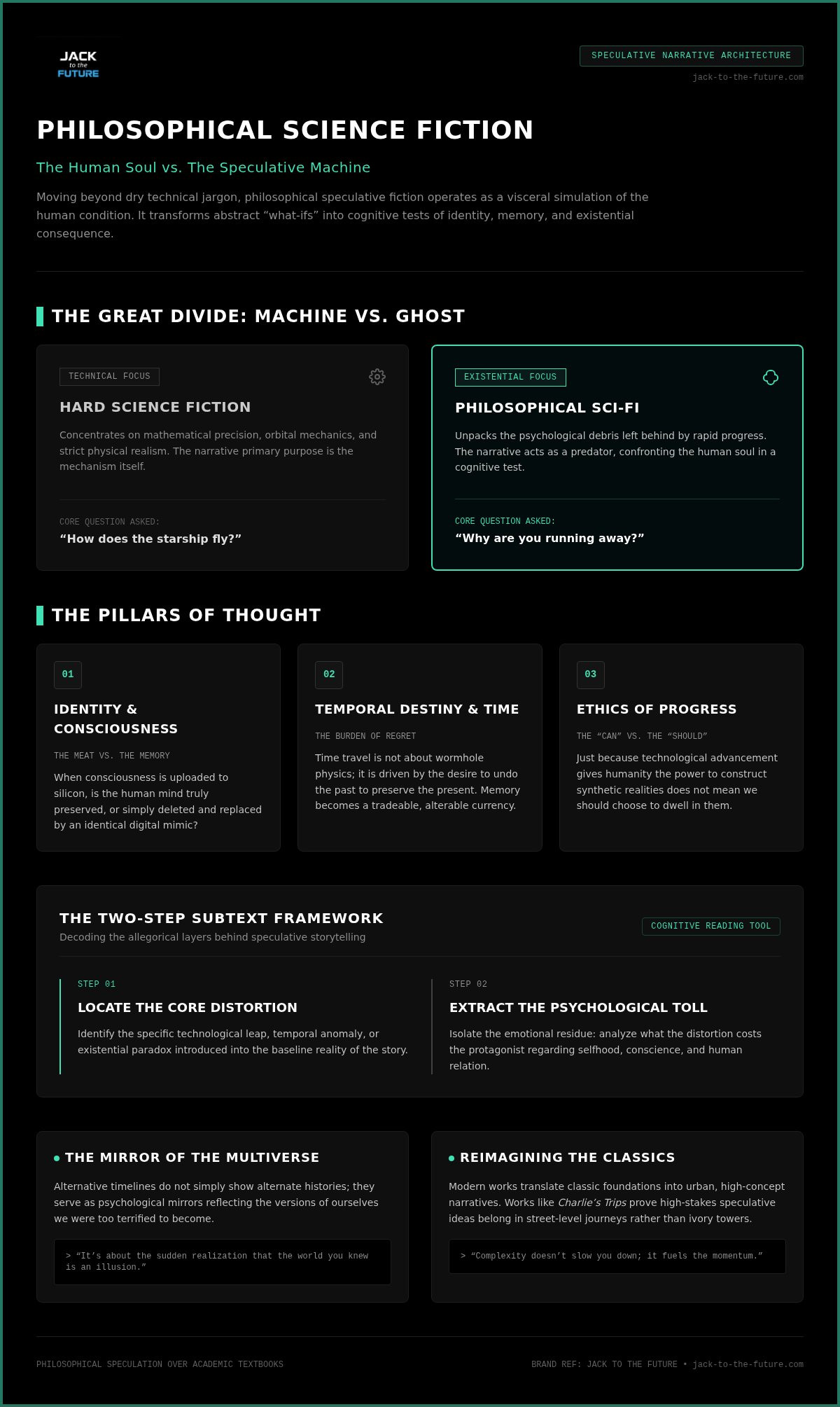
- Hard Sci-Fi: Focuses on equations, orbital mechanics, and technical realism. It asks how the starship flies.
- Philosophical Sci-Fi: Focuses on the psychological debris left behind by progress. It asks why you're running away.
The Visceral Side of Speculation
These stories act as thought experiments for the soul. Think of them as a cinematic montage of your own existential dread. Modern narratives often use a fast-paced rhythm to hide deep, unsettling questions. A well-placed paradox can hit harder than any kinetic explosion. It's about the feeling of the journey... the sudden realization that the world you knew is an illusion. It is visceral. It is immediate. It is anything but boring. The stakes aren't just survival; they're the definition of what it means to be human.
Beyond the Ivory Tower
You don't need a PhD to explore these territories. Writers like Philip K. Dick or modern visionaries like Jack Felson prove that high-concept ideas can live in the streets. This is an urban sensibility. It's edgy. We're reframing "dense" as "rich" and "rewarding." In speculative ebooks like Charlie’s Trips, the focus remains on the impact of the journey. The complexity doesn't slow you down; it fuels the momentum. It’s a curated experience for those who want more than just chrome and laser fire. It’s about discovery... and the thrill of the unknown.
The Pillars of Thought: Identity, Time, and the Ethics of "What If"
The core of the genre isn't the hardware. It's the headache. The beautiful, existential headache of being alive. While space operas focus on the scale of the empire, philosophical science fiction focuses on the scale of the individual. It asks the questions we usually avoid. What defines you? Is it the meat... or the memory? If you upload your consciousness to a silicon wafer, do you survive the transition? Or is the original you simply deleted; replaced by a perfect, digital mimic? This isn't just a plot point. It's a crisis of the self.
These narratives function as philosophical thought experiments that test our values in a vacuum. Take temporal logic. Time travel adventure novels aren't really about the physics of wormholes. They're about the crushing weight of regret. They explore the desire to undo the "then" to save the "now." It’s a dance with destiny that often reveals we're prisoners of our own nature, no matter which century we inhabit. In these worlds, memory becomes a currency. It's the architecture of the past, something that can be traded, edited, or erased to suit the needs of the powerful.
The morality of progress is the final pillar. Just because we can build a world, should we live in it? Philosophical science fiction forces us to confront the "should" before the "can" becomes a reality. You can start your own journey into these concepts with speculative sci-fi ebooks that push the boundaries of reality.
The Mirror of the Multiverse
Alternative timelines allow us to peer into the shadows of our own choices. They show us the versions of ourselves we were too afraid to become. In many alternative timeline sci-fi novels, the focus isn't on the divergence itself. It's on the psychological weight of living multiple lives. It challenges our current reality by suggesting that "now" is just one of a billion possibilities. It makes the mundane feel fragile... and the extraordinary feel inevitable.
The Ethics of the Future
AI isn't just a robot with a gun. It's a mirror. It asks if consciousness is a biological privilege or a logical inevitability. As the line between man and machine blurs, our societal structures begin to crumble. Are these speculative worlds a warning or a blueprint? The best stories don't give you answers. They leave you staring at the ceiling at 3 AM, wondering if your own thoughts are as original as you think they are.
Speculative Fiction vs. Hard Sci-Fi: The Great Divide
The divide is stark. Equations vs. emotions... the blueprint vs. the soul. In the vast expanse of the genre, readers often find themselves at a crossroads between the technical and the conceptual. Hard sci-fi demands accuracy. It’s the thrill of the "how." It's the engineering of a starship... the cold, hard logic of physics and the specific delta-v required to break orbit. But philosophical science fiction plays a different game. It’s about the passenger, not the vehicle. It's less concerned with the fuel type of the rocket and more with the psychological debris left in its wake.
This is why speculative fiction for adults often leaves the technical manuals behind. It prioritizes the human condition over orbital mechanics. It focuses on the philosophical questions explored through science fiction, such as the nature of reality or the ethics of synthetic life. Can a book be both? Certainly. The sweet spot exists where logic meets lore. It’s that rare narrative where the world feels grounded in reality, yet the questions it raises keep you staring at the stars long after the final page.
The Hard Sci-Fi Perspective
Hard sci-fi is the realm of the builder. It focuses on scientific plausibility and technological detail with obsessive care. There is a specific, visceral thrill in "getting the science right." These are gadget-first narratives... stories where the solution to a problem is found in a math equation or a clever piece of engineering. It’s methodical. It’s grounded. It’s the poetry of the machine.
The Philosophical Speculation Perspective
The speculative side is the realm of the visionary. Here, the focus shifts to psychological impact and sociological shifts. It’s about the "vibe" of the unknown... prioritizing atmosphere and mystery over spec sheets. In this space, the "feeling" of a story matters more than the mechanics of the FTL drive. It explores how a single technological shift can break a character’s identity or reshape an entire culture. It’s a journey into the interior... a search for meaning in a universe that often feels indifferent to our existence.
Reading for the Subtext: A Visionary’s Guide to Deep Sci-Fi
Watching a story unfold is one thing. Hunting for its soul is another. To truly appreciate philosophical science fiction, you must look past the starships. You need to read between the lines of code. It’s about identifying the architecture of the "what if." This isn't a passive experience. It’s a pursuit. Here is your field guide to unlocking the depth within the digital pages.
- Step 1: Identify the "Core Distortion." Every speculative world is built on one broken rule. In the tradition of philosophical science fiction, you must ask: what is the one thing that has changed? Is it the end of death? The death of privacy? Find the crack in reality.
- Step 2: Follow the Ripple Effect. Once you find the distortion, watch how it breaks the characters. If memory can be edited, how does a person know who they love? The drama isn't in the tech. It's in the psychological debris.
- Step 3: Look for the "Echo." Every futuristic nightmare is a mirror. How does this problem reflect a current human fear? A story about rogue AI is often a story about our own loss of agency.
- Step 4: Question the Ending. Does the story wrap up neatly, or does it leave you with a new, more dangerous question? A true philosophical ending is rarely a resolution. It’s a transformation.
Unlocking the Narrative Trailer
Modern speculative writing often mimics a cinematic trailer. Short. Punchy. Fragments that build a sense of movement. Reading between the ellipses... that’s where the real story lives. What is the author NOT telling you? This "cerebral" pacing keeps the tension high without drowning you in technical manuals. It’s about the vibe. The atmosphere. The mystery of what lies just beyond the next page.
Curating Your Virtual Shelf
Mainstream algorithms often play it safe. They give you more of the same. But the edges of the genre are where the boldest ideas survive. Indie sci-fi offers fewer filters and more intellectual risk. You can find these hidden gems through unique sci-fi book downloads that prioritize concept over commercial tropes. It’s the fastest way to start your journey into the unknown. If you’re ready to challenge your perception of reality, explore the collection of speculative sci-fi ebooks available today. Don't just read a story. Inhabit a new world.
Reimagining the Classics: The Ultimate Philosophical Retelling
Why do we keep returning to the source? Because the classics are more than just stories. They are the foundations of our collective consciousness. They provide the map... but we are the ones who decide where to redraw the borders. By using a familiar framework, a writer can bypass the basic world-building and dive straight into the deep end. This is the heart of modern philosophical science fiction. It takes the archetypes we know and twists them until they reveal a truth we've been too comfortable to see. It’s about taking the universal and making it personal again.
The Power of the Retelling
There is a specific, visceral power in the "familiar." It anchors the "extraordinary." When you know the yellow brick road, the author can focus on the shadows lurking just off the path. Reimagining a classic allows us to see old truths in a new light... a harsh, speculative glare that exposes the cracks in the original myth. This is where the rebellious spirit of the indie author thrives. They aren't bound by the rules of the source material. They are free to break the original; to reimagine the hero as an outcast and the journey as a descent into the psychological unknown. It's about taking a story from the past and making it feel like it was written for the anxieties of tomorrow.
Take the case of Charlie’s Trips. It is a masterclass in the genre. Imagine the Wizard of Oz... but stripped of its innocence and injected with the high-stakes complexity of time travel. Jack Felson doesn't just retell a story. He uses familiar tropes to explore unfamiliar psychological territories. He asks: what happens to the mind when the "home" you're looking for doesn't exist in this timeline? It turns a simple quest into a labyrinth of regret and identity. It’s a masterclass in how to use the past to interrogate the future.
Your Next Speculative Journey
For the intellectually bold, Charlie’s Trips is the perfect entry point into philosophical science fiction. It offers the thrill of the "what-if" comparison... Oz like you’ve never seen it before. It’s a journey that challenges your perception of destiny, memory, and the fragility of the self. Because this is a digital experience, you don't have to wait for the mail. There is an instant gratification in the digital download. You can start your odyssey in seconds.
One-time purchase. Infinite exploration. That is the beauty of the ebook. No heavy paperbacks to carry. No waiting for shipping. Just a direct line to a new reality. If you're ready to move beyond the chrome and laser fire, your next journey is waiting. Explore the collection of speculative sci-fi ebooks and find the story that finally asks the questions you've been thinking about at 3 AM. The unknown is just a click away.
Step Into the Unknown
The journey beyond the chrome and laser fire is just beginning. You've seen why philosophical science fiction is more than just tech. It's a high-stakes simulation of the human soul. By looking past the hardware, you've learned to identify the "core distortion" and follow the psychological ripples that define our greatest speculative works. From the ethics of synthetic identity to the heavy weight of temporal destiny. These stories don't just entertain. They transform.
It's time to curate your own virtual shelf with narratives that respect your intelligence. We provide instant access to bold, high-concept narratives designed for the intellectually curious. No waiting. No clutter. Just pure discovery. You'll even enjoy free shipping on all digital ebook downloads as you start your odyssey today. The thrill of the unknown is finally within reach.
Download your next speculative journey at Jack to the Future and find a world where the questions are just as thrilling as the answers. Your next great discovery is only a click away. The unknown is waiting for you. Catch up.
Frequently Asked Questions
What is the best philosophical science fiction book for a beginner?
Start with a story that grounds the extraordinary in the familiar. While classics like Solaris are foundational, many beginners prefer a modern entry point. Philosophical science fiction works best when it uses a relatable hook. Look for narratives that reimagined known archetypes. This allows you to focus on the psychological depth rather than struggling with complex world-building. Digital collections often offer the most diverse range of these cerebral starters.
Is philosophical sci-fi the same as dystopian fiction?
They are distinct categories that often intersect. Dystopian fiction is primarily concerned with societal structures and political oppression. It’s about the "where" and the "how" of a broken world. In contrast, philosophical science fiction is concerned with the nature of existence and consciousness. It asks more fundamental questions about reality. A story can be both, but the focus remains on the interior journey of the individual.
Why do philosophical sci-fi books often involve time travel?
Time travel functions as a laboratory for the soul. It provides a way to examine the architecture of the past and the weight of regret. Authors use it to test how identity survives when the timeline shifts. It’s less about the mechanics of the machine and more about the ethics of the "what if." It challenges our perception of destiny and the persistence of memory.
Can philosophical science fiction be fast-paced and exciting?
It can be just as intense as any space opera. The excitement comes from the ripple effect of a core distortion. When a character’s reality breaks, the stakes become visceral. High-concept ideas require high-octane stakes to stay grounded. It’s a cinematic experience that prioritizes atmosphere and mystery. You aren't just reading a lecture. You're following a fast-paced hunt for the truth.
How do I find indie philosophical sci-fi authors?
Skip the mainstream algorithms that favor commercial tropes. The boldest ideas often live on the fringes of the industry. You can find visionary indie creators by exploring dedicated digital platforms. Jack to the Future offers a curated collection of speculative fiction ebooks that you won't find in big-box stores. These stories are unfiltered and rebellious. They provide a direct line to the author’s original, cerebral vision.
What are some common themes in cerebral sci-fi?
You will encounter several recurring themes that challenge the human condition. These narratives typically explore:
- The persistence of memory in a synthetic world.
- The blurring line between biological and digital identity.
- The ethical consequences of unbridled scientific progress.
Is "Charlie’s Trips" suitable for readers who enjoy philosophical themes?
It is a masterclass in the genre. For readers who crave intellectual exploration, this ebook reimagines a classic foundation to ask deeper questions about destiny. It uses the familiar landscape of Oz to anchor a complex, time-travel narrative. It’s perfect for the intellectually bold who want a visceral journey into the soul. You can get instant access to this high-concept odyssey through a one-time digital purchase.
0 comments