

What if the strangest journey in science fiction happened inside your own mind? The best psychological sci-fi novels use impossible technologies, altered realities, or unfamiliar worlds to make inner life newly visible. Memory shifts. Identity fractures. A choice that seemed simple starts to feel like a test of who you are.
If genre labels feel confusing, you’re not alone. Psychological science fiction can overlap with philosophical or literary sci-fi, but complexity alone doesn’t make a story psychologically rich. Look for a speculative idea that changes how a character understands their memories, relationships, or sense of self.
This guide will help you recognize those qualities and find a book that suits the questions you want to explore, without needing a technical handbook to enjoy the ride. We’ll look at how different novels approach identity, memory, perception, and choice, and how to match a book’s mood to your own, from intimate and unsettling to fast-paced and mind-bending. Then you can choose your next read for the questions it raises, not just the label on its shelf.
Key Takeaways
- See how a speculative premise can turn questions of identity, memory, and perception into personal conflict.
- Use theme and narrative feel to find psychological sci-fi novels that suit the reading experience you want.
- Compare introspective character studies with suspense-led stories that unsettle your sense of reality.
- Choose a book by checking whether its unusual premise serves the character and emotional stakes, not just the puzzle.
- Discover Charlie’s Trips, Jack Felson’s time-travel adventure inspired by classic stories, as a related speculative-fiction read.
What Makes Psychological Sci-Fi Novels Different from Other Science Fiction?
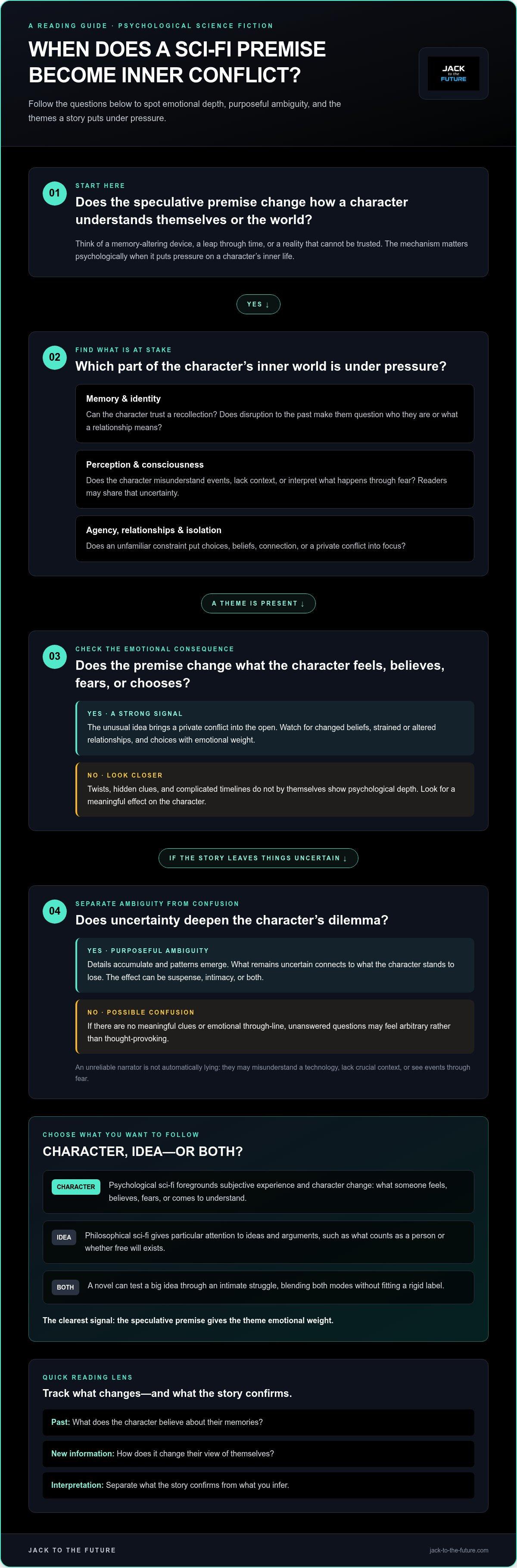
Psychological science fiction uses a speculative premise to test how characters understand themselves and the world around them. A memory-editing device, a leap through time, or a reality that can’t be trusted becomes more than a clever mechanism. It puts pressure on a character’s identity, perception, or choices. The Psychological science fiction entry offers a useful reference point for how the subgenre connects speculative storytelling with psychological fiction.
That focus distinguishes psychological sci-fi from stories driven mainly by engineering problems or external action. A novel might focus on how a character adapts to new technology rather than detailing how the machine works. Or it might use a strange world to make familiar feelings feel uncertain. The science and spectacle still matter, but so does their effect on a character’s inner life.
Complex plotting alone isn’t psychological depth. A story can twist through timelines, conceal clues, and leave reality in doubt without showing much change in its characters. Look for emotional consequences: Does a character question their memories? Do their beliefs or relationships shift? Does the speculative premise bring a private conflict into the open? These are stronger signals than obscurity for its own sake.
Which themes appear in psychological science fiction?
Recurring questions include memory and whether the past shapes who we are; selfhood and what makes someone the same person over time; consciousness and the boundary between thought and experience; isolation and the need for connection; and agency, or how much control people have over their choices. A memory-focused story might ask whether a person can trust a recollection, while one about agency might explore a choice made under unfamiliar constraints.
These themes overlap, but no single checklist defines every book. One novel may center on loneliness; another may use shifting identity to explore belonging. The key is whether the premise gives the theme emotional weight.
How is psychological sci-fi different from philosophical sci-fi?
Psychological stories foreground subjective experience and character change: what a person feels, believes, fears, or comes to understand. Philosophical science fiction gives particular attention to ideas and arguments, such as what counts as a person or whether free will exists. One approach isn’t deeper by default. A novel can explore a big idea through a character’s intimate struggle, blending both modes without fitting a rigid label.
As you browse psychological sci-fi novels, ask what the story wants you to follow: a character’s shifting inner world, an idea being tested, or both. That distinction makes a blurred genre label more useful.
How Psychological Sci-Fi Novels Turn Speculative Ideas into Inner Conflict
A speculative device can expose inner conflict by making a private uncertainty visible and difficult to ignore. A character who can’t trust their memories may also struggle to trust their identity. A timeline that keeps slipping can give regret or grief a shape the character must confront.
The key is the connection between premise and pressure. A memory-altering technology matters psychologically not just because it’s futuristic, but because it raises questions: Which memories feel like mine? Can I trust the person I was? A review exploring the intersection of the two fields, Science Fiction and Psychology, considers how science fiction can bring psychological concepts into view. In a novel, those ideas gain force through what the character experiences and the choices they face.
How do memory and identity shape psychological sci-fi?
Memory gives a character a sense of continuity, a story linking who they were to who they are now. Disrupt that past and the character may question more than whether an event happened. They may wonder whether their interpretation is reliable, or whether a relationship still means what they thought it meant. Psychological sci-fi novels can turn the gap between remembering and trusting a memory into emotional suspense without revealing every answer at once.
For a spoiler-light way to read this kind of story, notice what a character believes about their past, then watch how new information changes their view of themselves. A shifting perspective may invite several interpretations. Distinguish what the story confirms from what you infer.
What does an unreliable perspective add to a sci-fi story?
An unreliable perspective limits what readers know. The narrator might misunderstand a technology, lack crucial context, or interpret events through fear. That doesn’t automatically mean they’re lying. Instead, readers share the character’s uncertainty, weighing observations against assumptions as the story unfolds. The result can be suspense, intimacy, or both.
Ambiguity works when it feels purposeful: details accumulate, patterns emerge, and uncertainty deepens the character’s dilemma, even if no twist resolves everything. Confusion is different. If the story offers no meaningful clues or emotional through-line, unanswered questions may feel arbitrary rather than thought-provoking. Look for a clear connection between what remains uncertain and what the character stands to lose.
If time-travel premises interest you, Jack Felson’s speculative science-fiction ebooks offer a related discovery: Charlie’s Trips, a time-travel adventure inspired by classic stories. Its premise offers another route into speculative storytelling.
Which Psychological Sci-Fi Novel Fits Your Reading Mood?
Choose by the question you want to carry beyond the final page. Some psychological sci-fi novels draw you close to a character’s shifting sense of self; others use a speculative puzzle to unsettle your grip on reality. The table below matches reader interests to story experiences, using the novels’ stated premises rather than assuming how their plots unfold.
| If you’re curious about… | Look for a story that… | Verified example and why it may suit |
|---|---|---|
| Identity | Places the self under pressure, perhaps through transformation or divided experience. | Sublimation by Isabel J. Kim centers on immigration splitting a person into two selves, making it a fitting starting point for readers interested in identity. |
| Consciousness and technology | Connects an unfamiliar technology to questions about awareness or personhood. | Dead But Dreaming of Electric Sheep by Paul Tremblay is a near-future tech story about a man in a vegetative state with an AI implanted in his brain. |
| Time and disorientation | Uses a disrupted timeline to complicate a character’s experience of the present. | The Traveler by Joseph Eckert follows a man who uncontrollably jumps forward in time, a premise for readers drawn to time’s effect on lived experience. |
| Perception and uncertainty | Restricts what you know, inviting you to question how events are being understood. | Look for a perspective-led narrative that makes uncertainty part of the reading experience, rather than relying only on a final reveal. |
Do you want a story about identity, perception, or consciousness?
Identity-focused fiction asks what makes someone feel like the same person through change. Perception-led stories keep you alert to the gap between what a character observes and what they conclude. Consciousness-centered premises draw attention to thought, awareness, and the boundary between person and technology. A novel may leave these questions open; that can be part of its design, not a promise of a tidy answer. For a broader perspective on the genre’s psychological ideas, see this scholarly analysis of psychological sci-fi.
Do you prefer introspection, suspense, or literary ambiguity?
For introspection, choose a book that gives space to a character’s thoughts and changing self-understanding. For suspense, seek a clear central uncertainty that keeps the pages moving. For literary ambiguity, choose a story that leaves room to interpret what its images or events mean. None is inherently more rewarding; tone shapes the journey. If time and form intrigue you, explore this guide to literary time travel fiction for another angle on stories that bend chronology.
How to Choose Psychological Sci-Fi Novels Without Confusing Complexity for Depth
A striking premise can open the door, but what matters is what the story does with it. Use this three-step filter to choose a book that fits your curiosity and reading mood:
- Choose a theme. Are you drawn to memory, identity, consciousness, isolation, or choice?
- Decide on tone. Look for emotional intimacy, unsettling uncertainty, suspense, or reflective ideas.
- Check narrative style. Consider whether you want a clear, fast-moving story or one that leaves more room for interpretation.
What should you look for in a psychologically rich sci-fi novel?
Notice whether the central speculative idea changes what a character can choose, how they see themselves, or how they relate to others. The emotional consequences matter as much as the concept. A new technology or altered reality should put pressure on something the character values, fears, or believes. If the premise could be removed without changing the character’s conflict, its complexity may be mostly decorative.
Meaningful complexity makes an unusual premise serve the character, the theme, or both. Ambiguous scenes, dense prose, and surprise endings can be effective, but none proves psychological depth on its own. Ask whether uncertainty adds meaning or merely makes the plot harder to follow.
How can you find the right reading experience for you?
Start with the feeling you want from the book. For emotional intimacy, seek a close point of view and space to follow a character’s changing thoughts. For unsettling uncertainty, look for a perspective that limits what you know while offering clues to consider. For idea-led reflection, choose a premise that raises questions you enjoy turning over, even if the story doesn’t resolve them neatly.
Spoiler-light reviews can help you gauge tone and pacing without revealing key turns. If a legitimate preview is available, sample the opening pages. Notice how quickly the story introduces its central question, whether the prose feels inviting, and how much context you need to settle into the narrative. A short sample can tell you more about voice than a label alone.
If time travel is part of your reading interest, the time traveler books guide offers another route into stories shaped by shifting timelines. For a speculative read in that territory, explore Jack Felson’s speculative sci-fi ebooks, including Charlie’s Trips, a time-travel adventure inspired by classic stories.
Where to Go Next: Psychological Sci-Fi and Jack Felson’s Speculative Fiction
Your next read doesn’t need to fit a perfect genre label. Start with the question that interests you, choose a tone that suits your mood, then consider how much ambiguity or narrative complexity you enjoy. That approach helps you find psychological sci-fi novels that feel engaging rather than complicated for complication’s sake.
Could a time-travel adventure be your next speculative read?
Stories that bend time can take familiar ideas, such as cause and consequence, and place them in an unfamiliar frame. That makes time travel a rich area of speculative storytelling, though a time-travel premise alone doesn’t make a book psychological science fiction.
Charlie’s Trips is Jack Felson’s time-travel adventure inspired by classic stories. It’s a related read for anyone curious about time-bending fiction. Visit the Charlie’s Trips overview to learn more about its premise.
What should readers carry into their next book?
Keep three questions in mind as you browse: What theme do I want to explore? What tone am I in the mood for? What narrative style will hold my attention? Emotional intimacy, unsettling uncertainty, and idea-led reflection can all make for rewarding reading, but they offer different experiences. Look for stories where the speculative premise gives those questions room to resonate.
Above all, follow your curiosity. A compelling story can make an ordinary assumption feel strange again, whether it asks what makes a person themselves or what happens when time refuses to stay in order.
For another step into speculative fiction, explore Jack Felson’s downloadable speculative fiction ebooks, including Charlie’s Trips. Ebook access is provided after checkout, so you can move from browsing to your next imaginative journey.
Choose Your Next Journey Through the Mind
The right psychological sci-fi novels don’t need the most tangled plot or the biggest twist. Look for a speculative idea that puts pressure on a character’s choices, relationships, or sense of self. Then match the book’s theme and tone to the reading experience you want, whether that’s intimate, suspenseful, or open to interpretation.
Let curiosity lead you beyond familiar labels. Jack Felson’s independent author platform features downloadable speculative science-fiction ebooks, including Charlie’s Trips, a time-travel adventure inspired by classic stories. Explore Jack Felson’s speculative fiction ebooks and find a new premise to follow. Your next thought-provoking read may begin with one question: what if?
Frequently Asked Questions
What is a psychological sci-fi novel?
A psychological sci-fi novel uses speculative ideas, such as altered memory, unfamiliar realities, or advanced technology, to explore characters’ inner lives. Its focus isn’t only what happens in an imagined world, but how those events affect identity, perception, emotion, and choice. The category can overlap with philosophical and literary science fiction, so a novel may combine approaches rather than fit one strict label.
What are the main themes in psychological science fiction?
Common themes include identity, memory, consciousness, perception, isolation, and personal agency. A story might ask whether someone can trust a memory or remain the same person after a radical change. These aren’t requirements every novel must meet. The defining quality is how the speculative premise brings a character’s inner experience into focus, whether the story centers on one theme or lets several intersect.
Is psychological sci-fi the same as philosophical science fiction?
No, though the two often overlap. Psychological science fiction tends to foreground subjective experience: how characters think, feel, remember, and change. Philosophical science fiction gives particular attention to questions about knowledge, reality, ethics, or existence. A single story can explore both through its characters and ideas. Rather than relying on a strict label, consider whether the novel emphasizes personal experience, abstract questions, or a blend of the two.
How do I choose a psychological sci-fi novel?
Start with the question you want to explore, such as identity, memory, or consciousness. Then consider tone and pacing: do you want introspection, suspense, or ambiguity? Look for a premise that shapes character choices and emotional consequences, not just the imagined world. A spoiler-light description or sample can help you judge whether the voice, pacing, and level of uncertainty suit your reading mood.
Are psychological sci-fi novels difficult to read?
Some psychological sci-fi novels are conceptually demanding, but the label doesn’t automatically mean a book is obscure or difficult. Many use recognizable emotions and accessible characters to explore unusual ideas. Check the pacing, narrative voice, and degree of ambiguity rather than judging complexity by the premise alone. A clear, fast-moving story can still leave you with challenging questions about memory, identity, or choice.
Can a time-travel novel also be psychological science fiction?
Yes. Time travel can raise questions about memory, identity, regret, and the consequences of choice, making it a useful device for psychological storytelling. But a time-travel premise alone doesn’t make a novel psychological; the story’s attention to character and inner experience matters. For a broader look at time-bending fiction and its range of approaches, explore the time traveler books guide.
0 comments