

What if time travel didn’t change the past, but made you question whether you remembered it correctly? The best sci-fi books with complex themes don’t rely on bigger machines or louder battles. They find tension in the friction between time and memory, then unsettle the boundary between identity and reality. If predictable time-travel twists and weightless, disposable plots leave you cold, you’re looking for stories that stay with you after the final page.
This guide explores high-concept speculative fiction for readers who want more than familiar genre machinery. You’ll discover stories that use shifting timelines, uncertain memories, and fractured realities to ask sharper questions about who we are and what we can trust. Expect fresh perspectives, including the possibility of finding a distinctive indie author beyond the usual bestseller lists.
One intriguing example is Jack Felson’s Charlie’s Trips, a time-travel adventure that reimagines The Wonderful Wizard of Oz for adult readers. It’s available as an ebook with instant digital access. Read on for thoughtful picks and ideas to help you choose your next journey into the unknown.
Key Takeaways
- Recognize that complexity comes from the questions a story raises about identity and reality, not simply from scientific detail.
- Explore how time shifts and nonlinear storytelling can make readers reconsider memory, regret, and what counts as truth.
- See how science-fiction retellings of classic stories can challenge familiar ideas about heroism and the journey’s meaning.
- Find sci-fi books with complex themes by looking beyond technical labels and considering speculative fiction and independent voices.
- Discover how Jack Felson’s Charlie’s Trips approaches time travel through a fresh, classic-inspired lens.
What Makes Sci-Fi Themes Truly Complex?
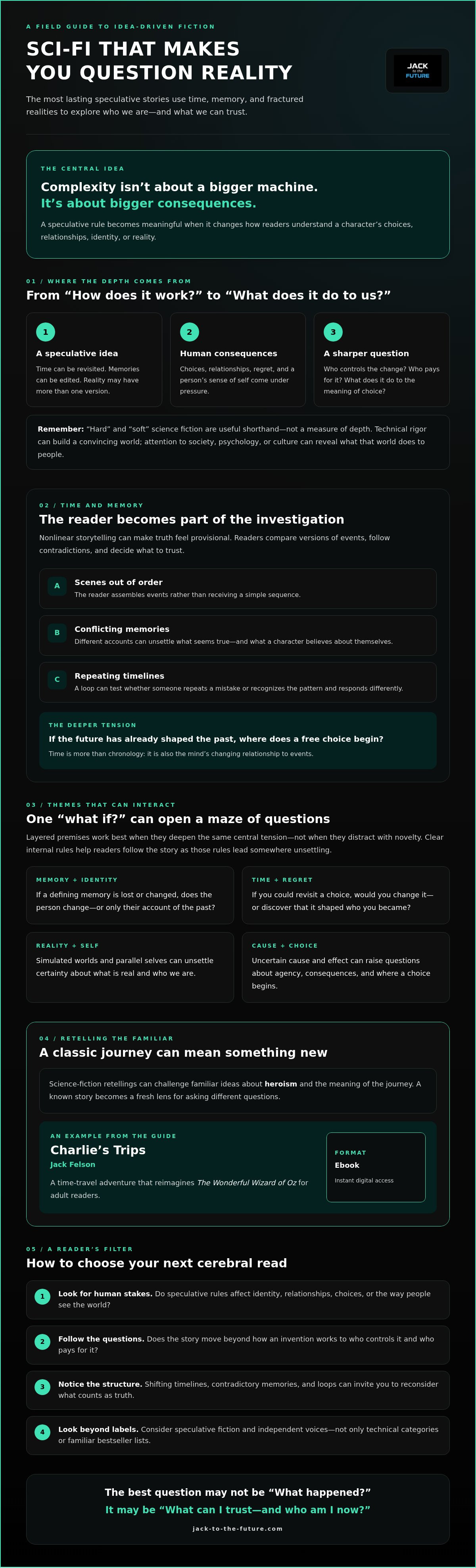
A cerebral shift happens when a speculative idea does more than power the plot. It changes how readers interpret a character’s choices, relationships, or sense of self. A story can feature advanced technology and still feel emotionally simple; another can bend one familiar rule of reality and open a maze of questions. Complexity lives in the consequences.
Complex sci-fi is a mirror to modern anxiety, reflecting fears about identity, control, and whether the truths we rely on can be trusted. That makes it more than a puzzle to solve. It gives readers a way to examine human concerns from an unfamiliar angle, without requiring a story to predict the future or explain every mechanism in scientific detail.
The divide between “hard” and “soft” science fiction can be a useful shorthand, but it isn’t a measure of depth. Technical rigor may create a convincing world; close attention to society, psychology, or culture may reveal what that world does to people. The most compelling sci-fi books with complex themes can combine both. Instead of asking only how an invention works, they ask who controls it, who pays for it, and how it changes the meaning of choice.
The Layering of Speculative Ideas
One “what if?” can unsettle a story. Layer several, and their consequences begin to interact. Imagine a society where memories can be edited and time can be revisited: would a changed memory alter a person’s identity, or merely their account of the past? Each added premise should deepen the same central tension, not distract with another novelty. Internal consistency helps readers follow the rules, even as those rules lead somewhere unsettling.
Psychological vs. Technical Complexity
Memory and identity are powerful frontiers because they’re both intimate and unstable. A story might ask whether a person remains the same after losing a defining memory, or whether a remembered event can be trusted when different characters recall it differently. Other reality-bending themes include simulated worlds, parallel selves, and uncertain cause and effect. The technology may invite curiosity, but the emotional question gives the idea weight: how would this feel to live through?
That shift from “how does it work?” to “what does it do to us?” is central to philosophical fiction. Philosophical fiction explores ideas through narrative, and science fiction can use its imagined worlds to make abstract questions immediate. As you choose your next read, look for stories where speculative rules have human consequences and where the reader’s imagination helps connect the clues. The answer shouldn’t be handed over too soon. It should change the question.
The Architecture of Memory and Time Perception
A time machine can take a character into the past. The harder journey is facing what the past means now. In thoughtful speculative fiction, time travel becomes a pressure test for regret and identity: if you could revisit a choice, would you change it, or discover that it shaped the person you’ve become? The device matters less than the emotional consequences of using it.
Nonlinear storytelling makes readers part of that investigation. A scene shown out of order, a memory that contradicts another account, or a loop that quietly resets the stakes can make the truth feel provisional. You’re not just following events; you’re comparing versions and deciding what to trust. That structure can bring the character’s uncertainty into the reading experience itself.
Temporal Loops and Identity
A repeating timeline reveals character through choices made under pressure. Does someone keep repeating a mistake, or notice the pattern and respond differently? The paradox is more than a puzzle or potential plot hole. It raises questions about agency and cause: if the future has already shaped the past, where does a free choice begin? For another perspective on idea-driven stories, explore this guide to cerebral science fiction books.
Loops also bring consciousness into the architecture of time. A character may remember events that technically haven’t happened yet, while others experience each cycle as new. That gap creates tension between objective chronology and lived experience. Time is not only a sequence of moments; it’s the mind’s changing relationship to them.
Speculative Fiction for Adults
Adult-oriented time travel can carry the weight of accumulated decisions, relationships, and aging. Instead of treating the past as a playground for endless do-overs, a story can ask what it means to accept an irreversible loss or live with a choice. That isn’t necessarily pessimism. It can make change feel earned, and the present more consequential. See how speculative fiction for adults approaches cerebral storytelling.
For broader reading inspiration, NPR’s 50 best science fiction and fantasy books roundup offers a curated point of discovery. Readers drawn to bold time-travel questions might also explore Jack Felson’s Charlie’s Trips, a speculative adventure reimagining The Wonderful Wizard of Oz for adults. Its ebook is available through Jack to the Future’s speculative sci-fi ebooks.
Reimagining the Classics: A Masterclass in Complexity
A familiar story gives a speculative writer a powerful starting point. Readers already carry its characters, symbols, and expectations in memory, so a retelling can spend less time establishing the basic framework and more time questioning what it means. What happens when a familiar journey unfolds under new rules of time or reality? The recognition creates a point of entry. The changes create friction.
That friction can turn the traditional Hero’s Journey inside out. A hero’s departure might become a test of whether escape is possible; a return might raise questions about which version of home, or of the self, is real. Science fiction makes those tensions newly strange through altered timelines, imagined technologies, or worlds that no longer obey familiar assumptions. The result isn’t automatically complex, but it can make old archetypes feel newly uncertain.
From Oz to the Multiverse
Charlie’s Trips by Jack Felson draws on The Wonderful Wizard of Oz, bringing a well-known classic into adult speculative territory through a time-travel adventure. That premise creates an intriguing meeting point: nostalgia offers recognition, while speculative exploration invites readers to reconsider the story’s familiar frame. Rather than treating the classic as untouchable, a retelling can use its archetypes as material for fresh questions about choice, identity, and the stories people inherit.
This approach also challenges the idea that retellings belong only to one audience or mode. Familiar source material can support cerebral adult fiction when the new narrative uses it to examine consequential ideas, not simply replay beloved scenes. The pleasure is double: noticing what remains recognizable, then discovering what the new lens makes strange.
Retelling as a Narrative Puzzle
A speculative retelling is a dialogue between the story’s past and an imagined future, with each version changing how the other is understood. Readers bring knowledge of the source, then use it to spot echoes, gaps, and deliberate reversals. A changed role or altered destination may signal more than a surprise; it can challenge assumptions about who gets to be the hero and what a journey is meant to resolve.
That layered reading can make retellings especially rewarding for readers seeking sci-fi books with complex themes. The original supplies one pattern; the speculative version tests it against new possibilities. Look for retellings that transform the source’s central questions rather than relying on recognition alone. In Charlie’s Trips, the classic-inspired framework meets time travel, creating space to consider how a familiar narrative might shift when its relationship with time changes.
How to Choose Your Next Cerebral Read
A bestseller badge can show what’s popular, but it won’t tell you whether a story will challenge your assumptions. To find sci-fi books with complex themes, look beyond sales labels and ask what the premise does to the characters’ inner lives. “Speculative” can be a useful tag when you’re seeking stories about possibilities and human consequences, while “hard sci-fi” often signals a stronger emphasis on scientific detail. Neither label guarantees depth, so use them as clues, not verdicts.
Scan the description for themes such as time perception, memory, identity, or an unstable sense of reality. Then test the central “what if?” Is it mainly a gadget that drives the action, or an idea that could change how someone understands themselves or the world? Complexity feels earned when the premise reshapes a character’s choices, not when technical language simply makes the plot harder to follow.
The Digital Advantage for Discovery
Independent authors can bring distinctive perspectives and take creative risks with structure or premise. Exploring indie speculative fiction is one way to move beyond familiar bestseller filters and encounter narratives built around unusual questions. Digital ebooks also make it possible to access available reads instantly and build a personal virtual shelf around the themes you want to explore, from fractured timelines to shifting identity.
Evaluating High-Concept Premises
Before choosing a story, consider whether its central idea unsettles your view of reality and whether the characters’ responses give that idea emotional weight. A useful premise opens a question; compelling storytelling follows its consequences. For more guidance on assessing ambitious premises, explore this guide to high-concept sci-fi ebooks.
- Look for human stakes: Does the speculative idea affect a character’s memory, relationships, or sense of self?
- Check for purposeful structure: Do timeline shifts or unanswered questions deepen the experience?
- Notice the balance: Is the world understandable enough to let you focus on its meaning?
These questions help distinguish a genuinely thought-provoking read from one that uses complexity as decoration. If you’re ready to explore an independent perspective, discover Jack Felson’s speculative sci-fi ebooks, including Charlie’s Trips, a time-travel adventure inspired by classic stories.
Jack Felson: Speculative Fiction for the Visionary
For readers who want science fiction to unsettle as well as entertain, independent voices can offer a different route into the genre. Jack to the Future presents Jack Felson’s speculative sci-fi ebooks, built around bold ideas and questions that reach beyond the machinery of time travel. This is the digital rebellion: choosing a distinctive perspective over another familiar formula, and following a story willing to test the edges of reality.
Felson’s Charlie’s Trips brings that spirit to a time-travel adventure inspired by The Wonderful Wizard of Oz. Its classic-story foundation gives adult readers a recognizable point of entry, while the speculative frame invites them to consider how time can change the way a story is understood. It’s a strong choice for readers seeking sci-fi books with complex themes, especially those drawn to the tension between familiar narratives and unexpected possibilities.
Charlie’s Trips: A Masterclass in Retelling
A retelling can do more than revisit a beloved story. It can use recognition to make readers question what they thought they knew. In Charlie’s Trips, the combination of a classic narrative and time travel creates room to reconsider how a journey shapes its traveler, and how new possibilities can shift the meaning of a familiar framework. Read more about Charlie’s Trips by Jack Felson and its approach to time-travel retelling.
The appeal is not simply nostalgia. For adult readers, the pleasure lies in seeing a familiar story through a more speculative lens, where the expected path can open onto fresh questions. Felson’s work offers an invitation to approach classic inspiration with curiosity rather than reverence, and to let imagination unsettle the boundaries of the known.
Join the Future of Speculative Fiction
Jack to the Future focuses on digital-only speculative sci-fi ebooks, giving readers instant digital access to its available stories. That format suits spontaneous discovery: find a premise that sparks your curiosity, then explore it without waiting for a physical delivery. Each ebook can become another doorway into a virtual shelf shaped by your interests, whether you’re drawn to time travel, classic-story reinvention, or bold “what if?” scenarios.
If you’re ready to explore a distinctive indie perspective, explore Jack Felson’s ebooks today. Step into Charlie’s Trips and see where a familiar story leads when time itself becomes part of the journey.
Choose a Story That Stays With You
The most rewarding sci-fi books with complex themes do more than imagine new technology. They use time, memory, and altered realities to put pressure on identity and choice. Look for a speculative premise with human consequences, and for storytelling that invites you to question what you think you know. A familiar classic, seen through a bold new lens, can open a path into unexpected territory.
For readers ready to explore beyond predictable genre formulas, Jack Felson’s Charlie’s Trips brings time travel into conversation with a classic story. Jack to the Future offers speculative sci-fi ebooks for readers drawn to cerebral ideas and distinctive perspectives, with instant digital access to its available reads.
Explore the Jack Felson collection and download your next journey today. Follow the question that intrigues you most, and let your next read challenge the way you see time, identity, and reality. The boldest journey may be the one that keeps unfolding after the last page.
Frequently Asked Questions
What defines a sci-fi book as having “complex themes”?
A sci-fi book has complex themes when its speculative ideas probe questions about human experience rather than serving only as plot devices. Look for consequences that test characters’ identity, memory, agency, or understanding of reality. The story doesn’t need dense science or an obscure setting. A useful test: does its central “what if?” leave you thinking about the characters’ choices and what those choices mean?
Is there a difference between hard sci-fi and speculative fiction?
Yes, though the labels can overlap. Hard sci-fi generally emphasizes scientific plausibility and technical detail, while speculative fiction foregrounds imagined possibilities and their effects on people or society. Neither label tells you by itself how thoughtful a book will be. To find the right fit, check whether the description focuses on how an invention works, what it changes for characters, or both.
Why are time travel books often considered the most complex?
Time travel can complicate cause and effect, but its deeper challenge is often personal: what does revisiting the past do to regret, responsibility, or identity? A looping timeline might make a character confront the same decision from a new perspective. Nonlinear storytelling can also ask readers to piece together events. The complexity works best when these structures sharpen emotional stakes instead of becoming puzzles for their own sake.
Can indie sci-fi ebooks be as cerebral as the classics?
Yes. A book’s intellectual depth depends on its ideas, characters, and execution, not whether it comes from an independent author or has classic status. Indie sci-fi ebooks may offer perspectives and narrative experiments that feel distinct from familiar genre formulas. Evaluate a description by asking what the premise explores and how it affects the characters. A fresh voice can make familiar questions feel newly alive.
What are some common complex themes in modern science fiction?
Common themes include memory and identity, the nature of consciousness, free will, and the reliability of reality. Stories may explore these through altered timelines, simulated worlds, parallel selves, or technology that changes how people understand themselves. To assess a book, look beyond its imagined device: consider which human question that device brings into focus. The most resonant themes connect speculative possibility to recognizable emotions or dilemmas.
How do I find adult-oriented speculative fiction that isn’t YA?
Check the book’s audience description, author page, and reviews, then look for adult concerns in the premise, such as accumulated choices, complex relationships, or the cost of revisiting the past. A time-travel story isn’t automatically written for young readers; genre tropes don’t determine its intended audience. If the description is unclear, preview available sample pages or look for publisher or author notes that identify the readership.
Why should I choose digital sci-fi ebooks over physical copies?
Digital sci-fi ebooks can be a practical choice if you want instant access and prefer keeping your reading collection on a device. They also make it easy to explore an author’s available digital titles without waiting for delivery. The best format depends on how you like to read, so consider your device and reading habits. Jack to the Future offers downloadable speculative sci-fi ebooks with instant access.
What makes Jack Felson’s books unique in the sci-fi genre?
Jack Felson’s speculative fiction combines cerebral time-travel storytelling with inspiration from classic narratives. His title Charlie’s Trips reimagines The Wonderful Wizard of Oz as an adventure for adult readers, bringing a familiar story into a speculative frame. Jack to the Future offers Felson’s work as digital ebooks, giving readers interested in independent perspectives a direct way to explore his approach to time and familiar story worlds.
0 comments