

What makes a speculative story worth remembering: the fact that few people have found it, or the question it leaves behind? The best underrated speculative fiction isn’t simply overlooked. It shifts your sense of memory, identity, or possibility, then lingers after the final page.
If recommendation lists keep circling the same familiar titles, choosing your next read can feel like guesswork. Labels such as science fiction and fantasy don’t always tell you whether a book will feel eerie, intimate, adventurous, or intellectually challenging. This guide compares seven distinctive reads by premise, themes, and reading mood, with spoiler-light descriptions to help you choose.
The list includes Charlie’s Trips, a speculative science-fiction ebook featuring time-travel adventures inspired by classic stories. The picks aren’t ranked by obscurity. Instead, use their ideas and reading experiences to find a story that suits your curiosity, then explore the ebook that catches your attention.
Key Takeaways
- Use “underrated” as a discovery lens, not a popularity score. Look for stories with ideas that stay with you.
- Choose between idea-led, psychologically focused, and adventure-driven reads by considering the experience you want.
- Compare each pick’s speculative hook and best-fit reader to narrow down which story may suit your mood.
- When choosing underrated speculative fiction, check the synopsis and sample the writing for pace, ambiguity, and emotional focus.
- Consider Charlie’s Trips as an author-led ebook option if you’re looking for adventurous, idea-led science fiction.
What Makes Speculative Fiction Underrated, and Worth Your Attention?
Recommendation lists often return to familiar titles, which can make discovering something new feel harder than it needs to be. You don’t have to search for the most obscure book. Start instead with a premise, mood, or question that appeals to you.
Speculative fiction spans stories that imagine realities beyond the familiar, from altered histories to possible futures and worlds shaped by different rules. In this article, “underrated” is an editorial lens, not a measurable popularity ranking. The selections are subjective, spoiler-light, and not ordered by sales. Each is considered for three practical reasons:
- A distinctive premise: a compelling shift from ordinary reality.
- Thematic resonance: ideas with something human at stake.
- A clear reader fit: a sense of who might enjoy its mood or approach.
Does underrated mean unknown, overlooked, or simply a matter of taste?
These ideas can overlap, but they aren’t interchangeable. A book may have limited visibility in one community and be well known in another. A reader may also miss a title because its genre label or description doesn’t signal the experience they want. None of this proves that a book is better, worse, or neglected by critics. Think of “underrated” as a prompt to explore, not an objective verdict.
What kinds of speculative questions make a story memorable?
What if memory could be altered? What makes a person the same self across time? Who holds power when the rules of a world change? Speculative premises let questions like these unfold in unfamiliar circumstances while keeping their emotional stakes recognizable. A strange future can sharpen a present-day fear; an impossible world can make identity feel newly uncertain.
Here, underrated means a story whose ideas deserve a closer look, whether or not it’s widely known. The picks ahead are intended to help you choose by premise and reading experience, not by popularity score.
Choose Your Kind of Speculative Fiction: Ideas, Atmosphere, or Adventure
Genre labels can point you in the right direction, but they rarely tell you how a story feels to read. A more useful starting point is to ask what you want from your next book: a puzzle to turn over, an unsettling mood to inhabit, or a journey that keeps moving. These experiences can overlap. None is a measure of quality; they’re simply different ways into speculative fiction.
For readers drawn to reality, identity, and philosophical puzzles
Idea-led stories make the familiar feel less certain. A shift in how reality works can prompt questions about identity, memory, or what makes a choice meaningful. Psychologically focused fiction often brings those questions close, tracing how uncertainty shapes a character’s inner life. Choose this mode if you enjoy ambiguity and making your own connections. The story may invite interpretation rather than provide one final answer.
If you’re drawn to fiction that puts concepts and questions in the foreground, explore this guide to cerebral storytelling in adult speculative fiction. It offers another way to consider how an idea can shape a story’s experience, beyond its setting or genre label.
For readers who want atmosphere and psychological tension
Some stories hold attention through mood as much as plot. Their worlds may feel disorienting, intimate, or quietly uncanny, with tension gathering around what a character can trust. If you like lingering with uncertainty and noticing how a setting affects a person’s sense of self, look for descriptions that signal a reflective pace and close emotional focus. A story can be absorbing without racing toward its next twist.
For readers who want time travel, alternate possibilities, or momentum
Time-travel and alternate-world stories make consequence part of the journey. Each new possibility can change how a character sees the past, the future, or the path between them. High-concept adventure tends to move through challenges and discoveries; slower, more reflective fiction may pause to examine what those changes mean. Neither approach is better. The right fit depends on whether you want forward momentum, room to think, or both.
For another route into the genre, browse these thought-provoking science-fiction ebooks worth reading. As you explore underrated speculative fiction, use the premise and reading mood as your compass rather than relying on a strict subgenre category.
7 Underrated Speculative Fiction Picks, Compared Without Spoilers
These seven picks span unsettling ideas, strange realities, historical time shifts, and speculative adventure. “Underrated” is a subjective prompt for discovery here, not a claim about sales or literary merit. Scan the table for the premise and reader fit that interest you. The best starting point depends on the kind of story you want.
| Title | Author | Speculative hook | Best-fit reader |
|---|---|---|---|
| The Employees | Olga Ravn | Employees aboard a spaceship describe their experiences with human and humanoid colleagues. | Readers drawn to fragmented storytelling and questions about work, feeling, and what makes someone human. |
| The Memory Police | Yoko Ogawa | On an island where objects vanish from memory, authorities enforce the disappearances. | Readers who enjoy quiet, unsettling fiction about memory, loss, and control. |
| The Invention of Morel | Adolfo Bioy Casares | A fugitive on a remote island encounters visitors whose presence feels impossible. | Readers who like compact, uncanny mysteries and reality-bending premises. |
| The City & the City | China Miéville | A murder investigation unfolds across two cities occupying the same physical space. | Readers who enjoy crime fiction fused with an ingenious, perception-shifting world. |
| The Lathe of Heaven | Ursula K. Le Guin | A man's dreams alter reality, raising questions about attempts to control change. | Readers who want philosophical science fiction with psychological stakes. |
| Kindred | Octavia E. Butler | A Black woman in 1970s California is repeatedly transported to the antebellum South. | Readers prepared for an intense blend of time travel, history, and questions of survival and power. |
| Charlie’s Trips | Jack Felson | Time-travel adventures inspired by classic stories. | Readers looking for idea-led speculative science fiction with an adventurous direction. |
Books for readers who want ideas that unsettle familiar reality
The Employees and The Memory Police unsettle familiar ideas about identity and memory through different story frames. One uses workplace accounts in space; the other centers on enforced forgetting on an island. Both premises invite questions rather than dictate a single interpretation. Choose between them based on whether you’re more curious about the boundaries of personhood or the power of collective memory.
Books for readers who want strange worlds and bold narrative turns
The Invention of Morel and The City & the City build intrigue around places that challenge what seems possible. Le Guin’s dream-altered reality and Butler’s time-displacement premise bring different weight to questions of consequence, agency, and power. For another route into discovery, explore distinctive downloadable science-fiction books.
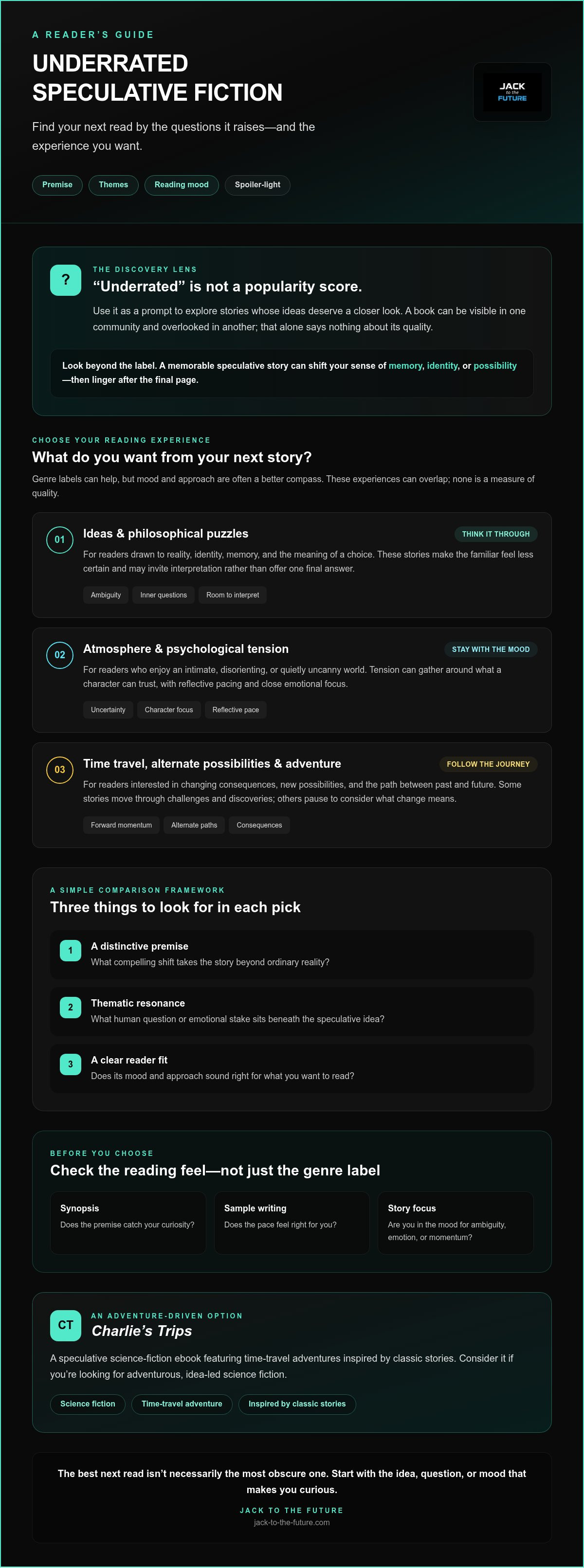
How to Compare Underrated Speculative Fiction Before You Choose
A striking premise can catch your attention, but it won’t tell you whether you’ll enjoy the pace, tone, or questions that follow. Use this four-step check to get a clearer sense of fit before choosing. You don’t need to assign scores or rank the books.
- Choose a question. Are you curious about identity, memory, power, time, or another idea?
- Match a mood. Decide whether you want wonder, unease, intellectual challenge, or momentum.
- Check the synopsis. Look for clues about the story’s focus and progression, not just its central concept.
- Sample if possible. If a preview is available, read enough to see whether the voice and opening draw you in.
As you compare options, consider four dimensions: concept, the speculative “what if”; pace, whether the story moves quickly or gives ideas room to breathe; ambiguity, how much it leaves open to interpretation; and emotional focus, what the characters stand to lose or understand. Use these as questions to guide your choice, not as a scoring system.
Match a book’s central question to the mood you want
Start with the reading experience you want now. A reality-bending premise may suit a reader seeking intellectual challenge, while an unfamiliar world can offer wonder or unease. A time-driven adventure may promise more forward motion. Genre labels can help you browse, but descriptions from an author or publisher may offer clearer clues about tone and pacing.
Choose idea-led fiction when you want a question to linger; choose adventure-led fiction when you want that question to carry you forward. The two can meet, but knowing which mood you’re after makes it easier to spot descriptions that appeal to you.
Use the synopsis and sample to test reader fit
Separate what a description confirms from what you infer. A synopsis may establish the premise, while a reviewer’s interpretation is one reader’s response, not the only possible meaning. Check the author or publisher description for the basic setup, then use a sample or preview, if available, to judge voice and pace. An intriguing premise may still not match your preferred style.
Ready to explore an author-led option? Browse Jack Felson’s speculative science-fiction ebooks and see whether one fits the ideas and reading mood you’re looking for.
Start Your Next Speculative Fiction Journey with Jack Felson
After comparing different kinds of speculative stories, you may know what you want next: a bold idea, a journey through time, or a premise that keeps you questioning what’s possible. If adventurous, idea-led science fiction appeals to you, Jack Felson’s work offers one author-led direction to explore. Comparing first can help you find a premise that matches your curiosity.
Is Charlie’s Trips right for readers who enjoy time-travel fiction?
Charlie’s Trips is a speculative science-fiction title by Jack Felson, positioned around time-travel adventures inspired by classic stories. It may suit readers drawn to stories where time and familiar tales meet an adventurous premise. The description here stays broad and doesn’t assume particular plot events or name specific classic-story connections.
Think about what you want from your next read. If you’re looking for a time-travel adventure with an idea-led sensibility, the premise may catch your interest. If you prefer a slow, psychologically focused story, check the title’s description before deciding. A shared theme doesn’t guarantee a shared reading experience.
Explore Jack Felson’s speculative-fiction ebooks
Jack to the Future is Jack Felson’s independent author platform, offering downloadable speculative science-fiction ebooks. The platform describes its fiction as bold and cerebral. Its catalogue includes Charlie’s Trips; the available products are ebooks rather than physical print books or audiobook editions. Check each ebook’s description for its premise and details relevant to your reading preferences.
Underrated speculative fiction isn’t a fixed category or a promise that every pick will suit every reader. It’s an invitation to follow a question that feels alive to you, whether that leads to an unfamiliar author or a time-travel adventure. If Jack Felson’s idea-led approach sounds appealing, explore the catalogue to see whether one of its premises fits your next read.
Find the Speculative Story That Calls to You
The most rewarding underrated speculative fiction isn’t defined by how obscure it is. It’s the story whose premise, mood, and questions meet you where your curiosity is. A reality-bending puzzle, an unsettling atmosphere, or a time-travel adventure can each open a different path into the unknown.
Use the comparisons as a starting point, not a ranking. Consider what you want to feel, check the synopsis for the confirmed premise, and sample the writing if a preview is available. A fascinating idea matters, but the right fit also depends on pace, ambiguity, and emotional focus.
If you’re drawn to adventurous, idea-led science fiction, Jack to the Future sells downloadable speculative-fiction ebooks, including Jack Felson’s Charlie’s Trips. Explore the catalogue at your own pace and see whether its time-travel direction suits your next read.
Explore Jack Felson’s speculative-fiction ebooks and find the premise that draws you in.
Frequently Asked Questions
What is underrated speculative fiction?
Underrated speculative fiction is a subjective discovery category, not a proven sales or popularity ranking. A book that feels overlooked to one reader may be familiar to another, depending on their reading circles and experience. Look for an intriguing speculative premise, a distinctive treatment of its ideas, and a strong match for your interests. A book isn’t automatically worthwhile simply because it’s lesser-known; its story still needs to appeal to you.
What are some underrated speculative fiction books to read?
Start with this article’s spoiler-light roundup, where each selection offers a distinct premise or reading experience. It includes The Employees, The Memory Police, The Invention of Morel, The City & the City, The Lathe of Heaven, and Kindred. Check reliable bibliographic and synopsis sources for details. Jack Felson’s Charlie’s Trips is also included, a speculative science-fiction ebook positioned around time-travel adventures inspired by classic stories.
How do I find speculative fiction beyond bestseller lists?
Search by theme and reading mood, not only by genre label. Try topics such as identity, memory, alternate realities, or time travel, then explore author catalogues, curated recommendation lists, library suggestions, and sample pages where available. Before choosing, read a synopsis to check the premise and tone. Treat phrases such as “underrated” and “hidden gem” as editorial opinions, not objective measures of a book’s quality or popularity.
Is speculative fiction the same as science fiction?
Not exactly. Speculative fiction is often used as a broad umbrella for stories that explore imagined possibilities, while science fiction is commonly treated as one part of that wider space. Boundaries can shift between readers, publishers, and booksellers, so a title may fit more than one category. Rather than relying only on a label, consider the premise, themes, and style you want to read.
Can speculative fiction be literary and entertaining?
Yes. A speculative story can explore identity, time, power, or reality while also offering suspense, emotional connection, or adventure. The balance varies from book to book. Philosophical themes don’t automatically make a story slow or difficult, just as an exciting premise doesn’t guarantee a fast pace. Check a reliable synopsis or available preview for clues about the writing style and narrative movement before deciding.
How do I choose an underrated speculative fiction ebook?
Start with the question or mood you want from your next read, then compare a book’s premise, tone, and narrative pace. Read an accurate synopsis and sample the text if a preview is available. Before buying, check the seller’s information for the ebook format and device compatibility. Treat any recommendation as a shortlist, not a guarantee that a particular story will suit every reader.
0 comments