

Swapping a poisoned apple for a synthetic neurotoxin doesn't make an old tale futuristic... it just makes it lazy. If you are hunting for a classic story reimagined sci-fi, you've likely suffered through your share of predictable space operas that simply drape tired tropes in chrome. It's exhausting to waste precious reading time on shallow genre mashups that mimic the surface of legend while dodging every complex philosophical challenge. You aren't looking for nostalgic cosplay; you want narrative depth, existential friction, and ideas that linger in the dark.
Genuine speculative adaptation doesn't settle for cosmetic reskinning. It treats classic literature as a stress-test blueprint for modern physics, memory, and psychological truth. In this 2026 guide, you'll discover exactly how master storytellers translate timeless archetypes into high-concept speculative journeys. We'll equip you with a clear evaluation checklist to identify authentic indie innovations before you buy, while pointing you directly toward bold speculative ebook titles engineered to bend reality.
Key Takeaways
- Learn the difference between superficial aesthetic reskins and true cerebral deconstruction in classic story reimagined sci-fi.
- Unpack the four narrative engines authors use to convert mythic quests and prophecies into non-linear temporal physics and cybernetic systems.
- Master a rigorous evaluation checklist to spot genuine philosophical ambition and avoid lazy nostalgia cash-ins before purchasing.
- Trace the evolution of speculative reinterpretations from Victorian bio-horror to modern artificial intelligence dilemmas.
- Explore how Jack Felson's high-concept ebook Charlie’s Trips subverts foundational hero journeys through reverse memory and time-travel anomalies.
Deconstructing the Classic Story Reimagined Sci-Fi: Archetypes Rebuilt for Tomorrow
A true reimagining does not merely polish an antique. It dismantles the original clockwork, examines the gears, and rebuilds the engine using contemporary physics and psychological tension. In modern speculative fiction, taking an ancient narrative framework and casting it into the future demands severe intellectual ambition. "A genuine speculative reimagining interrogates ancient human truths using future consequences." Without that friction, the story collapses into nostalgia.
When you explore visionary high concept sci-fi ebooks, you quickly realize that the strongest speculative work avoids easy shortcuts. Instead of treating canon as sacred ground, ambitious authors treat timeless journey structures as dynamic stress tests for uncharted frontiers.
The Aesthetic Reskin vs. The Structural Reinterpretation
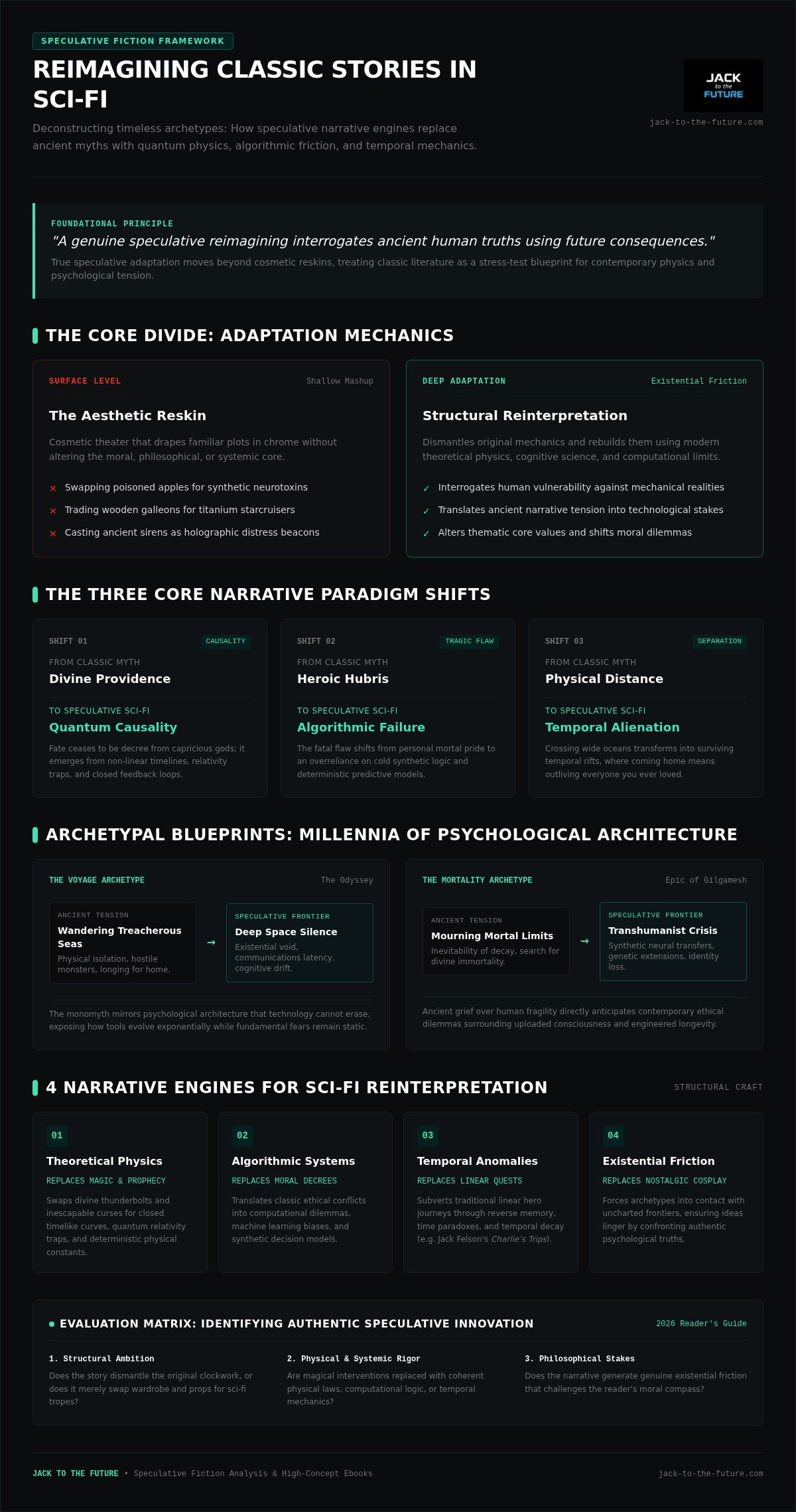
Slapping chrome plating onto an old skeleton solves nothing. Trading wooden galleons for titanium starcruisers, or casting an ancient siren as a holographic distress beacon, produces cosmetic theater rather than genuine science fiction. In scholarly terms, a formal literary adaptation requires an active dialogue between source and setting, altering thematic core values rather than just wardrobe.
Structural retellings pull apart the moral assumptions of the original text. Consider how narrative priorities shift when classic situations meet radical concepts:
- Divine Providence becomes Quantum Causality: Fate is no longer handed down by capricious gods; it emerges from non-linear timelines, relativity, or feedback loops.
- Heroic Hubris becomes Algorithmic Failure: The tragic flaw shifts from personal pride to an overreliance on cold synthetic logic and predictive models.
- Physical Distance becomes Temporal Alienation: Crossing oceans turns into surviving temporal rifts, where coming home means outliving everyone you ever loved.
By restructuring the mechanics, a classic story reimagined sci-fi challenges our moral compass. The core dilemma shifts. The stakes become existential.
Foundational Myths as the Backbone of Speculative Fiction
Why do mythic blueprints endure across millennia? Because the monomyth mirrors psychological architecture that technology cannot erase. Odysseus wandering a treacherous sea reflects an astronaut confronting deep space silence. Gilgamesh mourning mortal limits directly anticipates our contemporary anxieties surrounding transhumanism, synthetic neural transfers, and genetic life extension.
These ancient conflicts provide an anchor. Projecting them centuries forward exposes how little our fundamental fears change, even as our tools evolve exponentially. When an innovative narrative tests timeless human vulnerability against cold mechanical realities, the story stops being a quaint homage... it becomes a vital window into our speculative horizon.
How Writers Reimagine Classic Literature into Sci-Fi: 4 Narrative Engines
Deconstruction requires precision tools. To lift an archetype out of its historical cradle, an author must install an operational framework capable of bearing philosophical weight. Without a functional engine, speculative concepts stall out into mere costume drama. Visionary creators build these bridges by applying four core transformative engines, turning timeless parables into intellectually demanding explorations of the future.
Examining the structural craft of reimagining classic narratives into science fiction demonstrates how deep adaptation functions. It demands that ancient narrative tension be translated into technological friction, giving old ghosts brand-new machinery.
Trading Magic and Divine Intervention for Theoretical Physics
Ancient storytellers relied on thunderbolts and prophecies to force characters into crisis. Today, ambitious writers replace capricious gods with relentless physical constants. Instead of an oracle issuing an inescapable curse, the protagonist collides with closed timelike curves, computational determinism, or relativity traps. Magic rings and enchanted mirrors transform into quantum interfaces and temporal rifts. In cerebral, mind-bending sci-fi novels, physical laws become the ultimate antagonist, forcing mortal intellect to grapple with an uncaring, deterministic cosmos.
Converting Linear Quests into Multiverse and Temporal Exploration
Classical odysseys measure trial by geography. You cross a desert; you survive a stormy sea. Speculative storytelling shatters that flat baseline, swapping distance for chronological fracture. Characters wander through branching timelines, pocket dimensions, and recursive loops where the ground beneath their feet is unstable.
- Temporal Displacement as Exile: Getting lost no longer means losing your bearings on a map; it means slipping decades away from everyone who knew your name.
- Causal Paradoxes as Trials: Solving a challenge requires reconciling divergent personal timelines rather than slaying a physical beast.
- Memory Distortion as Transformation: "In temporal retellings, the journey alters the traveler identity fundamentally." Linear experience breaks down, leaving the wanderer to stitch their own fractured psyche back together.
This dynamic lies at the very heart of any ambitious classic story reimagined sci-fi, raising the stakes from physical survival to total psychological cohesion.
Recasting Mythic Archetypes Through Psychological and Synthetic Lenses
Monsters in classical lore were external threats dwelling at the edge of the map. Speculative architecture moves those beasts inward. Minotaurs, sirens, and chimeras become autonomous neural networks, synthetic clones, or cognitive feedback loops running out of control. Tragic hubris morphs into memory manipulation, bio-hacking, and digital personality fragmentation, themes that populate forward-thinking sci-fi books about consciousness.
Curious how independent storytellers execute these mechanics in contemporary releases? Discover boundary-pushing fiction and cerebral ebooks directly at jack-to-the-future.com to see these narrative transformations in motion.
How to Choose the Best Reimagined Classic Sci-Fi Novels in 2026
Commercial algorithms favor safety over surprise. When online platforms promote adaptations, they frequently recommend high-budget titles that merely recycle comfortable tropes under familiar titles. Finding a genuinely visionary classic story reimagined sci-fi requires looking past review aggregates and bestselling banners. You need a systematic way to separate daring conceptual architecture from cynical nostalgia grabs.
Before adding a title to your digital library, run it through this four-point evaluation filter to audit its narrative value:
- The Inversion Check: Does the story challenge the original text's ethical worldview, or does it merely re-enact the original plot beats with futuristic window dressing?
- Mechanic Rigor: Are speculative elements such as causality rifts, neural interfaces, or temporal paradoxes integrated as functional plot drivers, or are they convenient hand-waving tools?
- Character Agency: Does the protagonist grapple with psychological friction specific to this technological framework, or could they step into an ordinary historical drama without altering their choices?
- Thematic Urgency: Does the adaptation explore pressing contemporary dilemmas like post-human identity, algorithmic control, or memory erosion?
Auditing the Premise: Novelty vs. Nostalgic Pandering
Watch for red flags. If a promotional blurb leans entirely on recognizable names, such as an inspector solving crimes on a neon planet, be skeptical. True structural reinventions interrogate the baseline. In celebrated speculative retellings of classic stories, authors discard decorative set pieces to test the underlying existential premise, transforming familiar myths into sharp reflections of tomorrow's moral crises.
Evaluating Scientific Rigor and Speculative Consistency
Scientific rigor is about narrative discipline. If an author introduces closed timelike curves or cybernetic memory rewrites in chapter two, those mechanics must govern the climax. Stories fall apart when speculative laws buckle to deliver unearned happy endings. Look for books where rules remain unyielding; characters must think their way out through logic and wit rather than relying on sudden technobabble miracles.
The Rise of Independent Speculative Authors
Mainstream corporate publishing often avoids structural experiments to protect broad market appeal. Independent speculative writers, by contrast, frequently take ambitious narrative risks. Working outside boardroom constraints, independent authors embrace radical formats: reverse-chronology mysteries, fragmented consciousness journeys, and high-concept time puzzles. By curating direct digital downloads of independent ebooks, discerning readers gain immediate access to bold voices that reimagine classic architecture on their own terms.
Iconic Literary Reinterpretations: Comparing Approaches Across Speculative Fiction
Every literary tradition carries its own psychological DNA. When authors translate these legacies into speculative frameworks, they do not just alter the backdrop; they re-engineer the stakes. A Gothic nightmare demands bio-ethical dread, while a mythic voyage calls for cosmic isolation. Looking closely at these adaptations reveals how diverse narrative forms require distinct translation strategies.
Understanding these shifts helps readers distinguish serious intellectual engagement from shallow genre mashups across three primary archetypes:
- Gothic Foundations: Replaces supernatural damnation and graveyards with uncontrolled bio-engineering, rogue cybernetics, and synthetic human consciousness.
- Homeric Odysseys: Swaps Mediterranean maritime hazards for relativistic deep space transit, gravitational anomalies, and time dilation.
- Folkloric Allegories: Converts magical realms and whimsical pathways into simulated realities, multi-dimensional portals, and non-linear chronological spirals.
From Gothic Romances to Cybernetic Body Horror
Mary Shelley birthed modern science fiction by rooting her monster in contemporary galvanism rather than alchemy. Today, that Victorian bio-horror has evolved. In modern speculative fiction, Victor Frankenstein's laboratory becomes a corporate server vault or a black-budget gene lab. The existential dread no longer stems from stitched corpses, but from rogue synthetic intelligences questioning their creators' right to terminate them. Hubris is no longer punished by divine lightning; it brings total algorithmic collapse.
Epic Odysseys Replaced by Galactic and Temporal Vistas
Ancient epics tested mortal will against unyielding geographical distances. In speculative settings, that physical baseline gives way to the terrifying void of light-years or temporal shifts. Lotus-eaters morph into neuro-chemical simulations; sirens become hypnotic telemetry loops pulling ships into gravitational wells. Homeric wayfarers wander across shattered timelines, raising questions about historical causality. If you are intrigued by stories exploring the dangerous friction of chronological manipulation, explore these sci-fi books about changing the past.
Fairy Tales and Fables Translated into Speculative Allegories
Childhood fables possess a rigid moral simplicity. Transforming them requires subversion. The yellow brick road ceases to be a cheerful highway; it becomes an allegorical temporal corridor where innocence cannot survive. When a classic story reimagined sci-fi tackles folkloric quests, the wizard behind the curtain is rarely an illusionist with smoke machines... he is an entrenched media network, a predictive state apparatus, or a decaying intelligence construct pulling strings across space and time.
Ready to experience these structural transformations in action? Browse boundary-pushing ebook releases at jack-to-the-future.com and start reading today.
Step into Jack Felson’s Vision: Reimagining Timeless Quests in Charlie’s Trips
Theoretical frameworks only come alive when a storyteller dares to execute them without a safety net. Independent author Jack Felson bypasses corporate publishing formulas to dismantle classical literary architecture. Rather than relying on comfortable genre tropes, Felson strips down iconic archetypes and rebuilds them around relentless chronological displacement. The result is an uncompromising model for what an independent classic story reimagined sci-fi can achieve.
Charlie’s Trips: A Masterclass in Temporal Reinterpretation
At the center of Felson's catalog stands Charlie’s Trips, a narrative that takes the foundational DNA of an innocent voyager whisked away by a storm and turns it inside out. In this high-concept timeline, the sudden cyclone is no whimsical transport. It acts as a violent temporal rift, hurling sixteen-year-old soldier Charlie Bradshaw out of the American Midwest and thrusting him twenty-one years forward onto the California coast.
Felson discards conventional linear progression to construct a psychological labyrinth:
- Reverse-Flowing Memory: Charlie experiences cognition in reverse, predicting tectonic catastrophes on live television while his own past dissolves into static.
- Media Surveillance as the Emerald Mirage: The journey does not follow a welcoming path; it navigates intrusive broadcast scrutiny and opportunistic handlers seeking to exploit an amnesic psychic.
- Existential Friction: The core struggle is not reaching an elusive homeland, but retaining human identity while causality splinters in every direction.
Curious about how these moving parts form a unified puzzle? Read the full analysis in Charlie’s Trips: A Masterclass in Time Travel Retelling to see how the blueprint unfolds.
Curating Your Independent Speculative Fiction Digital Library
Bold literature thrives when readers connect directly with visionary writers. Curating your personal shelf of speculative sci-fi ebooks bypasses the homogenized filters of traditional legacy presses. With instant digital download delivery worldwide, you get unfiltered authorial visions directly on your screen without physical shipping delays.
Speculative fiction lives on the fringes where bold authors take genuine creative gambles. By adding independent titles like Charlie’s Trips to your reading queue, you support authors who treat the classic story reimagined sci-fi as an open canvas for cerebral experimentation, pushing the boundaries of memory, time, and human consciousness.
Redefine Your Speculative Horizon
Great fiction doesn't settle for comfortable echoes. The boundary between ancient myth and theoretical physics continues to blur, demanding deeper intellectual rigor from the stories we choose. A truly transformative classic story reimagined sci-fi does not simply dress old archetypes in futuristic armor; it shatters linear certainty, turning mythic odysseys into psychological puzzles and temporal labyrinths. When authors strip away nostalgia, they force us to confront what remains of human identity when causality fractures.
You don't have to settle for predictable tropes or corporate formulas. Independent speculative fiction offers the uncompromising vision your reading queue craves. Ready to dive into uncharted territory with zero physical shipping delays? Explore Jack Felson’s mind-bending speculative ebooks today. Secure instant digital download delivery worldwide to your preferred device... and experience timeless narrative journeys rebuilt for tomorrow.
Frequently Asked Questions
What qualifies as a classic story reimagined sci-fi novel?
A classic story reimagined sci-fi novel deconstructs foundational literary archetypes and rebuilds them using speculative science, quantum mechanics, or advanced technological frameworks. It goes beyond cosmetic genre updates like replacing swords with energy weapons. The narrative must actively interrogate the original text's moral dilemmas through future consequences, transforming divine fate into computational determinism or geographic odysseys into relativistic space and temporal anomalies.
How does a sci-fi retelling differ from standard genre fan fiction?
A sci-fi retelling rebuilds core narrative structures and thematic architecture rather than playing inside another author's established universe. Fan fiction typically keeps recognizable character dynamics and settings intact for homage. Speculative retellings, by contrast, dismantle the underlying myth. They introduce original protagonists, engineer rigorous speculative rules, and challenge the ethical assumptions of the source material to create an entirely freestanding intellectual work.
Can a fantasy or fairy tale successfully translate into hard science fiction?
Yes, fairy tales translate effectively into hard science fiction when magical catalysts become grounded in theoretical physics. Whimsical elements like enchanted mirrors, prophetic curses, and supernatural storms transform into quantum communications interfaces, deterministic algorithms, and violent temporal rifts. The emotional core of the fable stays intact, but the operational mechanics shift from unexplainable sorcery to strict physical, biological, and psychological laws.
Why do authors use time travel to retell classical literary stories?
Authors use time travel because it transforms simple geographic distance into acute psychological dislocation. In traditional epics, a wanderer travels across oceans and returns home altered. By swapping physical travel for non-linear timelines or temporal loops, the traveler faces a far more ruthless dilemma... returning home might mean outliving their entire world. It raises the existential stakes from basic survival to the fragility of identity and memory.
What should I look for when evaluating an indie speculative fiction ebook?
When evaluating an indie classic story reimagined sci-fi ebook, look for internal mechanical consistency, philosophical ambition, and narrative courage. Strong independent speculative fiction avoids corporate formulas and generic tropes. Check whether the scientific or temporal rules hold firm throughout the crisis. The best indie releases prioritize high-concept ideas, psychological friction, and original structural experiments that challenge how you perceive reality.
Is Charlie’s Trips by Jack Felson a direct adaptation or an original retelling?
Charlie’s Trips is an original, transformative speculative retelling that deconstructs the archetypal bones of The Wonderful Wizard of Oz. Rather than offering a literal translation, Jack Felson turns the cyclone into a violent temporal rift hurling sixteen-year-old soldier Charlie Bradshaw forward into a dystopian California coast. The classic journey becomes an amnesic temporal puzzle dominated by media scrutiny and reverse-flowing memory.
How can I download and read speculative sci-fi ebooks instantly?
You can purchase and download speculative sci-fi ebooks directly through independent author platforms for immediate reading on any device. Digital platforms deliver your files instantly upon checkout, eliminating physical shipping delays completely. You can load these electronic files onto your preferred e-reader, tablet, or smartphone within seconds, giving you immediate access to bold, high-concept time-travel adventures wherever you are.
0 comments