

What if a story could bend time, unsettle your sense of identity, and still leave you room to think before the next thing on your calendar? The best short speculative fiction reads don’t feel like smaller novels. They’re complete journeys built around one sharp possibility and its consequences.
Choosing one can still be tricky. A short story, novella, and story collection ask for different kinds of commitment, and a brief read isn’t automatically a satisfying one. Look for an idea that has room to land, not a premise that stops just as it gets interesting.
This roundup helps you match a read to the time you have and the mood or question you want to carry with you. We’ll clarify the formats, explore speculative themes, and offer a focused shortlist instead of an endless scroll of recommendations. Whether you want a quick reality-bender or a longer visit to an unfamiliar world, there’s a good place to begin. Short doesn’t have to mean shallow. Sometimes one strange idea is enough to change the shape of an ordinary day.
Key Takeaways
- Use your available reading time and preferred format to narrow down short speculative fiction reads for your next break.
- Compare short stories, novellas, and collections to find the kind of commitment that suits you.
- Browse a spoiler-light shortlist of third-party titles, with details to help you decide what to try.
- Choose a read by matching its mood and speculative theme to your interests, then check sample pages and edition details where available.
- Find a next step for exploring speculative fiction beyond short-form stories.
What Counts as a Short Speculative Fiction Read?
You have a spare moment, not an entire weekend. But what counts as a short book: one story, a slim novella, or a compact ebook? This guide offers a practical, spoiler-light shortlist, starting with what the labels mean and what to check before you begin.
Short speculative fiction is a brief story that imagines a departure from familiar reality, such as altered time, unfamiliar technology, or a changed version of the world. The umbrella covers many genres and subgenres. The Speculative fiction overview offers broader context. For a reader choosing a story for a break, look beyond the label. Reading time depends on the text’s length, its pace, and how quickly you read. Page count can help you compare editions, but it can’t tell you exactly how long you’ll need.
Short story, novella, or collection: what is the difference?
A short story usually follows one central situation or change. A novella gives its premise more room, often with a longer arc or more developed character dynamics. A collection brings together multiple stories, which may share a theme or stand alone. Word-count boundaries between these forms aren’t universal, so don’t rely on the label alone.
Check the description and length of the specific edition before choosing. Most importantly, distinguish a single complete story from a collection. One offers a contained narrative, while the other gives you several separate entry points. If you want one story for a short break, confirm that the edition isn’t an anthology or an excerpt from a larger work.
Can a brief speculative story still feel complete?
Yes. A concentrated premise can create its own momentum: what if a memory could be altered, or a familiar rule of reality suddenly changed? With limited space, a story may focus on one character, one dilemma, or one world-changing idea. That focus can make its emotional or conceptual impact feel immediate rather than shallow.
But “complete” doesn’t always mean every mystery is explained or every plot thread is tied off. Some short fiction deliberately leaves room for uncertainty. Before picking from the short speculative fiction reads ahead, consider what kind of ending suits you: a resolved arc, a lingering question, or an idea that keeps unfolding after the final line.
Six Short Speculative Fiction Reads to Put on Your List
These are third-party reading suggestions, not titles sold by Jack to the Future. The shortlist spans social unease, technological change, and questions of identity. National University’s overview of what speculative fiction is is a useful reminder of how widely the umbrella reaches. Format labels can vary by edition and publisher, so check the specific version’s contents and length before settling in. Your reading time will also depend on your pace.
Stories for readers who want one unsettling idea
Start with two stories that make familiar social rules feel strange. In Ursula K. Le Guin’s “The Ones Who Walk Away from Omelas,” a city’s apparent happiness rests on a hidden moral cost. Shirley Jackson’s “The Lottery” follows a village ritual whose ordinary surface conceals a disturbing purpose. Both invite reflection on collective responsibility, but their moods and implications differ.
Stories for readers drawn to technology, identity, or altered futures
The remaining choices turn toward machines, memory, and possible futures. Ray Bradbury’s “There Will Come Soft Rains” imagines an automated home continuing after human life has vanished. Octavia E. Butler’s “Bloodchild” explores an unsettling relationship between human beings and an alien species. Ted Chiang’s “Story of Your Life” connects language, time, and perception. Philip K. Dick’s “The Minority Report” examines prediction, policing, and the possibility of free choice.
Comparison shortlist
| Title | Author | Format | Speculative hook | Reading-time caveat |
|---|---|---|---|---|
| “The Ones Who Walk Away from Omelas” | Ursula K. Le Guin | Short story | A community’s happiness carries a moral price. | Check the page count in the edition you choose. |
| “The Lottery” | Shirley Jackson | Short story | A village tradition raises questions about conformity. | Anthology layouts and added material affect length. |
| “There Will Come Soft Rains” | Ray Bradbury | Short story | An automated house persists in a changed world. | Confirm whether your edition includes only the story. |
| “Bloodchild” | Octavia E. Butler | Novelette | An alien bond complicates consent and survival. | Check the edition’s length and any accompanying material. |
| “Story of Your Life” | Ted Chiang | Novella | Language transforms how time is understood. | Often encountered in a collection; check its contents. |
| “The Minority Report” | Philip K. Dick | Short story | Prediction puts free will and justice under pressure. | Verify the title’s format and length in your chosen edition. |
Use the table to choose by idea first, then confirm the format and edition rather than assuming every version is equally brief. If these questions of time and possibility lead you toward a larger science-fiction world, explore Jack Felson’s speculative science-fiction ebooks. Check each title’s details, since the catalogue’s titles aren’t all confirmed as short reads.
Short Speculative Fiction Is Not Shallow: What Brief Stories Can Do
A story doesn’t need a sprawling cast or a map of an invented world to leave a mark. Short fiction can focus attention on one impossible premise, then follow its human consequences. That doesn’t make every brief read profound by default. The idea still needs room to become more than a clever “what if?”
Brevity can focus a story’s speculative question until one choice, consequence, or image carries the weight of an entire imagined world. That focus can feel intense, elegant, or deliberately unsettling. It can also leave readers wanting more context. The right fit depends on what you want from a story, not on whether it’s short.
How a compact story makes a big speculative idea land
Consider Ursula K. Le Guin’s “The Ones Who Walk Away from Omelas.” Its central moral dilemma gives readers a clear pressure point: what does a society’s happiness cost, and what should anyone do about that cost? The story doesn’t need to catalogue every institution in its imagined city. The premise directs attention toward complicity and choice.
Ray Bradbury’s “There Will Come Soft Rains” takes another approach. Details of an automated house suggest a world beyond the rooms it describes, letting setting and routine imply a larger change. In Ted Chiang’s “Story of Your Life,” language and perception shape questions about time and human experience. These works show different possibilities, not a formula. A well-placed detail can invite readers to imagine the wider world, but an unclear or unsupported gap may simply feel confusing.
What short fiction may leave out
Compression has trade-offs. A brief story may have less room for supporting characters, extended worldbuilding, or the gradual development of several plotlines. If you want to inhabit a world over time, that can feel limiting. If you prefer one charged encounter or a single idea followed to its emotional edge, the same focus may be exactly what you want.
Endings offer different kinds of satisfaction, too. Shirley Jackson’s “The Lottery” leaves room for readers to consider how tradition and community shape behavior; other short works may resolve their central conflict more directly. An open ending isn’t automatically deeper, just as a clear resolution isn’t automatically simplistic. Ask yourself what you want to carry away: a finished character arc, a vivid atmosphere, or a question that keeps shifting after you’ve closed the story.
That’s the useful distinction: short speculative fiction reads can deliver concentrated impact, but they don’t all aim for the same kind of completeness. Choose by the experience you want, then let the story’s scope be part of its appeal.
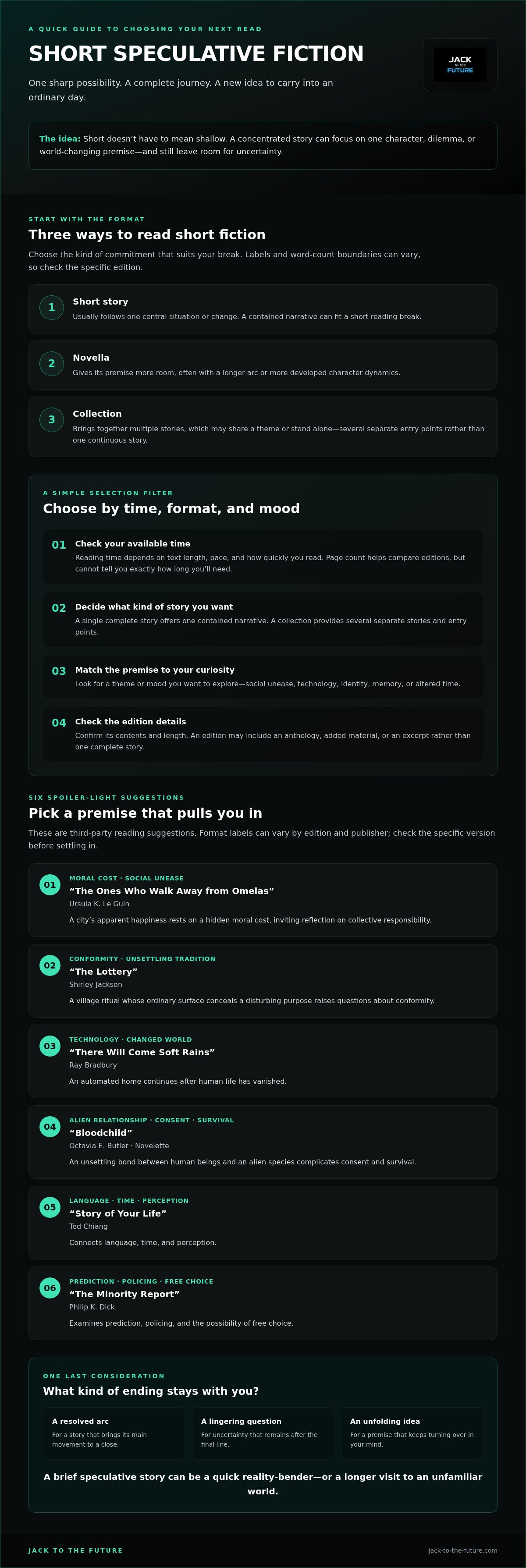
How to Choose a Short Speculative Read for Your Next Break
The best choice isn’t simply the shortest title. It’s the one that fits your reading window and gives you the kind of imaginative spark you’re in the mood for. Use this four-step check before committing to one of the short speculative fiction reads on your list.
- Choose your available time. Decide whether you have a brief pause or a longer stretch. Treat this as a boundary, not a promise of how quickly you’ll finish.
- Pick a format. A short story can suit a compact session; a novella offers more room if you’re ready to stay with one narrative longer. For an ebook, check whether it contains one work or several.
- Name the mood. Are you after something eerie, philosophical, emotionally focused, or driven by a striking idea? These are starting points, not guarantees of how a story will feel.
- Choose a speculative theme. Look for the kind of “what if” that catches your attention: altered time, unfamiliar technology, changed social rules, or questions of identity.
Match your reading window to the format
Check the edition details before downloading or borrowing a title. Page counts, layouts, and included material can vary, so use the specific version’s length rather than a general label to judge whether it fits your break. A sample, when available, can help you assess both the prose and pace.
Also confirm that you’re choosing a standalone story, not an excerpt or the opening instalment of a longer work. If the ebook is a collection, scan its contents to see whether you can read one story on its own or whether the pieces build on each other. A little checking helps you avoid starting a story that doesn’t match the time or commitment you had in mind.
Choose by mood, theme, and story shape
Use this quick checklist: Do you want unease or wonder? A close focus on one character, or a bigger social idea? A resolved arc, or a question that lingers? Your answers can help narrow the options without assuming that a particular theme will produce a specific reading experience.
If you want a more layered discussion of ideas in science fiction, explore sci-fi books with complex themes. Curious about stories that cross familiar genre lines? Take a look at genre-bending science fiction. You can also explore Jack Felson’s speculative science-fiction ebooks. Check each title’s details to see whether it suits the format and reading window you want.
Where to Go Next After Your Short Speculative Fiction Roundup
A short story can open a door without showing you every room beyond it. If a premise leaves you wanting a broader world, a longer speculative adventure can give its characters, history, and consequences more space to unfold. Or follow the question that caught your attention into another corner of the genre. Your next read doesn’t have to match the last one in length or format.
When a short story leaves you wanting a larger journey
Think about what you want more of. Was it the altered timeline, the unfamiliar rules, or the way a character responded to an impossible choice? Use that spark to guide your next pick, then check the format and length before committing. A larger work may explore a premise across more scenes and perspectives, while a short story often concentrates on a single turning point.
For a separate look at a title in Jack Felson’s catalogue, read about Charlie’s Trips and its place among time-travel adventures inspired by classic stories. This is an exploration of the title, not a short-fiction recommendation; its length isn’t specified here. For a wider view of the genre and its themes, continue with this guide to speculative fiction for adults.
Explore Jack Felson’s speculative-fiction ebooks
If you’re curious about the author behind Charlie’s Trips, Jack Felson’s catalogue includes downloadable speculative science-fiction ebooks and time-travel adventures. The available information doesn’t establish which titles qualify as short reads, so check each ebook’s details before choosing one for a brief reading window. A title can be a natural next discovery without fitting the compact format of the short speculative fiction reads in this roundup.
Let your next step follow your curiosity, whether that means another standalone story, a longer journey through an imagined world, or a new speculative theme. If Jack Felson’s work sounds like your kind of adventure, explore the downloadable ebooks when you’re ready.
Choose Your Next Doorway Into the Unknown
The right short speculative fiction read depends on more than page count. A short story, novella, or collection offers a different kind of reading experience, and a focused story can leave a powerful impression without explaining every corner of its world.
Use your available time, preferred format, mood, and favorite speculative themes to narrow the shortlist. Then check the specific edition’s length and contents, especially if you want a standalone story rather than an excerpt or opening instalment. A little checking makes it easier to choose a read that fits both your break and the idea you want to carry with you.
If you’re ready to follow that curiosity into a larger imagined world, Jack Felson’s independent author platform features downloadable speculative science-fiction ebooks. Digital files are available for instant access after checkout, though the catalogue’s titles aren’t confirmed as short reads. Explore Jack Felson’s speculative-fiction ebooks and choose a title that suits your next reading session. Your next thought-provoking story can begin with one curious “what if?”
Frequently Asked Questions
What counts as short speculative fiction?
Short speculative fiction is a brief work that imagines a departure from familiar reality, such as changed social rules, altered time, or unfamiliar technology. It may be a standalone short story, a novella, or one story within a collection. Publishers don’t use the labels identically, so check the specific edition’s format and contents to see whether you’re choosing one complete story or several.
Is short speculative fiction good for beginners?
Yes. Short speculative fiction can be an inviting starting point if you’re curious about science fiction, fantasy, or other imagined realities but don’t want to begin with a long series. A standalone story lets you try a premise or writing style with less commitment. Look for a subject that interests you, then sample the opening if available. If the first story doesn’t click, you can try a different subgenre.
How long does it take to read a short speculative story?
There’s no fixed reading time. It depends on the story’s length, the edition’s layout, the pace of the writing, and your own reading speed. Check the page count or ebook details for the version you plan to read, then use that as a rough guide rather than a guarantee. A sample can also help you judge the prose and decide whether the story fits your available time.
Is a novella shorter than a novel?
Generally, yes. A novella is a prose work longer than a short story but shorter than a novel, though publishers and readers don’t always apply those labels in exactly the same way. Check the specific edition’s length and description instead of relying only on the category. This is especially useful with ebooks, where a novella may appear in a collection alongside other stories or additional material.
Can speculative fiction be both short and thought-provoking?
Absolutely. A brief story can focus closely on one character, dilemma, or speculative question, giving its central idea room to resonate without building a vast fictional world. For example, a story might ask what a changed relationship with time would mean for human choices. Shortness alone doesn’t guarantee depth, but a sharply developed premise can leave readers thinking well beyond the final page.
Where can I find short speculative fiction to read?
Look through literary magazines, short-story collections, library catalogues, and ebook listings. Before choosing, check whether the item is a standalone story, a collection, an excerpt, or the start of a longer work. Jack to the Future is an independent author platform featuring Jack Felson’s downloadable speculative science-fiction ebooks, but its titles aren’t all confirmed as short reads. Review each title’s details before deciding.
Are speculative fiction ebooks suitable for short reading sessions?
They can be, if the ebook’s length and structure suit your session. Some contain one standalone story; others gather several pieces or present a longer work in chapters. Check the contents and edition details before you start, and use a sample where available to judge the pace. Jack to the Future offers downloadable speculative science-fiction ebooks, with digital files available for instant access after checkout.
0 comments